


A potential attack on Taiwan has been a “motivating factor” behind China’s military modernization, a new report from the US-China Economic and Security Review Commission says.
The report cites the development of four major Chinese weapons systems: Yuan-class diesel-electric attack submarines, SC-19 anti-satellite systems, Dongfeng-21D anti-ship ballistic missiles and Chengdu J-20 stealth fighter aircraft.
“China’s military priority since the early to mid 1990s has been to maintain a strategic advantage over Taiwan’s military forces and — if it should ever feel compelled to initiate military operations against Taiwan — in deterring and countering any US intervention,” it says.
“This driver for PLA [People’s Liberation Army] force modernization was given particular impetus following the Taiwan Strait Crisis of 1996,” the report adds.
In this crisis, the report says, the PLA brass was “humiliated” by the dispatch of US Navy aircraft carriers to the vicinity of Taiwan in reaction to PLA saber-rattling exercises that were intended to “intimidate Taiwan’s populace in the midst of island-wide elections.”
Titled Indigenous Weapons Development in China’s Military Modernization, the report concludes that the 1996 incident “catalyzed investment in the long-term modernization and professionalization of China’s armed forces.”
It adds that as a result of the Taiwan Strait Crisis, the PLA accelerated its efforts to acquire modern submarines, missiles and third and fourth-generation aircraft “that could keep American forces at bay.”
The report says that the development of the anti-ship ballistic missile could be especially important because it is designed to target US aircraft carriers and that anti-satellite weapons are also a priority in a Taiwan contingency.
The report says that the US has underestimated the growth of China’s military because policymakers have taken public statements at face value or failed to understand Beijing’s thinking.
It said the US had a mixed record on predicting the rising power’s new weaponry, including largely missing the emergence of more advanced submarines.
As for the speed of military modernization, the study found “identifiable cases of miscalculation,” with China developing anti-ship ballistic missiles and stealth fighter jets earlier than the US expected.
US analysis could have been improved if more experts read Chinese or even looked at open publications such as academic technical journals, it said.
The study said that US experts “may have failed to fully appreciate the extent to which the Chinese leadership views the United States as a fundamental threat to China’s security.”
The study said that US experts assumed in the late 1990s that China would never catch up militarily with the US and would put a low priority on its defense industry compared with other parts of the economy.
“A decade on, it is now clear that much of the conventional wisdom about China dating from the turn of the century has proven to be dramatically wrong,” it said.
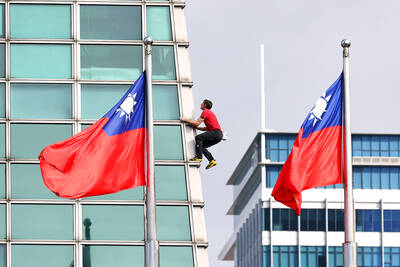
DAREDEVIL: Honnold said it had always been a dream of his to climb Taipei 101, while a Netflix producer said the skyscraper was ‘a real icon of this country’ US climber Alex Honnold yesterday took on Taiwan’s tallest building, becoming the first person to scale Taipei 101 without a rope, harness or safety net. Hundreds of spectators gathered at the base of the 101-story skyscraper to watch Honnold, 40, embark on his daredevil feat, which was also broadcast live on Netflix. Dressed in a red T-shirt and yellow custom-made climbing shoes, Honnold swiftly moved up the southeast face of the glass and steel building. At one point, he stepped onto a platform midway up to wave down at fans and onlookers who were taking photos. People watching from inside
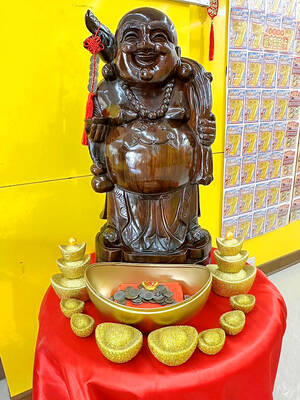
A Vietnamese migrant worker yesterday won NT$12 million (US$379,627) on a Lunar New Year scratch card in Kaohsiung as part of Taiwan Lottery Co’s (台灣彩券) “NT$12 Million Grand Fortune” (1200萬大吉利) game. The man was the first top-prize winner of the new game launched on Jan. 6 to mark the Lunar New Year. Three Vietnamese migrant workers visited a Taiwan Lottery shop on Xinyue Street in Kaohsiung’s Gangshan District (崗山), a store representative said. The player bought multiple tickets and, after winning nothing, held the final lottery ticket in one hand and rubbed the store’s statue of the Maitreya Buddha’s belly with the other,
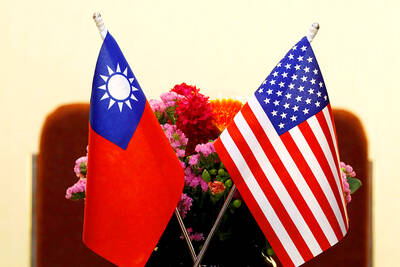
‘NATO-PLUS’: ‘Our strategic partners in the Indo-Pacific are facing increasing aggression by the Chinese Communist Party,’ US Representative Rob Wittman said The US House of Representatives on Monday released its version of the Consolidated Appropriations Act, which includes US$1.15 billion to support security cooperation with Taiwan. The omnibus act, covering US$1.2 trillion of spending, allocates US$1 billion for the Taiwan Security Cooperation Initiative, as well as US$150 million for the replacement of defense articles and reimbursement of defense services provided to Taiwan. The fund allocations were based on the US National Defense Authorization Act for fiscal 2026 that was passed by the US Congress last month and authorized up to US$1 billion to the US Defense Security Cooperation Agency in support of the

HIGH-TECH DEAL: Chipmakers that expand in the US would be able to import up to 2.5 times their new capacity with no extra tariffs during an approved construction period Taiwan aims to build a “democratic” high-tech supply chain with the US and form a strategic artificial intelligence (AI) partnership under the new tariffs deal it sealed with Washington last week, Taipei’s top negotiator in the talks said yesterday. US President Donald Trump has pushed Taiwan, a major producer of semiconductors which runs a large trade surplus with the US, to invest more in the US, specifically in chips that power AI. Under the terms of the long-negotiated deal, chipmakers such as Taiwan Semiconductor Manufacturing Co (TSMC, 台積電) that expand US production would incur a lower tariff on semiconductors or related manufacturing


 RSS
RSS