


A law barring drivers from calling or receiving calls with their mobile phones without the use of a hands-free kit has been expanded to include any use of mobile phones, tablet computers and laptops.
Drivers caught using phones without the hands-free kit or tablets while operating a vehicle could face a fine of NT$3,000 if legislators pass an amendment to the Act Governing the Punishment of Violation of Road Traffic Regulations (道路交通管理處罰條例).
The amendment, proposed by Democratic Progressive Party (DPP) Legislator Huang Wei-cher (黃偉哲) and Chinese Nationalist Party (KMT) Legislator Lee Hung-chun (李鴻鈞), passed review at the legislature’s Transportation Committee yesterday. It must pass a second and third reading before becoming law.
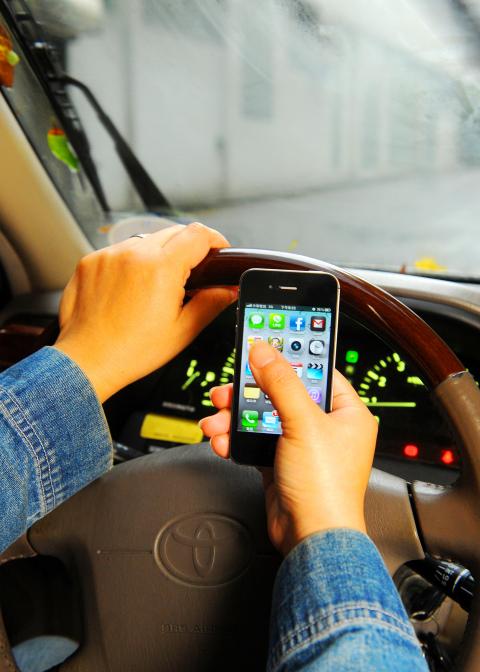
Photo: Wang Min-wei, Taipei Times
Currently, Item 1 of Article 31 in the act only bars motorists from dialing, receiving phone calls or communicating with their mobile phones without the hands-free kit while driving. Car drivers violating the specific regulation may be fined NT$3,000, while motorcyclists may be fined NT$1,000.
However, Huang and Lee said mobile phones now allow people to do more than just dial and receive phone calls. Some tablet computers are equipped with mobile phone functionality as well.
They proposed that the law’s scope be expanded to include users of mobile phones, tablet computers or any other types of computer.
According to the amendment, talking on a mobile phone without the hands-free kit or using a mobile phone or computer to go online, send text messages or play applications while driving would be considered dangerous driving behavior.
The Ministry of Transportation and Communications said police can fine motorists between NT$6,000 and NT$24,000 using the current regulations stated in the act if drivers are deemed to be engaging in behavior qualifying them as “dangerous drivers.”
“They [dangerous drivers] are so distracted [while using mobile devices] that they cannot focus on what is in front of them or they begin to swerve out of their lanes,” said Lin Fu-shan (林福山), a section chief of the ministry’s Department of Railways and Highways.
The proposed amendment would allow police to fine motorists who are caught engaging in any of these activities, even if they are not causing immediate danger to themselves or other drivers.
The minimum fine would still be NT$3,000 for car drivers and NT$1,000 for motorcyclists.
Vice Minister of Transportation and Communications Yeh Kuang-shih (葉匡時) said the ministry would respect and support the committee’s decision on the amendment.
The amendment, though designed to enhance road safety, did not say whether motorists could check their mobile phones or computers if they are waiting for traffic lights or stopped temporarily at the side of a road.
To avoid controversy, Lin said the ministry still needed to stipulate rules to help police enforce the act if the amendment is passed.

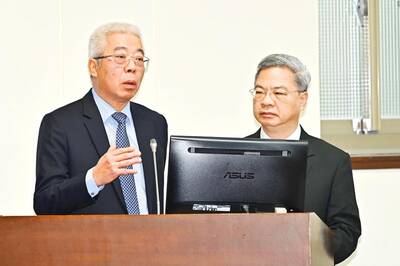
Taiwan has arranged for about 8 million barrels of crude oil, or about one-third of its monthly needs, to be shipped from the Red Sea this month to bypass the Strait of Hormuz and ease domestic supply pressures, CPC Corp, Taiwan (CPC, 台灣中油) said yesterday. The state-run oil company has worked with Middle Eastern suppliers to secure routes other than the Strait of Hormuz, through which about 20 percent of the world’s oil and liquefied natural gas typically passes, CPC chairman Fang Jeng-zen (方振仁) said at a meeting of the legislature’s Economics Committee in Taipei. Suppliers in Saudi Arabia have indicated they
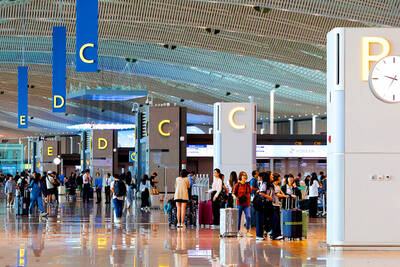
South Korea has adjusted its electronic arrival card system to no longer list Taiwan as a part of China, a move that the Ministry of Foreign Affairs said would help facilitate exchanges between the two sides. South Korea previously listed “Taiwan” as “Taiwan (China)” in the drop-down menus of its online arrival card system, where people had to fill out where they came from and their next destination. The ministry had requested South Korea make a revision and said it would change South Korea’s name on Taiwan’s online immigration system from “Republic of Korea” to “Korea (South),” should the issue not be

Tainan, Taipei and New Taipei City recorded the highest fines nationwide for illegal accommodations in the first quarter of this year, with fines issued in the three cities each exceeding NT$7 million (US$220,639), Tourism Administration data showed. Among them, Taipei had the highest number of illegal short-term rental units, with 410. There were 3,280 legally registered hotels nationwide in the first quarter, down by 14 properties, or 0.43 percent, from a year earlier, likely indicating operators exiting the market, the agency said. However, the number of unregistered properties rose to 1,174, including 314 illegal hotels and 860 illegal short-term rental

AIR ALERT: China’s reservation of airspace over the Yellow Sea and East China Sea could be an attempt to test the US’ response ahead of a Trump-Xi meeting, the NSB head said China’s attempts to infiltrate Taiwan are systematic, planned and targeted, with activity shifting from recruiting mid-level military officers to rank-and-file enlisted personnel, National Security Bureau (NSB) Director-General Tsai Ming-yen (蔡明彥) said yesterday. The Chinese Communist Party’s (CCP) integrates national security, intelligence operations and “united front” efforts into a dense network to conduct intelligence gathering and espionage in Taiwan, Tsai said at a meeting of the legislature’s Foreign Affairs and National Defense Committee. It uses specific networks to screen targets through exchange activities and recruiting local collaborators to establish intelligence-gathering organizations, he said. China is also shifting who it targets to lower-ranking military personnel,


 RSS
RSS