


The Environment and Animal Society of Taiwan (EAST) yesterday said it suspected that the Council of Agriculture had concealed cases of avian influenza for more than two years and had lied to the World Organisation for Animal Health (OIE) in its reports.
The group said former premier Wu Den-yih (吳敦義) and former Council of Agriculture minister Chen Wu-hsiung (陳武雄) should be held responsible for the cover up.
EAST disclosed two documents from 2010, dated March 1 and March 8, that the council’s Animal Health Research Institute sent to the Bureau of Animal and Plant Health Inspection and Quarantine. The documents showed that two technical group meetings held on Feb. 25 and March 5 that year had already received H5N2 Intravenous Pathogenicity Index [IVPI] lab results, which showed readings above 1.2 and 2.41, indicators that the strains were highly pathogenic.
Readings greater than 1.2 in an IVPI test on a six-week-old chicken indicate a highly pathogenic strain.
However, the council’s four reports to the OIE that year all said that the cases were “of a low pathogenic level,” EAST executive director Wu Hung (朱增宏) said, adding that the council should explain why it added “clinical high death rate” as a criteria for determining a virus strain’s severity.
The association received a report from an undisclosed source in early 2010 that said an outbreak of highly pathogenic H5N2 avian influenza had occurred and that the council was trying to cover up the fact, Wu Hung said, adding that to confirm the report, the association had asked the bureau to provide any related documents, but the bureau refused, saying they were “official confidential information.”
Wu Hung said the association had filed a lawsuit with the Administrative Court against the bureau for violating the Freedom of Government Information Act (政府資訊公開法), but it was rejected. It is now in the process of being appealed at the Taipei High Administrative Court.
Chen Yen-chun (陳彥君), a lawyer from Primordial Law Firm, which was commissioned by the association to pursue the case, said the bureau must provide other legal sources to explain why the documents were classified “confidential, official use only.”
Furthermore, the bureau’s response — “check foreign official Web sites on the Internet by yourself” — was not an adequate government attitude, because it is the government’s duty to answer public inquiries, Chen Yen-chun said.
EAST director Chen Yu-min (陳玉敏) said when facing outbreaks of bird flu in Southeast Asia in March 2006, the National Security Council had formulated a policy prohibiting all slaughter of poultry in traditional markets and funds were made available for several government agencies to enforce the policy.
“However, right before the official enactment day on April 1, 2010, the council released a proclamation saying that because the conditions of avian influenza had stabilized and in consideration of the public’s eating habits, selling and slaughtering live poultry in traditional markets would be allowed,” Chen Yu-min said.
The outbreak of highly pathogenic avian influenza was occurring in Taiwan at that time, so how could the council make such a risky decision, Chen Yu-min asked.
The group said the council had concealed the truth from the OIE, the media and the public for two years, not just for 70 days since the outbreak in Changhua County in December last year.
They urged the Control Yuan to find out who should be held responsible for the decision to cover-up the outbreak.
At a separate setting, the Democratic Progressive Party (DPP) also blamed Chen Wu-hsiung for the controversy.
Under Chen Wu-hsiung’s leadership, the council betrayed its professionalism and filed a false report on the outbreak, DPP spokesperson Lin Yu-chang (林右昌) said.
The council’s report was first submitted to the OIE on Jan. 10, four days before the presidential election, the OIE Web site shows.
In a follow-up report on Saturday, the council still listed the outbreak as having a low pathogenic level.
The government’s handling of the case is a major mistake, Lin said, adding that the latest outbreak of H5N2 influenza could be blamed on the inaction and incompetence of the administration of President Ma Ying-jeou (馬英九).
Facing a similar crisis when it was in office, the DPP -administration adopted a standard operating procedure in handling avian influenza outbreaks — culling poultry, sterilizing poultry farms, taking control of contaminated farms and making public announcements on the spread of the disease, Lin said.
“There was no severe outbreak of highly pathogenic avian influenza during the DPP administration, and it was not because we were lucky, but because we always took the matter seriously,” he said.
At a press conference yesterday, Chen Wu-hsiung denied any wrongdoing during his term and said: “I have nothing to apologize for.”
The former minister, who stepped down last month said the report by Kevin H. J. Lee (李惠仁), a freelance journalist who spent more than six years investigating avian influenza in Taiwan and first reported on its spread in his documentary titled A Secret That Can’t Be Exposed (不能戳的秘密), only presented “partial facts” on the matter.
He said he would be willing to discuss the matter with Lee or anyone in an open debate.

OPTIMISTIC: The DGBAS sharply upgraded its GDP growth estimate from 3.54 percent to 7.71 percent after the Taiwan-US trade agreement signing and given AI optimism The US imported more from Taiwan than China for the first time in decades, as US President Donald Trump’s tariffs reshape trade flows while a global boom in artificial intelligence (AI) fuels demand for tech products. US purchases of goods from China plunged almost 44 percent in December last year from 2024 to US$21.1 billion, US Department of Commerce data showed on Thursday. By contrast, shipments from Taiwan more than doubled during the same period to US$24.7 billion. The soaring Taiwanese shipments to the US reflect the huge expansion in supplies of chips and servers for AI companies, which has completely changed
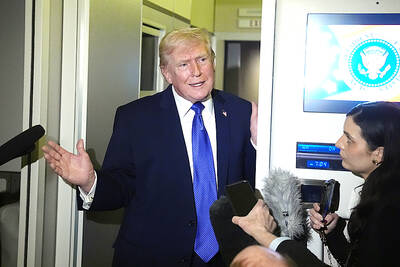
NON-NEGOTIABLE: The US president’s action ran counter to one of the US’ ‘six assurances’ on not consulting China about arms sales to Taiwan, US lawmakers said US President Donald Trump’s admission that he is discussing arms sales to Taiwan with Chinese President Xi Jinping (習近平) is “alarming and a blatant violation of US policy and the six assurances,” US Representative Ro Khanna said on Tuesday. Trump on Monday said he would decide soon on whether to send more weapons to Taiwan, after Xi warned him not to do so. “I’m talking to him about it. We had a good conversation, and we’ll make a determination pretty soon,” Trump told reporters aboard Air Force One when asked about warnings raised by Beijing during a phone call with Xi over
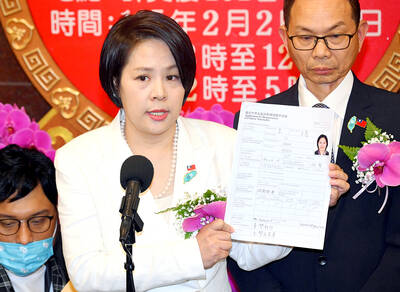
The Central Election Commission has amended election and recall regulations to require elected office candidates to provide proof that they have no Chinese citizenship, a Cabinet report said. The commission on Oct. 29 last year revised the Measures for the Permission of Family-based Residence, Long-term Residence and Settlement of People from the Mainland Area in the Taiwan Area (大陸地區人民在台灣地區依親居留長期居留或定居許可辦法), the Executive Yuan said in a report it submitted to the legislature for review. The revision requires Chinese citizens applying for permanent residency to submit notarial documents showing that they have lost their Chinese household record and have renounced — or have never
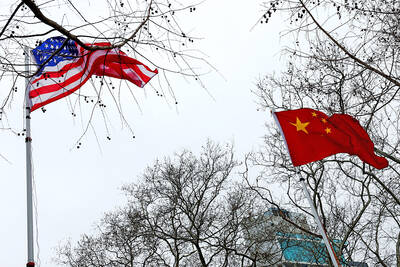
US and Chinese fighter jets briefly faced off above waters near the Korean Peninsula this week, Yonhap News agency reported, marking a rare confrontation in that area between the two superpowers. About 10 US fighter jets on Wednesday departed an airbase in Pyeongtaek, South Korea, for drills above international waters off South Korea’s western coast, the news outlet cited unidentified military sources as saying. While the US planes did not enter China’s air defense identification zone, Beijing scrambled planes as they neared that region, the report said. “The Chinese People’s Liberation Army organized naval and air forces to monitor and effectively respond


 RSS
RSS