


The Ministry of National Defense (MND) yesterday denied reports alleging that media coverage of a military exchange visit by Minister of National Defense Kao Hua-chu (高華柱) to Singapore had led to the suspension of all military cooperation between the two countries.
The Chinese-language United Daily News (UDN) reported that Singapore was unhappy that Kao’s visit had been made public by Taiwanese media, adding that a Singaporean colonel, who has been stationed in Taiwan with the Starlight training program, visited the ministry on Tuesday last week to read out a protest announcement before Kao.
In the protest, the city-state said the Taiwanese military should not have broken a promise that Kao’s visit would remain secret.
In an article on Feb. 15, the Chinese-language China Times quoted Democratic Progressive Party (DPP) Legislator Hsueh Ling (薛凌) as saying that Kao was in Singapore with a military delegation to conduct secret military exchanges with their Singaporean counterparts.
The China Times report added that it was the highest level of military exchanges between the two countries in recent years, which could be seen as a significant breakthrough.
The UDN said in its report yesterday that the delegation, led by Kao and Deputy Chief of Staff Lieutenant General Liu Chen-wu (劉震武), not only met senior military officials from Singapore, but also visited military bases and inspected equipment.
The UDN said Kao felt pressure and encountered an unfriendly atmosphere after the visit was made public, but he completed the visit according to schedule and returned to Taiwan on Feb. 16.
The report said Political Warfare Department acting director-general Wang Ming-wo (王明我) was scheduled to lead a military delegation to Singapore this week, but the Singaporean government canceled the trip.
Ministry spokesman Colonel David Lo (羅紹和) said the UDN report was not based on facts.
“No Singaporean military official read out a protest announcement before Minister Kao,” Lo said.
The spokesman said both countries have a solid friendship and the ministry cherishes its close relationship with its Singaporean counterpart. However, Lo said some military cooperation programs were changing based on the requirements from both sides.
A Chinese Nationalist Party (KMT) lawmaker, who wished to remain anonymous, confirmed yesterday that Singapore had lodged concerns over the media disclosure, but not to Kao.
The Singaporean officer met Deputy Chief of the General Staff for Intelligence Shen Yi-ming (沈一鳴) to convey his government’s concern, the legislator said.
Lo said the ministry had no comment on this.
The ministry maintains that Kao attended the Singapore Air Show and did not conduct military exchanges with Singaporean defense officials.
Under the Starlight training program, which began in 1975, Singapore sends military units to train in Taiwan because of the lack of space in the city-state.
Weighing in yesterday, DPP legislators said both Singapore and Taiwan shared some of the blame for the dispute.
Singapore has “gone too far” with its retaliation, which was disrespectful of the ministry and infringes upon Taiwan’s freedom of the press, Hsueh said.
Hsueh said she suspects Singapore’s protest was a tactic to gain leverage in bilateral negotiations for the Agreement Between Singapore and the Separate Customs Territory of Taiwan, Penghu, Kinmen and Matsu on Economic Partnership.
Regardless of Singapore’s motive, Hsueh said, President Ma Ying-jeou’s (馬英九) administration should have the “guts” to initiate countermeasures against the city-state.
DPP Legislator Huang Wei-cher (黃偉哲) said he did not think Taiwan would suffer any substantial consequences in the dispute, but Singapore appeared to have blown the situation out of proportion.
However, Taiwan has not done enough to maintain stable bilateral relations and defend its national integrity, he said, adding that there is a lot of room for improvement for Taiwan to maintain confidentiality.
Minister of Foreign Affairs Timothy Yang (楊進添) did not confirm nor deny the UDN report, saying the ministry was not in a position to comment on the matter under the purview of the defense ministry.
“We understand Singapore has its concerns over things like this, but Singapore knows well what the media environment in Taiwan is like. We are powerless to restrain the media’s reportage,” he said.
“Media coverage should not hinder the two countries from moving their relationship forward if they can show consideration for each other, enhance mutual understanding, talk to each other when there are irritants and put themselves in the place of other parties,” Yang said.
KMT Legislator Chen Cheng-hsiang (陳鎮湘), a former army commander-in-chief, said he did not think media coverage of Kao’s visit to Singapore was the cause of the dispute.
“In the past 30 years, Taiwan has maintained a solid relationship with Singapore. The likelihood that the relationship became strained due to a single incident is low,” Chen said.
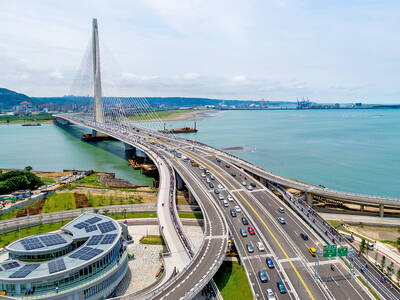
The Ministry of Transportation and Communications yesterday inaugurated the Danjiang Bridge across the Tamsui River in New Taipei City, saying that the structure would be an architectural icon and traffic artery for Taiwan. Feted as a major engineering achievement, the Danjiang Bridge is 920m long, 211m tall at the top of its pylon, and is the longest single-pylon asymmetric cable-stayed bridge in the world, the government’s Web site for the structure said. It was designed by late Iraqi-British architect Zaha Hadid. The structure, with a maximum deck of 70m, accommodates road and light rail traffic, and affords a 200m navigation channel for boats,
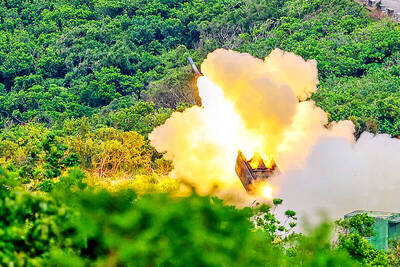
PRECISION STRIKES: The most significant reason to deploy HIMARS to outlying islands is to establish a ‘dead zone’ that the PLA would not dare enter, a source said A High Mobility Artillery Rocket System (HIMARS) would be deployed to Penghu County and Dongyin Island (東引) in Lienchiang County (Matsu) to force the Chinese military to retreat at least 100km from the coastline, a military source said yesterday. Taiwan has been procuring HIMARS and Army Tactical Missile Systems (ATACMS) from the US in batches. Once all batches have been delivered, Taiwan would possess 111 HIMARS units and 504 ATACMS, which have a range of 300km. Considering that “offense is the best defense,” the military plans to forward-deploy the systems to outlying islands such as Penghu and Dongyin so that
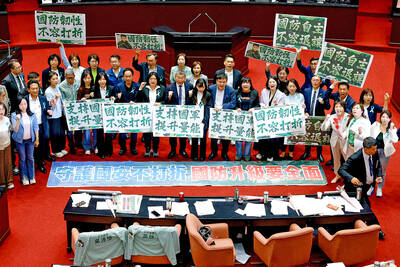
WHAT WAS ALL THAT FOR? Jaw Shaw-kong said that Cheng Li-wen had pushed for more drastic cuts and attacked him, just for the outcome to be nearly identical to his bill The legislature yesterday passed a supplementary budget bill to fund the purchase of separate packages of US military equipment, with the combined amount of spending capped at NT$780 billion (US$24.8 billion). The Chinese Nationalist Party (KMT) and Taiwan People’s Party (TPP) used their legislative majority to pass the bill, which runs until 2033 and has two main funding provisions. One was for NT$300 billion of arms sales already approved by the US for Taiwan on Dec. 17 last year, the other was for NT$480 billion for another arms package expected to be announced by Washington. The bill, which fell short of the NT$1.25
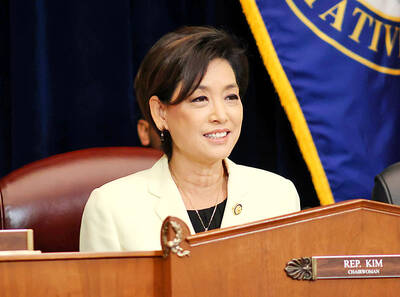
‘CLEAR MESSAGE’: The bill would set up an interagency ‘tiger team’ to review sanctions tools and other economic options to help deter any Chinese aggression toward Taiwan US Representative Young Kim has introduced a bill to deter Chinese aggression against Taiwan, calling for an interagency “tiger team” to preplan coordinated sanctions and economic measures in response to possible Chinese military or political action against Taiwan. “[Chinese President] Xi Jinping [習近平] has directed the People’s Liberation Army to be ready to invade Taiwan by 2027. China has a plan. America should have one too,” Kim said in a news release on Thursday last week. She introduced the “Deter PRC [People’s Republic of China] aggression against Taiwan act” to “ensure the US has a coordinated sanctions strategy ready should


 RSS
RSS