


The Democratic Progressive Party (DPP) yesterday said the Chinese Nationalist Party (KMT) was using 10 “dirty tactics” in the run-up to the presidential election, sparking accusations by the KMT that the DPP was engaging in a “discrediting campaign.”
DPP spokesperson Lin Chun-hsien (林俊憲) told a press conference that the KMT had abused state resources to interfere in the elections, with actions including the abuse of national security authorities to monitor DPP presidential candidate Tsai Ing-wen’s (蔡英文) campaign efforts.
Earlier this week, Next Magazine unveiled a document from the Ministry of Justice’s Investigation Bureau that it claimed showed the bureau had collected information on Tsai for the National Security Council (NSC).
Lin said the KMT also directed judicial authorities to launch an investigation into the KMT’s allegation that Tsai Ing-wen (蔡英文) had profiteered from Yu Chang Biologics Co (宇昌生技股份有限公司) when she was vice premier in 2006 and 2007.
He said the KMT had abused government resources to help the party’s chances in the elections, such as Control Yuan Vice President Chen Jinn-lih (陳進利) and Minister of Education Wu Ching-ji (吳清基) attending President Ma Ying-jeou (馬英九) and Premier Wu Den-yih’s (吳敦義) campaign event.
Lin said the KMT was suspected of vote-buying in Greater Taichung’s Shihgang District (石岡) and local DPP officials had recorded the act, but judicial authorities have not questioned anyone involved in the matter.
Conversely, when a DPP official from a Greater Kaohsiung borough was going to a wedding party with a number of neighbors, prosecutors accused them of vote buying.
Other “anonymous smear tactics” included hanging a large number of posters saying Tsai had bullied farmers and using the media to make false accusations against Tsai, Lin said.
Lin said other dirty tactics included giving cash to voters, treating them to free tours and paying facility bills on their behalf.
In response, the KMT lashed out at the DPP’s latest allegations and urged Tsai’s camp to stop its “smear campaign.”
Stepping up its efforts to defend Ma’s integrity over recent accusations that he instructed the NSC to monitor Tsai’s campaign, the KMT dismissed Tsai’s claim that Wu had rescheduled his campaign events after obtaining information on Tsai’s campaign schedule. It insisted that Wu’s schedule was previously determined.
“The campaign schedules of KMT presidential and vice presidential candidates are transparent and open. The DPP made groundless accusations without double-checking the situation and refused to acknowledge its mistakes afterwards. Should people depend on such an irresponsible party?” KMT Culture and Communication Committee director Chuang Po-chun (莊伯仲) told a press conference.
Chuang’s comments came after Tsai raised questions on Thursday about the possible use of the state intelligence apparatus to monitor her campaign activities.
She accused Ma’s camp of obtaining information about her meeting with independent Greater Taichung Councilor Lai Yi-huang (賴義鍠) on Wednesday afternoon, as her camp found out that Wu had called Lai earlier the same day to set up an impromptu meeting two hours before Tsai’s scheduled courtesy call.
KMT spokesperson Lai Su-ju (賴素如) said the KMT invited the councilor to meet with Wu earlier this month and decided last Staurday that the two would meet on Wednesday at the councilor’s office in Greater Taichung.
She added that it was the director of the DPP’s Taichung branch, Tseng Chao-jung (曾朝榮), who called the councilor on Wednesday to set up a meeting with him.
Lai said Tseng should move his meeting with Tsai to another day to avoid a problem because of Wu’s visit, but Tseng refused to reschedule the meeting, she said.
“This incident once again proved that the DPP has a habit of making groundless accusations. Tsai should offer an apology for discrediting others without any evidence,” she said.
The NSC, the National Security Bureau and the Investigation Bureau have all said there had been no wrongdoing on their part.

PROVOCATIVE: Chinese Deputy Ambassador to the UN Sun Lei accused Japan of sending military vessels to deliberately provoke tensions in the Taiwan Strait China denounced remarks by Japan and the EU about the South China Sea at a UN Security Council meeting on Monday, and accused Tokyo of provocative behavior in the Taiwan Strait and planning military expansion. Ayano Kunimitsu, a Japanese vice foreign minister, told the Council meeting on maritime security that Tokyo was seriously concerned about the situation in the East China and South China seas, and reiterated Japan’s opposition to any attempt to change the “status quo” by force, and obstruction of freedom of navigation and overflight. Stavros Lambrinidis, head of the EU delegation to the UN, also highlighted South China Sea
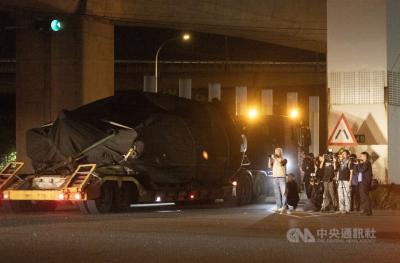
The final batch of 28 M1A2T Abrams tanks purchased from the US arrived at Taipei Port last night and were transported to the Armor Training Command in Hsinchu County’s Hukou Township (湖口), completing the military’s multi-year procurement of 108 of the tanks. Starting at 12:10am today, reporters observed more than a dozen civilian flatbed trailers departing from Taipei Port, each carrying an M1A2T tank covered with black waterproof tarps. Escorted by military vehicles, the convoy traveled via the West Coast Expressway to the Armor Training Command, with police implementing traffic control. The army operates about 1,000 tanks, including CM-11 Brave Tiger

China on Wednesday teased in a video an aircraft carrier that could be its fourth, and the first using nuclear power, while making an allusion to Taiwan and vowing to further build up its islands, as it looks to boost maritime power, secure resources and bolster territorial claims. The video, issued on the eve of the 77th founding anniversary of the Chinese People’s Liberation Army Navy, featured fictional officers with names that are homophones of three commissioned aircraft carriers, the Liaoning (遼寧), Shandong (山東) and Fujian (福建). Titled Into the Deep, it showed a 19-year-old named “Hejian” (何劍) joining the group, sparking
Taiwan Semiconductor Manufacturing Co (TSMC, 台積電), the world’s largest contract chipmaker, said it expects its 2-nanometer (2nm) chip capacity to grow at a compound annual rate of 70 percent from this year to 2028. The projection comes as five fabs begin volume production of 2-nanometer chips this year — two in Hsinchu and three in Kaohsiung — TSMC senior vice president and deputy cochief operating officer Cliff Hou (侯永清) said at the company’s annual technology symposium in Silicon Valley, California, last week. Output in the first year of 2-nanometer production, which began in the fourth quarter of last year, is expected to


 RSS
RSS