


Serbian police yesterday arrested 17 people in the Muslim-populated area of Sandzak after a suspected radical Islamist opened fire on the US embassy in Sarajevo, local media reported.
“This morning at 5am a [police] operation was launched against the extremist Islamist Wahhabi movement in the territory of Novi Pazar, Sjenica and Tutin,” Serbian Interior Minister Ivica Dacic told the Tanjug news agency.
All three towns are in southwestern Serbia with large Muslim communities.
“Seventeen people were arrested, one of them from Bosnia,” Serbian police chief Milorad Veljovic told the private B92 TV channel.
The arrests came after the attack on the US embassy by a Serbian national with ties to the local Wahhabi community, a radical branch of Islam.
“Police will determine whether there is a need to detain more people,” Veljovic said.
The suspected radical Islamist, a Serb national from Novi Pazar identified by Bosnian police as Mevlid Jasarevic, was wounded and arrested after opening fire on Friday on the US embassy in Sarajevo. A police guard was wounded in the attack.
Local TV showed video footage of a bearded man carrying a Kalashnikov rifle.
A special police unit shot and wounded the suspect before arresting him, police spokesman Irfan Nefic told national BHT TV.
“The person who fired an automatic weapon was wounded and arrested during the police operation,” he said. “After receiving medical treatment on the scene the person was hospitalized.”
A statement from the US embassy, which closed after the incident, confirmed that the building “had been attacked with an automatic weapon” and had been hit “several times.”
It urged US citizens to “use caution, watch for any suspicious or unusual activity and remain aware of their surroundings.”
US State Department spokeswoman Victoria Nuland welcomed the prompt reaction of the Bosnian police.
Bosnian politicians were quick to denounce the attack.
“I firmly condemn the terrorist attack on the US embassy in Bosnia-Hercegovina,” Bakir Izetbegovic, the Muslim member of Bosnia’s three-man presidency, said in a statement.
Following the attack, Bosnian Acting President Zeljko Komsic met US ambassador Patrick Moon.
He told him that Bosnia was capable of “guaranteeing the security of all US citizens and diplomatic representatives” in the country.
“Our country is not a haven for terrorists,” he stressed, as the presidency said it had called a special meeting of all Bosnian police branches.
“I expect the competent authorities to carry out a quick and efficient investigation of this senseless act,” he added.
Witnesses described scenes of panic as the gunman opened fire.
“I was waiting for a tram when I saw right next to me this guy armed with a rifle firing at the embassy,” Igor Parac said. “People started running in all directions.”
Another eyewitness, Admir Hrenovica, told BHR1 TV the gun shots had lasted about 15 minutes.
“I first heard several bursts of gunfire and then single shots. People close to me threw themselves on the ground. It was total panic,” he said.

SILENCING CRITICS: In addition to blocking Taiwan, China aimed to prevent rights activists from speaking out against authoritarian states, a Cabinet department said The Ministry of Foreign Affairs (MOFA) yesterday condemned transnational repression by Beijing after RightsCon, a major digital human rights conference scheduled to be held in Zambia this week, was abruptly canceled due to Chinese pressure over Taiwanese participation. This year’s RightsCon, the world’s largest conference discussing issues “at the intersection of human rights and technology,” was scheduled to take place from tomorrow to Friday in Lusaka, and expected to draw 2,600 in-person attendees from 150 countries, along with 1,100 online participants. However, organizers were forced to cancel the event due to behind-the-scenes pressure from China, the ministry said, expressing its “strongest condemnation”
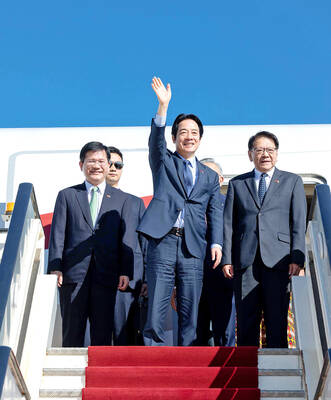
DELAYED BUT DETERMINED: The president’s visit highlights Taiwan’s right to international engagement amid regional pressure from China President Willaim Lai (賴清德) yesterday arrived in Eswatini, more than a week after his planned visit to Taiwan’s sole African ally was suspended because of revoked overflight permits. “The visit, originally scheduled for April 22, was postponed due to unforeseen external factors,” Lai wrote on social media. “After several days of careful arrangements by our diplomatic and national security teams, we successfully arrived today.” Lai said he looked forward to further deepening Taiwan-Eswatini relations through closer cooperation in the economy, agriculture, culture and education, as well as advancing the nation’s international partnerships. The president was initially scheduled to arrive in time to celebrate
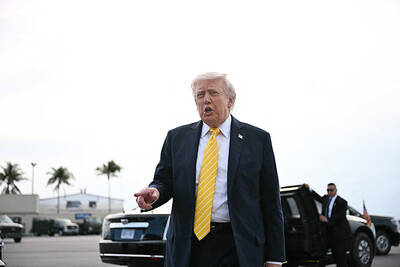
Iran’s Islamic Revolutionary Guard Corp (IRGC) yesterday said the US faced a choice between an “impossible” military operation or a “bad deal” with Tehran, after US President Donald Trump disparaged Iran’s latest peace proposal. Negotiations between the two countries have been deadlocked since a ceasefire came into effect on April 8, with only one round of direct peace talks held so far. Iran’s Tasnim and Fars news agencies reported that Tehran had submitted a 14-point proposal to mediator Pakistan, but Trump was quick to cast doubt on it. “I will soon be reviewing the plan that Iran has just sent to us, but

A group affiliated with indicted Chinese immigrant Xu Chunying (徐春鶯) is to be dissolved for monitoring Chinese immigrants in Taiwan, a source said yesterday. Xu, the secretary-general of the Cross-Strait Marriage and Family Service Alliance, was indicted on March 24 on charges of violating the Anti-Infiltration Act (反滲透法). The alliance “illegally monitored" Chinese immigrants living in Taiwan on behalf of the Chinese Communist Party (CCP) and the Ministry of the Interior is expected to dissolve the organization in the coming days under provisions of the Civil Associations Act (人民團體法), the source said. Xu, who married a Taiwanese in 1993 and became a Republic


 RSS
RSS