


Israel flew its ambassador home from Cairo yesterday after protesters stormed its embassy building, plunging Egypt’s military rulers into their worst diplomatic crisis since they took over from former Egyptian president Hosni Mubarak.
Three people were killed and 1,049 wounded in clashes between protesters and police, the Egyptian health ministry said.
The US, which has poured billions of dollars of military aid into Egypt since it made peace with Israel in 1979, urged Cairo to protect the embassy after protesters hurled embassy documents and the Israeli flag from windows.
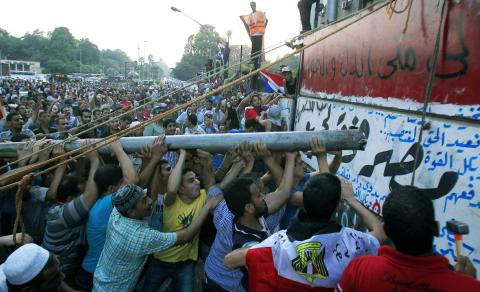
Photo: Reuters
“Our dignity has been restored,” said Mohi Alaa, 24, a protester who was speaking near the site of overnight clashes with police around the building that houses the Israeli embassy.
Bits of concrete and bullet casings were strewn over the street.
“We don’t want the Americans’ money,” he said, reflecting a growing readiness among many Egyptians to express anger at Israel and the US over Israeli treatment of the Palestinians, following decades of pragmatic official relations.
Police had fired shots in the air and tear gas to disperse the crowd. Protesters had lit tires on the street and at least two vehicles were set alight near the embassy, located on the upper floors of a residential block overlooking the Nile.
One of the three who died was in the nearby Agouza hospital, where a reporter saw a corpse with a punctured chest.
About 500 protesters stayed after dawn and a few threw stones at police, who gradually pushed them away and secured the area.
It was the second big eruption of violence at the embassy since five Egyptian border guards were killed last month when Israel repelled cross-border raiders it said were Palestinians. Egypt then briefly threatened to withdraw its envoy to Israel.
Israeli Ambassador to Egypt Yitzhak Levanon, his staff and family members arrived home yesterday, but one diplomat stayed in Egypt to maintain the embassy, an Israeli official said.
State television said Egyptian Prime Minister Essam Sharaf headed an emergency ministerial crisis meeting and then went to see Field Marshal Mohamed Hussein Tantawi, who heads the military council that has ruled Egypt since Mubarak resigned on Feb. 11.
Israel is finding itself increasingly at odds with formerly sympathetic states in the region. It is already embroiled in a feud with Turkey, once the closest of its few Muslim allies, over its treatment of the Palestinians.
Egypt’s generals, under pressure to hand power to civilians more swiftly, must balance public calls for a more assertive foreign policy toward Israel with maintaining ties that bring in cash and top-notch US military equipment.
Under Mubarak, Egyptians could never show such hostility to Israel without a crushing security response.
An Israeli official said the ambassador, his staff and family members had left in one plane and a second one had brought home six Israeli security personnel who had been left guarding the embassy, protected from the crowd only by a reinforced door until Egyptian troops extracted them.
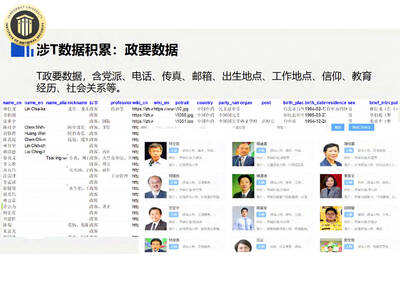
NETWORK-MAPPING PROJECT: The database contains 170 detailed files of Taiwanese politicians and about 23 million records of household registration data in Taiwan China has developed a network-mapping project targeting political figures and parties in Taiwan to monitor public opinion during elections and to craft tailored influence campaigns aimed at dividing Taiwanese society, according to documents leaked by Chinese technology firm GoLaxy (中科天璣). The documents, collected by Taipei-based Doublethink Lab, showed a database was specifically created to gather detailed information on Taiwanese political figures, including their political affiliations, job histories, birthplaces, residences, education, religion and a brief biography about them. Several notable Taiwanese politicians are in the database, including President William Lai (賴清德), former president Tsai Ing-wen (蔡英文), Minister of Foreign Affairs Lin Chia-lung (林佳龍),

RECOGNITION: Former Fijian prime minister Mahendra Chaudhry said that Taiwan’s New Southbound Policy serves as a stabilizing force in the Indo-Pacific region Taiwan can lead the unification of the Chinese people, Nobel Peace Prize laureate and former Polish president Lech Walesa said in Taipei yesterday, adding that as the world order is changing, peaceful discussion would find good solutions, and that the use of force and coercion would always fail. Walesa made the remarks during his keynote address at a luncheon of the Yushan Forum in Taipei, titled “Indo-Pacific Partnership Prospects: Taiwan’s Values, Technology and Resilience,” organized by the Taiwan-Asia Exchange Foundation with the Ministry of Foreign Affairs. Walesa said that he had been at the forefront of a big peaceful revolution and “if
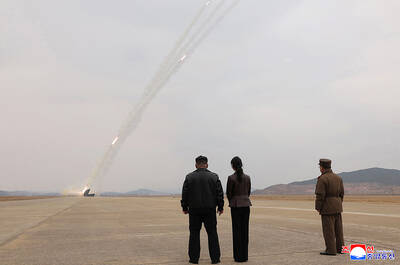
North Korea tested nuclear-capable rocket launchers, state media reported yesterday, a day after Seoul detected the launch of about 10 ballistic missiles. The test comes after South Korean and US forces launched their springtime military drills, due to run until Thursday. North Korean leader Kim Jong-un on Saturday oversaw the testing of the multiple rocket launcher system (MRLS), the Korean Central News Agency (KCNA) said. The test involved 12 600mm-caliber ultra-precision multiple rocket launchers and two artillery companies, it said. Kim said the drill gave Pyongyang’s enemies, within the 420km striking range, a sense of “uneasiness” and “a deep understanding

North Korea yesterday fired about 10 ballistic missiles to the sea toward Japan, the South Korean Joint Chiefs of Staff (JCS) said, days after Pyongyang warned of “terrible consequences” over ongoing South Korea-US military drills. Pyongyang recently dashed hopes of a diplomatic thaw with Seoul, Washington’s security ally, describing its latest peace efforts as a “clumsy, deceptive farce.” Seoul’s military detected “around 10 ballistic missiles launched from the Sunan area in North Korea toward the East Sea [Sea of Japan] at around 1:20pm,” JCS said in a statement, referring to South Korea’s name for the body of water. The missiles


 RSS
RSS