


The Ministry of National Defense (MND) yesterday denied claims in an opinion piece published in the Wall Street Journal (WSJ) that the nation’s military has been penetrated by Chinese intelligence.
“The accusation is unfounded and not supported by evidence,” ministry spokesperson Colonel David Lo (羅紹和) said. “There is a consensus within Taiwan’s armed forces that despite the warming of cross-strait relations, China is still an enemy.”
The comment came in response to an opinion piece titled “Taiwan is Losing the Spying Game” written by Taipei Times deputy news editor and Jane’s Defence Weekly correspondent J. Michael Cole that was published in the WSJ on Tuesday.

Photo: Chien Jung-fong, Taipei Times
The piece contended that China’s infiltration of almost every sector of Taiwanese society had become a factor in US decisions whether to sell advanced weaponry to Taipei.
Among the examples given were retired generals being entertained by counterparts in the People’s Liberation Army and the whereabouts of Ko-suen “Bill” Moo (慕可舜), a Taiwanese businessman who was sentenced to six-and-a-half years in a US federal prison in 2005 for seeking to ship sensitive military technology to China, after he was deported to Taiwan earlier last month following the completion of his sentence.
Asked by press if the ministry intended to sue Cole, Lo did not give a direct answer.
He reiterated the relations between Taiwan and the US are substantive and established on mutual trust.
However, at a separate setting, Chinese Nationalist Party (KMT) lawmakers implied there was a political overtone to the matter, with KMT Legislator Herman Shuai (帥化民) saying the purpose of the op-ed piece was to “humiliate the military” and to “insult President Ma’s [Ying-jeou (馬英九)] administration” to achieve its desired objective in January’s presidential and legislative elections.
KMT caucus whip Chao Li-yun (趙麗雲) made several demands of Cole, the Taipei Times and its sister newspaper, the Chinese-language Liberty Times.
She asked Cole to provide evidence to back up his statements, or offer an apology and admit the allegations are incorrect if he is unable to do so.
The allegations have dealt a blow to the country’s image and hurt its interests when Taiwan is still waiting for a decision by the US on the sale of F16C/D aircraft, the lawmaker said.
Chao said the KMT caucus would demand that the Council of Labor Affairs and the National Immigration Agency (NIA) look into Cole’s residence certificate and work permit and declare Cole persona non grata if he is not able to provide evidence.
Chao also urged the Taipei Times to “clean house” if the newspaper “truly loves Taiwan.”
“Didn’t the Taipei Times feel that it let its readers down” when it allowed an article by a staffer in which Taiwan was described as a country whose doors and windows are left wide open and defenseless be published in a foreign media?” Chao said.
Chao also said the Liberty Times had tried to mislead its readers by posting a translation of the article on its Web site on Tuesday night and not mentioning that it was written by Cole, in an effort to make it appear the article represented the WSJ’s views.
The government has no reason to supervise Moo in Taiwan because he was not involved in any criminal case in this country and no authority had placed him on a watchlist, Chao said.
“Just because he finished his sentence in the US and came back to Taiwan does not mean he has to be watched,” she said. “Are we a police state, an authoritarian state, or a colony of the US?”
Meanwhile, Democratic Progressive Party (DPP) Legislator Tsai Huang-liang (蔡煌瑯) said “what was mentioned in the piece was shocking, but it’s not surprising.”
“Almost everyone knows that China’s infiltration has intensified after President Ma took office in 2008 and that has led to US concerns,” Tsai said.
As to the KMT caucus’ plan asking the immigration agency to look into Cole’s work permit, the DPP lawmaker said: “This is an apparent retaliation from the KMT lawmakers, I advised them against doing so because it will once again show Taiwan’s disrespect for press freedom.”
The KMT caucus’ proposal will not only hurt Taiwan’s international image, but could also draw criticism from the international community, Tsai said.
He said he could not imagine that neither national security officials nor the defense ministry had taken any precautions involving Moo.
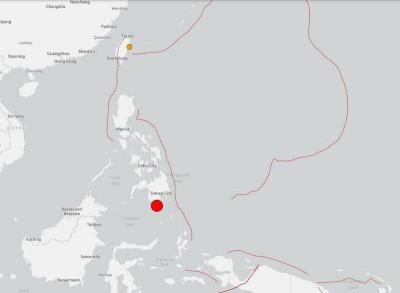
A magnitude 7.8 earthquake struck off the southern coast of Mindanao in the Philippines at 7:38am today, prompting the US Tsunami Warning System to issue an alert for neighboring countries, including Taiwan. The system issued a purple alert indicating a "tsunami threat." The potential threat zone includes Taiwan, the Philippines, Papua New Guinea, Yap and Palau. Philippine authorities were assessing the damage from the quake, with the office of civil defense seeking to verifying initial reports that 15 people had been killed and 129 injured in the region, mostly from falling debris. Arlene Hollero, disaster chief of Maasim town in the Philippines' Sarangani Province,
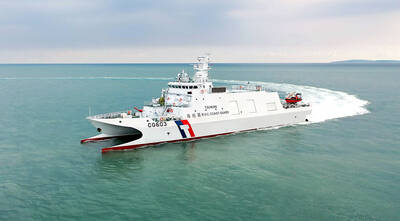
‘GRAY ZONE’ PRESSURE: Beijing’s activities are intended to create the deceitful impression that China has jurisdiction over the area around Taiwan, the CGA said Taiwan’s rights over its territorial waters and exclusive economic zone must not be violated by any country, the Mainland Affairs Council said yesterday, adding that it will not accept any unprovoked actions. The council issued the remarks in response to the China Coast Guard conducting maritime enforcement drills near eastern Taiwan and claiming to fully exercise China’s maritime administrative law enforcement authority. The Coast Guard Administration (CGA) has been closely monitoring the situation and is taking concrete steps to defend the nation’s sovereignty and secure its waters, the council said. China has no sovereign rights over the waters off eastern
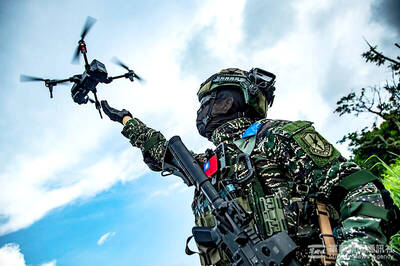
RESILIENCE: Taiwan plays a key role in semiconductors, energy, information infrastructure and advanced manufacturing, AIT Director Raymond Greene said Taiwan’s continued investment in deterrence and resilience remains vital, especially in uncrewed systems and other emerging technologies, American Institute in Taiwan (AIT) Director Raymond Greene said yesterday. Greene made the remarks at the annual National Strategic Summit on Supply Chain Resilience held by the Research Institute for Democracy, Society and Emerging Technology (DSET), a government-backed think tank. As Taiwan last year became the US’ fourth-largest trading partner and supply chain security is becoming more important, cooperation in emerging technologies continues to deepen between the two countries, he said. The US is committed to accelerating innovation, building key infrastructure, strengthening cooperation

The National Chungshan Institute of Science and Technology yesterday showcased its locally developed variants of the Vision 60 robotic patrol dog, which it plans to deploy on the nation’s outlying territories in the South China Sea. The variants were produced under the Joint Lab project — created by the institute and domestic companies — and assembled with domestically produced motors, lenses and artificial intelligence (AI) systems alongside licensed tech from the US, Missile and Rocket Systems Research Division deputy director Jen Kuo-kang (任國光) told the media event at a military base in Taipei’s Dazhi (大直) area. Taiwan has built up its strengths


 RSS
RSS