


The TAIEX plunged 3.57 percent to close at 7,342.96 yesterday on the back of heavy falls in Europe and Wall Street overnight, as fears over a new global recession deepened, driving investors across Asia to dump shares.
That made Taipei the second-worst performer in Asia after South Korea’s 6.22 percent drop, one day after Morgan Stanley painted the US and Europe as “dangerously close to recession” and Taiwan cut its GDP growth forecast to 4.81 percent for this year, from the 5.01 percent estimated last month.
“The economic landscapes at home and abroad look increasingly rugged ahead,” Schroders Investment Management Taiwan vice president Tony Chen (陳同力) said.
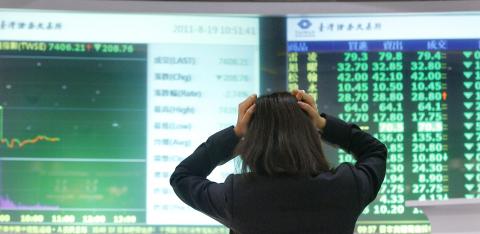
Photo: Reuters
The dimming outlook will feed investor jitters and drag the main index lower until European and US equity markets show signs of stabilization, he said.
“The confidence crisis, warranted or not, may develop into a self-fulfilling prophecy and hurt companies as well as the economy,” the analyst said. “Many firms’ shares are undervalued.”
Hua Nan Securities Co (華南永昌證券) chairman David Chu (儲祥生) also said Taiwan was following the international trend and local stocks were not likely to rebound unless the problems in the international markets were resolved.
Turnover reached NT$120.96 billion (US$4.18 billion) with losses nearly across the board, as more -foreign funds pulled out, Taiwan Stock Exchange statistics indicated.
Foreign investors sold a net NT$5.79 billion in local shares, while proprietary dealers and trust firms slashed a net NT$2.69 billion and NT$1.09 billion respectively, based on stock exchange data. That helped push the local currency down to a four-month low against the US dollar.
The New Taiwan dollar closed at NT$29.076 in Taipei trading yesterday, the weakest since April 18, according to central bank data.
Altogether, the TAIEX shed another 3.85 percent, or 294.06 points, in a week that saw foreign players unloading a net NT$37.76 billion in local shares, the Taiwan Stock Exchange said, adding that net -selling totaled NT$201.96 -billion so far this month.
In an attempt to calm the market, Government Information Office Minister Philip Yang (楊永明) reiterated yesterday that the nation’s economic fundamentals remained healthy despite the market turmoil.
Vice Premier Sean Chen (陳冲), who also chairs the National Stabilization Fund, called a meeting of economic and financial officials in the morning, but concluded that the situation did not merit intervention.
Blue-chip names led the tumble, as shares in HTC Corp (宏達電), the world’s No. 5 smartphone brand, closed down by the daily limit to NT$719, while shares in Largan Precision Co (大立光), Taiwan’s largest handset lens-maker, sank equally to NT$776, Taiwan Stock Exchange data showed.
JPMorgan Asset Management (摩根富林明投信) analyst James Yeh (葉鴻儒) said the TAIEX has yet to hit bottom and investors should be cautious.
Yeh suggested cutting holdings in technology shares because the sluggish recovery in the West would weaken the earnings of export--focused manufacturers.
ADDITIONAL REPORTING BY CNA
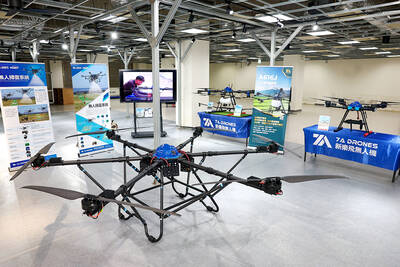
DRONE CENTRAL: Taiwan aims to become Asia’s democratic hub for drones, with most exports focused on high-quality military-grade models, an official said Taiwan’s drone industry is expected to expand significantly by 2030, producing 100,000 units per month and exporting half of them, the Ministry of Economic Affairs said yesterday. Current drone production capacity is about 15,000 units per month, but the industry can quickly scale up as demand increases, Industrial Development Administration Director-General Chiou Chyou-huey (邱求慧) told a news conference in Taipei. Taiwan’s drone output grew 2.5-fold last year to NT$12.9 billion (US$408.3 million) under a government program to develop the uncrewed vehicle sector, he said. The Executive Yuan in October last year approved plans to invest NT$44.2 billion into domestic production of uncrewed aerial
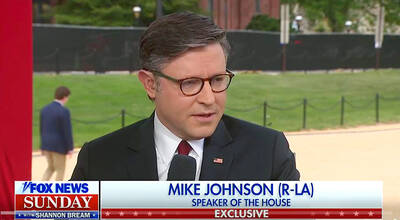
RESOLUTE BACKING: Two Republican senators are planning to introduce legislation that would impose immediate sanctions on China if it attempts to invade Taiwan US House of Representatives Speaker Mike Johnson on Sunday reaffirmed US congressional support for Taiwan, saying the US and “all freedom-loving people” have a stake in preventing China from seizing Taiwan by force. Johnson made the remarks in an interview with Fox News Sunday on US President Donald Trump’s summit with Chinese President Xi Jinping (習近平) last week. In an interview that aired on Friday on Fox News, just as Trump wrapped up a high-stakes visit to China, he said he has yet to green-light a new US$14 billion arms package to Taiwan and that it “depends on China.” “It’s a very good
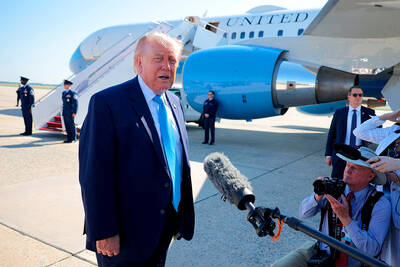
US President Donald Trump yesterday said he would speak to President William Lai (賴清德) as his administration considers whether to move ahead with a US$14 billion weapons sale to Taiwan — a potential arms deal that has drawn criticism from China. “Well, I’ll speak to him. I speak to everybody,” Trump told reporters yesterday when asked if he had any plans to call his counterpart, although he did not offer a time frame for when such a conversation could take place. Trump previously said he would speak to the person “that’s running Taiwan,” without specifying who he meant. “We have that situation very
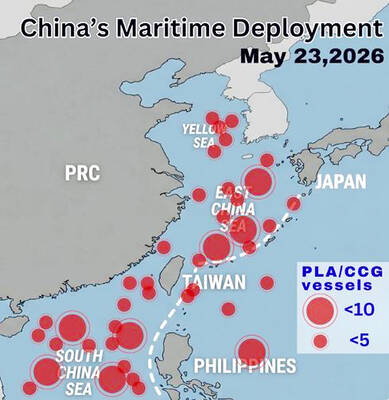
WARNING: China should stop engaging in actions that undermine regional peace and stability, as it would only build resentment among people across the Strait, the CGA said China has deployed more than 100 navy, coast guard and other vessels in waters from the Yellow Sea to the South China Sea and the western Pacific since US President Donald Trump and Chinese President Xi Jinping (習近平) met in Beijing, National Security Council Secretary-General Joseph Wu (吳釗燮) said yesterday. “In this part of the world, #China is the one & only PROBLEM wrecking the #StatusQuo & threatening regional peace & stability,” Wu wrote on X. In a separate post, he said Beijing was coercing Taiwan’s maritime domain, calling it illegal and provocative, after the Coast Guard Administration (CGA) expelled a


 RSS
RSS