


Chinese pressure forced Taiwanese taekwondo athlete Yang Shu-chun (楊淑君) to withdraw an appeal against her disqualification at the Asian Games last year from the Court of Arbitration for Sport (CAS), a Democratic Progressive Party (DPP) legislator said yesterday.
With the Chinese Taipei Taekwondo Association (CTTA) and the Sports Affairs Council (SAC) embroiled in allegations that they threatened Yang to get her to withdraw the appeal, DPP Legislator Gao Jyh-peng (高志鵬) yesterday added that he suspected they were under the influence of strong Chinese pressure.
Citing a letter to former Chinese Taipei Olympic Committee chairman Chang Feng-shu (張豐緒) obtained by the DPP, Gao said senior Chinese sports official Wei Jizhong (魏紀中), president of the International Volleyball Federation (FIVB), advised Taiwan to “weigh its options” in the appeal because he has many experienced “lawyer friends” in Lausanne, Switzerland.
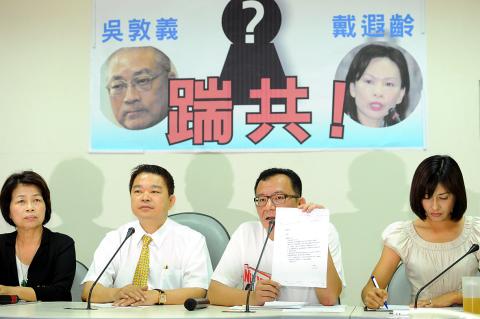
Photo: Lo Pei-der, Taipei Times
“What are your chances of winning the case against us?” Wei asked in the letter.
Gao’s allegations came after former CTTA chairman Chen Chien-ping (陳建平) was quoted as saying in the Chinese-language Liberty Times (the Taipei Times’ sister newspaper) on Monday that Yang was forced to drop the appeal and sign a letter of proxy enabling the CTTA to handle the lawsuit on her behalf under threat from current CTTA chairman Angus Hsu (許安進).
DPP spokesman Chen Chi-mai (陳其邁) said on that same day that Hsu threatened Yang by saying that her place on the Olympic taekwondo team, the position of her boyfriend and coach Liu Tsung-ta (劉聰達), as well as her training expenses, would all be at stake.
Hsu has denied the accusations, while SAC deputy chairman Steven Chen (陳士魁) said on Monday that the council neither recognized the letter of proxy nor held the view that Yang has been threatened by Hsu.
Gao yesterday said the SAC was aware of the letter from Wei, but had done nothing to help Yang.
DPP Legislator Tsai Huang-liang (蔡煌瑯) said President Ma Ying-jeou (馬英九) and Premier Wu Den-yih (吳敦義) had promised to offer Yang full support in her effort to “clear her name” after being disqualified.
“It is time for them to speak out,” Tsai said. “And if Yang was threatened, the judiciary should launch an investigation into the matter.”
In response, Steven Chen said the latest accusations were a “ridiculous association” between two separate events.
Steven Chen said he knew Chang and Wei had exchanged opinions over Yang’s case in December last year, when the SAC was in the process of helping Yang file lawsuits against the Olympic Council of Asia (OCA), the Guangzhou Asian Games Organizing Committee and the Asian Taekwondo Union.
“Chang relayed to us what Wei thought about the case, including [his advice to] not sue the OCA,” Chen said. “However, that was Wei’s opinion. We filed the lawsuits anyway.”
Chang said he had never seen the letter that Gao mentioned in the press conference.
Steven Chen said the council would have dropped the lawsuits in January or February if it really had no intention of continuing the legal process, adding that it did not have to wait until last month to make that announcement.
At a separate setting yesterday, Wu denied that Yang had been forced to withdraw the lawsuit.
Wu said he had asked Sports Affairs Council Minister Tai Hsia-ling (戴遐齡) to relay his opinions on this case to Yang upon learning from the media that Yang intended to withdraw the lawsuit.
“I wanted Tai to tell Yang that she can’t just hastily decide to swallow [the ruling]. [The ruling] was something that can’t be swallowed at will. The government and the public will never swallow that. As long as you [Yang’s] defense is defensible, the government will back her up till the end,” Wu said.
NO CHANGE
The government has not changed its position in supporting Yang in appealing the case, Wu added.
Meanwhile, Hsu yesterday filed a slander lawsuit with the Taipei District Prosecutors’ Office against Chen Chien-ping over the latter’s remarks that he pressured Yang to withdraw her appeal.
Hsu also rebutted Chen Chi-mai’s remarks. However, he said he would not file a lawsuit against Chen Chi-mai now because it was election season, but he would consider filing a lawsuit against him after January’s elections.
Additional reporting by Shelley Shan,Shih Hsiu-chuan and Rich Chang

A signaling system malfunction disrupted high-speed rail (HSR) services beginning at 8am today, with trains temporarily reduced to three northbound and three southbound trains per hour as authorities conduct inspections. The malfunction occurred on a section of track in Miaoli County during pre-operation checks early this morning, forcing northbound and southbound trains to use a single track, the HSR operator said. The regular schedule has been replaced with three hourly trains offering only nonreserved seating in each direction, stopping at every station, it said, adding that business class cars would still have reserved seating. Departures from terminal stations are scheduled at the top

Taiwan is still in the process of assessing the possibility of recruiting workers from Eswatini, the Ministry of Foreign Affairs said yesterday, adding that its goal is to help Eswatini upgrade its vocational training centers. If there are plans to recruit workers from Eswatini, safeguarding national security, protecting public health and ensuring the employment rights of Taiwanese would be prerequisites, Department of West Asian and African Affairs Director-General Yen Chia-liang (顏嘉良) told a news conference. Key considerations would also include filling labor shortages in specific industries, and fostering bilateral professional and technical exchanges, he said. Yen was asked about the progress of labor

A US uncrewed surface vessel (USV) encountered multiple Chinese warships during an autonomous transit of the Taiwan Strait, US defense company Seasats said in a statement on Wednesday. Seasats announced that a Lightfish USV had completed the first autonomous transit of the Taiwan Strait. Over five days, the USV traversed the entire length of the Strait while constantly monitoring surface vessel traffic, the company said. The Lightfish encountered multiple Chinese warships, one of which was a Chinese People’s Liberation Army Navy (PLAN) Type 056 corvette, it said. The Chinese vessels were operating “well within Taiwan’s exclusive economic zone without transmitting their identity via the

VERBOSE VESSELS: A CGA cutter and a China Coast Guard exchanged verbal barbs for more than a day in Taiwanese-controlled waters before the Chinese vessel left The Taiwanese and Chinese coast guards had a standoff near the strategically located Pratas Islands (Dongsha Islands, 東沙群島) in the north of the South China Sea, the Coast Guard Administration (CGA) said yesterday. The two sides engaged in intense radio exchanges over sovereignty claims during the 33-hour standoff. China Coast Guard vessel 3501 eventually left the restricted waters, 26.6 nautical miles (49.2km) west of the Pratas Islands, at 5pm yesterday, the CGA said. Lying approximately between southern Taiwan and Hong Kong, the Taiwan-controlled Pratas are seen by some security experts as vulnerable to Chinese attack due to their distance — more than


 RSS
RSS