


China will boost its coastal forces by adding ships and 6,000 personnel by 2020, state media said yesterday, a move likely to raise tensions with neighbors staking rival claims to waters thought to hold vast reserves of oil and gas.
The expansion of the China Maritime Surveillance forces, a paramilitary law enforcement agency that patrols China’s territorial waters, was unveiled two days after the country sent its largest civilian maritime patrol ship to the South China Sea.
The moves show Beijing’s resolve to protect its “maritime rights and sovereignty,” which it says have been increasingly violated amid a rising frequency of disputes, but other claimants are also keen to show they are not backing down.
The Philippines has sent its largest warship — a World War II-vintage destroyer escort — on a patrol that would take it through the disputed Scarborough Shoals (斯卡伯群島) in the South China Sea, off its main island of Luzon.
“The navy conducts regular offshore patrols and we should not connect the deployment of Rajah Humabon to the deployment of China’s maritime vessel,” Philippine Department of National Defense spokesman Eduardo Batac said.
However, Philippine President Benigno Aquino III insisted yesterday that his country won’t be bullied by China in a territorial spat over the Spratly Islands (南沙群島), but also announced an end to oil exploration in the disputed waters that had angered Beijing.
Aquino told The Associated Press in an interview that his government has completed the exploration around Reed Bank, about 130km from western Palawan Province and that the prospects are “very good.” He declined to elaborate for fear of further stoking tension over the area, which also is claimed by China.
He did say, however, “We will not be pushed around because we are a tiny state compared with theirs,” in reference to China.
“We think we have very solid grounds to say ‘do not intrude into our territory’ and that is not a source of dispute or should not be a source of dispute,” Aquino said.
Meanwhile, Philippine Foreign Affairs Secretary Albert del Rosario met diplomats from the nine other ASEAN members in Manila, urging a common position and approach to resolve the South China Sea dispute.
China’s maritime forces, under the Chinese State Oceanic Administration, will have 16 aircraft and 350 vessels by the end of the country’s five-year plan ending in 2015, and more than 15,000 personnel and 520 vessels by 2020, the China Daily said citing an unnamed senior official. It did not give a price tag.
“There have been an increasing number of intrusions by foreign vessels and planes into Chinese waters and airspace in recent years,” the newspaper said.
It said that the coastal forces had logged 1,303 foreign ships and 214 planes intruding this year, compared with a total of 110 cases in 2007.
Tensions in the South China Sea have risen in the past month on concerns that China is becoming more assertive in the waters, parts of which are also claimed by Taiwan, Brunei, Malaysia, the Philippines and Vietnam.
A commentary from Xinhua news agency blamed the tension on the US wading into the dispute.
The US’ statements had emboldened China’s neighbors “and only then did they dare adopt a ultra-hawkish stance in voicing their positions,” the commentary said.
China’s claim is by far the largest, forming a large U-shape over most of the sea’s 1.7 million square kilometers, including the Spratlys and the Paracel Islands (西沙群島).
This week, Beijing warned outside countries not to step into the dispute, after Vietnam said other countries, including the US, could help defuse the tension.
China has accused Vietnam of violating its claim to the Spratlys and nearby seas, which Vietnam also deems its own.
Beijing said last week it would hold naval drills in June in the western Pacific Ocean and its navy plans to launch its first aircraft carrier as early as this year.
The maritime forces have grown rapidly since Liu Cigui (劉賜貴), 55, took over as head of the State Oceanic Administration in March last year after a stint as Xiamen mayor.
Liu, head of Fujian’s provincial oceanic and fishery bureau from 2000 to 2002, is no stranger to maritime matters.
“Liu Cigui decided to beef up China Maritime Surveillance by adding ships and helicopters to its South Sea, East Sea and North Sea fleets” to safeguard territorial waters and the country’s marine economy, a source with ties to the oceanic administration said.
Liu put the output of China’s marine economy at 3.8 trillion yuan (US$586.8 billion) last year, accounting for 9.7 percent of gross domestic output. He did not give a comparative figure.
Maritime surveillance personnel are mainly retired navy men and officers, the source said, requesting anonymity because he was not authorized to speak to reporters.
China Maritime Surveillance was founded in 1998 and its duties include protecting the maritime environment.

NATIONAL SECURITY THREAT: An official said that Guan Guan’s comments had gone beyond the threshold of free speech, as she advocated for the destruction of the ROC China-born media influencer Guan Guan’s (關關) residency permit has been revoked for repeatedly posting pro-China content that threatens national security, the National Immigration Agency said yesterday. Guan Guan has said many controversial things in her videos posted to Douyin (抖音), including “the red flag will soon be painted all over Taiwan” and “Taiwan is an inseparable part of China,” while expressing hope for expedited “reunification.” The agency received multiple reports alleging that Guan Guan had advocated for armed reunification last year. After investigating, the agency last month issued a notice requiring her to appear and account for her actions. Guan Guan appeared as required,
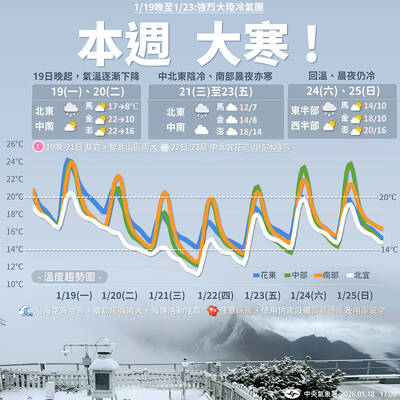
A strong cold air mass is expected to arrive tonight, bringing a change in weather and a drop in temperature, the Central Weather Administration (CWA) said. The coldest time would be early on Thursday morning, with temperatures in some areas dipping as low as 8°C, it said. Daytime highs yesterday were 22°C to 24°C in northern and eastern Taiwan, and about 25°C to 28°C in the central and southern regions, it said. However, nighttime lows would dip to about 15°C to 16°C in central and northern Taiwan as well as the northeast, and 17°C to 19°C elsewhere, it said. Tropical Storm Nokaen, currently
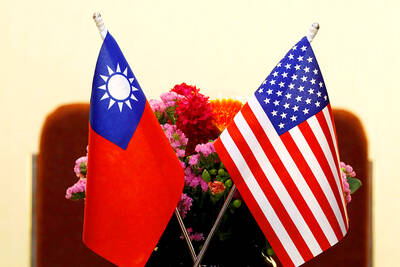
‘NATO-PLUS’: ‘Our strategic partners in the Indo-Pacific are facing increasing aggression by the Chinese Communist Party,’ US Representative Rob Wittman said The US House of Representatives on Monday released its version of the Consolidated Appropriations Act, which includes US$1.15 billion to support security cooperation with Taiwan. The omnibus act, covering US$1.2 trillion of spending, allocates US$1 billion for the Taiwan Security Cooperation Initiative, as well as US$150 million for the replacement of defense articles and reimbursement of defense services provided to Taiwan. The fund allocations were based on the US National Defense Authorization Act for fiscal 2026 that was passed by the US Congress last month and authorized up to US$1 billion to the US Defense Security Cooperation Agency in support of the
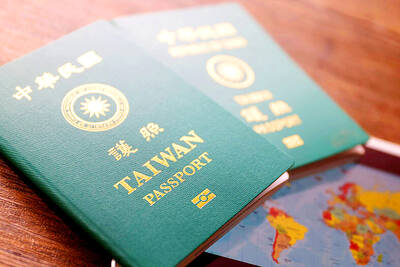
PAPERS, PLEASE: The gang exploited the high value of the passports, selling them at inflated prices to Chinese buyers, who would treat them as ‘invisibility cloaks’ The Yilan District Court has handed four members of a syndicate prison terms ranging from one year and two months to two years and two months for their involvement in a scheme to purchase Taiwanese passports and resell them abroad at a massive markup. A Chinese human smuggling syndicate purchased Taiwanese passports through local criminal networks, exploiting the passports’ visa-free travel privileges to turn a profit of more than 20 times the original price, the court said. Such criminal organizations enable people to impersonate Taiwanese when entering and exiting Taiwan and other countries, undermining social order and the credibility of the nation’s


 RSS
RSS