


The Obama administration is leading a global effort to deploy “shadow” Internet and mobile phone systems that dissidents can use to undermine repressive governments that seek to silence them by censoring or shutting down telecommunications networks.
The effort includes secretive projects to create independent cellphone networks inside foreign countries, as well as one operation out of a spy novel in a fifth-floor shop on L Street in Washington, where a group of young entrepreneurs who look as if they could be in a garage band are fitting deceptively innocent-looking hardware into a prototype “Internet in a suitcase.”
Financed with a US$2 million State Department grant, the suitcase could be secreted across a border and quickly set up to allow wireless communication over a wide area with a link to the global Internet.
The US effort, revealed in dozens of interviews, planning documents and classified diplomatic cables obtained by the New York Times, ranges in scale, cost and sophistication.
Some projects involve technology that the US is developing; others pull together tools that have already been created by hackers in a so-called “liberation technology” movement sweeping the globe.
The State Department, for example, is financing the creation of stealth wireless networks that would enable activists to communicate outside the reach of governments in countries like Iran, Syria and Libya, according to participants in the projects.
In one of the most ambitious efforts, US officials say, the State Department and Pentagon have spent at least US$50 million to create an independent cellphone network in Afghanistan using towers on protected military bases inside the country. It is intended to offset the Taliban’s ability to shut down the official Afghan services, seemingly at will.
The effort has picked up momentum since the government of former Egyptian president Hosni Mubarak shut down the Egyptian Internet in the last days of his rule. In recent days, the Syrian government also temporarily disabled much of that country’s Internet, which had helped protesters mobilize.
The Obama administration’s initiative is in one sense a new front in a longstanding diplomatic push to defend free speech and nurture democracy. For decades, the US has sent radio broadcasts into autocratic countries through Voice of America and other means. More recently, Washington has supported the development of software that preserves the anonymity of users in places like China, and training for citizens who want to pass information along the government-owned Internet without getting caught.
However, the latest initiative depends on creating entirely separate pathways for communication.
It has brought together an improbable alliance of diplomats and military engineers, young programmers and dissidents from at least a dozen countries, many of whom variously describe the new approach as more audacious and clever and, yes, cooler.
Sometimes, the State Department is simply taking advantage of enterprising dissidents who have found ways to get around government censorship. US diplomats are meeting with operatives who have been burying Chinese cellphones in the hills near the border with North Korea, where they can be dug up and used to make furtive calls, according to interviews and the diplomatic cables.
The new initiatives have found a champion in US Secretary of State Hillary Rodham Clinton, whose department is spearheading the US effort.
“We see more and more people around the globe using the Internet, mobile phones and other technologies to make their voices heard as they protest against injustice and seek to realize their aspirations,” Clinton said in an e-mail response to a query on the topic.
“There is a historic opportunity to effect positive change — change America supports,” she said. “So we’re focused on helping them do that, on helping them talk to each other, to their communities, to their governments and to the world.”
Developers caution that independent networks come with downsides: Repressive governments could use surveillance to pinpoint and arrest activists who use the technology or simply catch them bringing hardware across the border.
However, others believe that the risks are outweighed by the potential impact.
“We’re going to build a separate infrastructure where the technology is nearly impossible to shut down, to control, to surveil,” said Sascha Meinrath, who is leading the “Internet in a suitcase” project as director of the Open Technology Initiative at the New America Foundation, a nonpartisan research group.

NATIONAL SECURITY THREAT: An official said that Guan Guan’s comments had gone beyond the threshold of free speech, as she advocated for the destruction of the ROC China-born media influencer Guan Guan’s (關關) residency permit has been revoked for repeatedly posting pro-China content that threatens national security, the National Immigration Agency said yesterday. Guan Guan has said many controversial things in her videos posted to Douyin (抖音), including “the red flag will soon be painted all over Taiwan” and “Taiwan is an inseparable part of China,” while expressing hope for expedited “reunification.” The agency received multiple reports alleging that Guan Guan had advocated for armed reunification last year. After investigating, the agency last month issued a notice requiring her to appear and account for her actions. Guan Guan appeared as required,
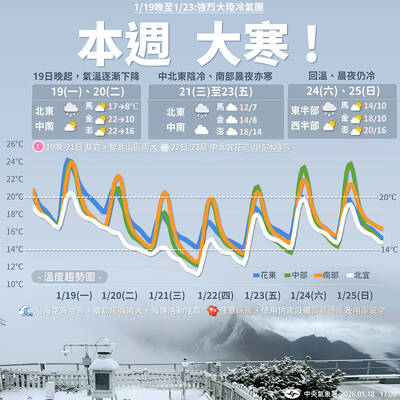
A strong cold air mass is expected to arrive tonight, bringing a change in weather and a drop in temperature, the Central Weather Administration (CWA) said. The coldest time would be early on Thursday morning, with temperatures in some areas dipping as low as 8°C, it said. Daytime highs yesterday were 22°C to 24°C in northern and eastern Taiwan, and about 25°C to 28°C in the central and southern regions, it said. However, nighttime lows would dip to about 15°C to 16°C in central and northern Taiwan as well as the northeast, and 17°C to 19°C elsewhere, it said. Tropical Storm Nokaen, currently
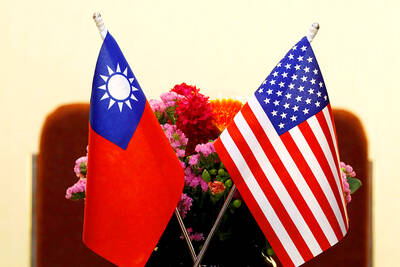
‘NATO-PLUS’: ‘Our strategic partners in the Indo-Pacific are facing increasing aggression by the Chinese Communist Party,’ US Representative Rob Wittman said The US House of Representatives on Monday released its version of the Consolidated Appropriations Act, which includes US$1.15 billion to support security cooperation with Taiwan. The omnibus act, covering US$1.2 trillion of spending, allocates US$1 billion for the Taiwan Security Cooperation Initiative, as well as US$150 million for the replacement of defense articles and reimbursement of defense services provided to Taiwan. The fund allocations were based on the US National Defense Authorization Act for fiscal 2026 that was passed by the US Congress last month and authorized up to US$1 billion to the US Defense Security Cooperation Agency in support of the
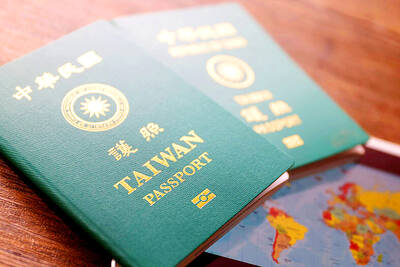
PAPERS, PLEASE: The gang exploited the high value of the passports, selling them at inflated prices to Chinese buyers, who would treat them as ‘invisibility cloaks’ The Yilan District Court has handed four members of a syndicate prison terms ranging from one year and two months to two years and two months for their involvement in a scheme to purchase Taiwanese passports and resell them abroad at a massive markup. A Chinese human smuggling syndicate purchased Taiwanese passports through local criminal networks, exploiting the passports’ visa-free travel privileges to turn a profit of more than 20 times the original price, the court said. Such criminal organizations enable people to impersonate Taiwanese when entering and exiting Taiwan and other countries, undermining social order and the credibility of the nation’s


 RSS
RSS