


Detained Chinese artist and activist Ai Weiwei (艾未未) was allowed to meet his wife at the weekend, breaking six weeks of isolation from his family, and he told her he had not been mistreated or tortured, Ai’s mother said yesterday.
The brief meeting on Sunday afternoon between Ai and his wife, Lu Qing (路青), followed weeks of international controversy since he was detained at Beijing’s international airport on April 3, igniting an outcry about China’s tightening grip on dissent.
Lu was contacted by police officers and taken to meet her husband “for a short while,” Ai’s mother, Gao Ying (高瑛), said by telephone.
Ai, 53, is being investigated on suspicion of economic crimes, which his family has said are an excuse to silence his criticism of the government. Police have not told his wife or other family members of his whereabouts. His detention prompted heavy criticism in the West and European Council President Herman Van Rompuy is expected to raise the 27-nation bloc’s concerns in Beijing this week.
“The fact that Lu Qing could see him was already a very merciful act by the authorities,” Gao said, adding that Ai did not go into details about the charge against him, -except that “he did not understand it. The rumors that we’ve heard about him being tortured have been too much for us to take, but now seeing is believing. His condition is good.”
Lu did not answer multiple calls made to her mobile phone.
Burly, bearded and blunt, Ai, is one of China’s best-recognized contemporary artists. His career encompasses protests for artistic freedom in 1979, provocative works in the 1990s and a role in designing the Bird’s Nest Stadium for the 2008 Beijing Olympics.
Lu did not meet with Ai at a police station, but rather at a location that she was not familiar with, Gao said. The couple sat across a table, with police officers watching them.
“His face was still red and he still has his beard. He didn’t look too skinny,” Gao said, adding that Ai had told Lu he exercised by walking.
Ai has produced work spanning porcelain sunflower seeds to names of earthquake victims scrolling on a computer screen.
Unlike many of his peers, he has waded into political territory and spoken out on everything from last year’s award of the Nobel Peace Prize to Chinese dissident Liu Xiaobo (劉曉波), denounced by authorities, to curbs on the Internet.

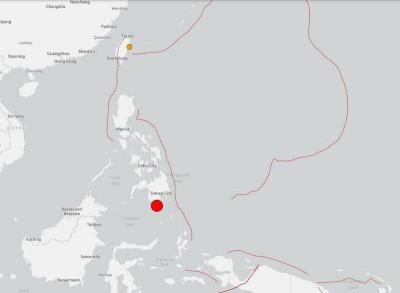
A magnitude 7.8 earthquake struck off the southern coast of Mindanao in the Philippines at 7:38am today, prompting the US Tsunami Warning System to issue an alert for neighboring countries, including Taiwan. The system issued a purple alert indicating a "tsunami threat." The potential threat zone includes Taiwan, the Philippines, Papua New Guinea, Yap and Palau. Philippine authorities were assessing the damage from the quake, with the office of civil defense seeking to verifying initial reports that 15 people had been killed and 129 injured in the region, mostly from falling debris. Arlene Hollero, disaster chief of Maasim town in the Philippines' Sarangani Province,
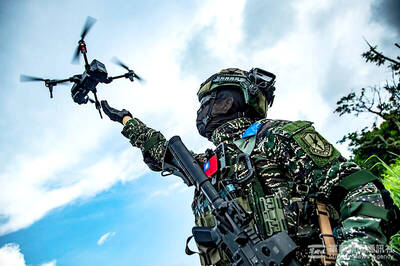
RESILIENCE: Taiwan plays a key role in semiconductors, energy, information infrastructure and advanced manufacturing, AIT Director Raymond Greene said Taiwan’s continued investment in deterrence and resilience remains vital, especially in uncrewed systems and other emerging technologies, American Institute in Taiwan (AIT) Director Raymond Greene said yesterday. Greene made the remarks at the annual National Strategic Summit on Supply Chain Resilience held by the Research Institute for Democracy, Society and Emerging Technology (DSET), a government-backed think tank. As Taiwan last year became the US’ fourth-largest trading partner and supply chain security is becoming more important, cooperation in emerging technologies continues to deepen between the two countries, he said. The US is committed to accelerating innovation, building key infrastructure, strengthening cooperation

The National Chungshan Institute of Science and Technology yesterday showcased its locally developed variants of the Vision 60 robotic patrol dog, which it plans to deploy on the nation’s outlying territories in the South China Sea. The variants were produced under the Joint Lab project — created by the institute and domestic companies — and assembled with domestically produced motors, lenses and artificial intelligence (AI) systems alongside licensed tech from the US, Missile and Rocket Systems Research Division deputy director Jen Kuo-kang (任國光) told the media event at a military base in Taipei’s Dazhi (大直) area. Taiwan has built up its strengths
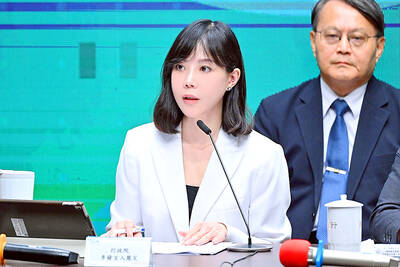
RIGHT DIRECTION: Taiwan’s efforts to prevent forced labor include a proposal to ‘fully prohibit’ employers from withholding workers’ documents, an official said Taiwan is to establish a mechanism to restrict imports of goods linked to forced labor, the Executive Yuan said yesterday, after the US proposed imposing additional tariffs on Taiwanese goods over labor concerns. “The Ministry of Labor and the Ministry of Economic Affairs are to establish an interministerial review procedure,” Executive Yuan spokesperson Michelle Lee (李慧芝) said at a news briefing in Taipei. “The government is to use the Foreign Trade Act [貿易法] as the legal basis to restrict imports of goods produced with forced labor” and bring its supply chain governance more in line with international standards on human rights, resilience


 RSS
RSS