

Taiwanese taekwondo athlete Yang Shu-chun (楊淑君) took the silver medal in the women’s 49kg category at the World Taekwondo Championships yesterday in Gyeongju, South Korea.
Yang recorded impressive victories in her march to the final, but she could not overcome China’s Wu Jingyu (吳靜鈺) and lost 6-2 in the final.
Yang is competing internationally for the first time since being suspended for three months by the World Taekwondo Federation in December last year for staging a sit-down protest and refusing to leave the mat following her disqualification in her opening bout at last year’s Asian Games in Guangzhou, China, on Nov. 17.
Yang told the media before she left for South Korea that she “would not overthink” the situation and would simply concentrate on putting forth her best effort in each bout.
However, she said her ultimate goal is to win at next year’s London Summer Olympics.
Ho Feng-yen (何豐彥), secretary-general of the nation’s taekwondo association, said yesterday that he is optimistic that Yang would win the World Qualification Tournament scheduled for June 30 in Azerbaijan.
He said the fact that Yang reached the finals proved that her techniques are truly on an international level.
Ho also said Yang did not appear at her best in this tournament because she only resumed her training in early March.
Meanwhile, fellow Taiwanese taekwondo competitor Wei Chen-yang (魏辰洋) took the bronze medal in the men’s 58kg category.
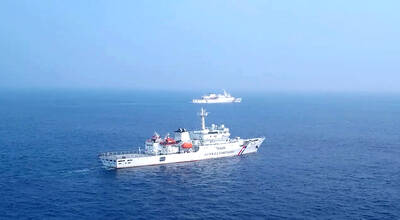
PATROL PARTNERS: The ‘Chiayi’ and the ‘Penghu’ departed for a two-day joint patrol of Palau’s exclusive economic zone, the CGA’s second diplomatic visit to the country The Coast Guard Administration (CGA) set a record for its southernmost deployment of a coast guard vessel as the vessels Chiayi and the Penghu reached Palau’s Pulo Anna Island on Saturday in a cooperative exercise between the two countries. The island, about 217 nautical miles (401km) southwest of Koror in the Palauan state of Sonsorol and 1,220 nautical miles from Taiwan’s southernmost point, Oluanpi (鵝鑾鼻), is the furthest south a CGA vessel has sailed. The two vessels are in Palau for the coast guard’s second diplomatic visit to the country. They docked at Malakal Harbor on Tuesday last week. The coast guard

The government is monitoring online rumors that a pneumonic plague outbreak has spread from Russia into China, and it might enhance quarantine measures, Premier Cho Jung-tai (卓榮泰) said yesterday. During a legislative meeting, Democratic Progressive Party Legislator Wang Ting-yu (王定宇) said that rumors had circulated that the disease had spread across several Chinese provinces. He asked Cho whether the government was prepared to prevent the disease spreading to Taiwan, given the volume of traffic between the two sides, and how concerned the government was about the alleged outbreak. The Ministry of Health and Welfare had implemented border quarantine measures after briefing the Executive
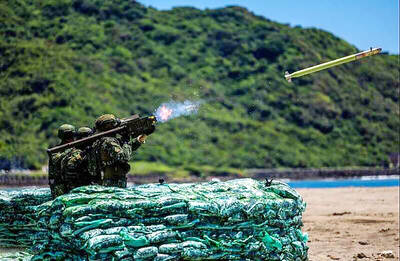
BATCH 1: The military has plans to assign the weapons to the army to defend Taiwan proper, as well as outlying islands and the navy for the Marine Corps, the official said Taiwan is to receive 500 Stinger missiles and 178 launchers from the US by the end of the year, the first batch under a planned two-stage acquisition totaling 2,621 missiles and 763 launchers, a defense official said yesterday on condition of anonymity. The portable missiles would play a vital role in the nation’s air defense capabilities, the source said. The army plans to deploy 2,235 missiles and 657 launchers to defend Taiwan proper and outlying islands, they said, citing military documents. The navy is allotted 295 missiles and 85 launchers to arm the Marine Corps and some surface vessels that lack air defense
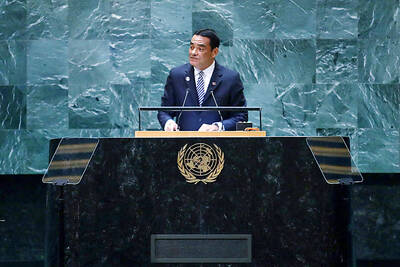
RIGHT TO DIPLOMACY: Under the UN Charter, every state has the right to conduct foreign policy free from external pressure, Belize said in a statement Belize and Paraguay on Monday condemned Beijing sanctions over their countries’ ties with Taiwan, saying China’s actions create unnecessary tensions. Earlier on Monday, Beijing announced sanctions against Paraguayan Minister of Information and Communication Technologies Gustavo Villate and Belizean Minister of Foreign Affairs Francis Fonseca. The Paraguayan Ministry of Foreign Affairs said it rejected the sanctions, writing on X that they created unnecessary friction. It added that it reaffirmed its support for Taiwan and its commitment to democratic values and principles. Villate told the Spanish-language Paraguayan daily ABC Color the sanctions were “predictable” and linked them to several cooperation projects between Taiwan and Paraguay. The projects


 RSS
RSS