


There is growing concern in Washington that the US State Department is withholding approval of Taiwan’s request to upgrade its aging fleet of F-16 fighter planes because some top officials do not want to upset China.
According to insiders, outgoing US Deputy Secretary of State James Steinberg is one of those directly involved in refusing to give final approval.
Steinberg announced earlier this week that he was leaving the government to take a job in academia.
However, he and others are believed to have convinced the White House that Beijing would immediately break off US-China military relations if the multibillion-dollar upgrade package goes ahead.
To avoid Congressional pressure, the US State Department is also said to be delaying a report to Capitol Hill on Taiwan’s airpower that is more than a year late.
The report, approved by the Pentagon, is said to argue that Taiwan’s air force is in desperate need of the upgrades.
News of the situation leaked on Thursday when the Washington Times published an article by security reporter Bill Gertz.
It said that the delay of the Taiwan airpower report was prompting at least one unnamed senator to threaten the nomination of Mark Lippert — a personal friend of US President Barack Obama — as the new assistant defense secretary for Asian and Pacific security affairs.
According to the Washington Times, Lippert’s nomination may not be approved by the Senate until the report on Taiwan’s airpower is submitted to Congress.
That report is expected to in turn trigger Congressional support for the US$4 billion F-16 upgrades, which include new electronics, engines and missiles.
Taiwan has 145 of the US-made F-16 fighters.
The Obama administration has said in the past that as a matter of policy, pressure from China would not be allowed to influence decisions on arms sales to Taiwan.
Beijing has twice cut off military relations with the Pentagon — most recently in January last year — over US arms sales to Taiwan.
The Washington Times said: “The Obama administration and Defense Secretary Robert M Gates have made improving military relations with China a key element of its military diplomacy. China’s leaders, according to defense officials, have exploited that desire by trying to hold military exchanges hostage and forcing an end of arms sales.”
US State Department spokesman Mark Toner denied that the report on Taiwan’s airpower and the F-16 upgrade sale are being delayed.
He said: “Ever since the Taiwan Relations Act was passed, the entire interagency has been and continues to be involved in the ongoing process to evaluate Taiwan’s defense needs, which informs the US government’s decisions on foreign military sales to Taiwan.”
In Taipei, when asked by press for comment on the information that the arms package for Taiwan to upgrade its F-16A/B fighter jets has been delayed, Minister of Foreign Affairs Timothy Yang (楊進添) said yesterday that the ministry was not aware of the reported delay.
“The related US administrative agencies, the Pentagon, State Department, National Security Council and Congress, are still in the process of evaluating the case. I don’t think it was [held up],” Yang said.
Yang said the US has been clear that Taiwan needs to replace its aging air force and that cross-strait rapprochement should be put in the context of Taiwan having better relations with its traditional friends, the US and Japan.
“I have been saying that we wanted to avoid every possibility of military conflict in the Strait by means of negotiation. During the negotiations, Taiwan needs lots of support from our traditional friends so that we do not enter the negotiations from a weak position and to give the Taiwanese confidence,” Yang said.
The US could support the peaceful development of cross-strait relations by selling Taiwan sufficient weapons for defense, he added.
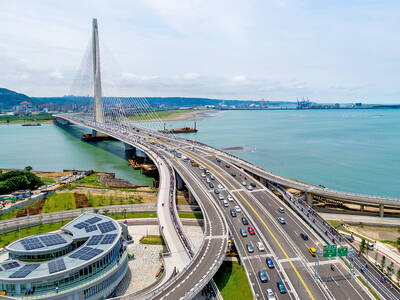
The Ministry of Transportation and Communications yesterday inaugurated the Danjiang Bridge across the Tamsui River in New Taipei City, saying that the structure would be an architectural icon and traffic artery for Taiwan. Feted as a major engineering achievement, the Danjiang Bridge is 920m long, 211m tall at the top of its pylon, and is the longest single-pylon asymmetric cable-stayed bridge in the world, the government’s Web site for the structure said. It was designed by late Iraqi-British architect Zaha Hadid. The structure, with a maximum deck of 70m, accommodates road and light rail traffic, and affords a 200m navigation channel for boats,
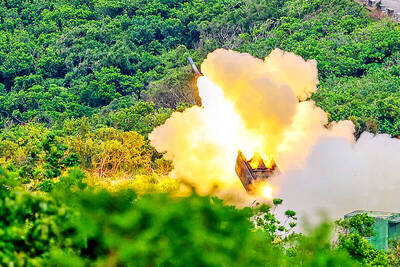
PRECISION STRIKES: The most significant reason to deploy HIMARS to outlying islands is to establish a ‘dead zone’ that the PLA would not dare enter, a source said A High Mobility Artillery Rocket System (HIMARS) would be deployed to Penghu County and Dongyin Island (東引) in Lienchiang County (Matsu) to force the Chinese military to retreat at least 100km from the coastline, a military source said yesterday. Taiwan has been procuring HIMARS and Army Tactical Missile Systems (ATACMS) from the US in batches. Once all batches have been delivered, Taiwan would possess 111 HIMARS units and 504 ATACMS, which have a range of 300km. Considering that “offense is the best defense,” the military plans to forward-deploy the systems to outlying islands such as Penghu and Dongyin so that

Taiwan Semiconductor Manufacturing Co (TSMC, 台積電), the world’s largest foundry service provider, yesterday said that global semiconductor revenue is projected to hit US$1.5 trillion in 2030, after the figure exceeds US$1 trillion this year, as artificial intelligence (AI) demand boosts consumption of token and compute power. “We are still at the beginning of the AI revolution, but we already see a significant impact across the whole semiconductor ecosystem,” TSMC deputy cochief operating officer Kevin Zhang (張曉強) said at the company’s annual technology symposium in Hsinchu City. “It is fair to say that in the past decade, smartphones and other mobile devices were
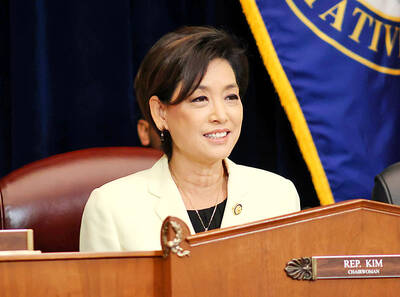
‘CLEAR MESSAGE’: The bill would set up an interagency ‘tiger team’ to review sanctions tools and other economic options to help deter any Chinese aggression toward Taiwan US Representative Young Kim has introduced a bill to deter Chinese aggression against Taiwan, calling for an interagency “tiger team” to preplan coordinated sanctions and economic measures in response to possible Chinese military or political action against Taiwan. “[Chinese President] Xi Jinping [習近平] has directed the People’s Liberation Army to be ready to invade Taiwan by 2027. China has a plan. America should have one too,” Kim said in a news release on Thursday last week. She introduced the “Deter PRC [People’s Republic of China] aggression against Taiwan act” to “ensure the US has a coordinated sanctions strategy ready should


 RSS
RSS