


Criticism of an article by George Washington University professor Charles Glaser in the current issue of Foreign Affairs magazine was evident yesterday, as rebuttals to his article were published in two influential publications.
Writing in The Diplomat, James Holmes and Toshi Yoshihara, both associate professors of strategy at the US Naval War College, said that ceding territory to land-hungry powers was a “morally bankrupt enterprise” that can only represent a temporary fix.
In an article titled “Will China’s Rise Lead to War? Why Realism Does Not Mean Pessimism,” Glaser said that to avoid a costly arms race between the US and China and to ensure Beijing’s cooperation on a number of disputes in Asia, Washington should accommodate Beijing by backing away from its security commitment to Taiwan.
Glaser further said that when a power has “limited territorial goals,” meeting those demands might not lead to further demands, but rather reduced tensions.
“But buying peace with land has been tried many times before — with ephemeral results at best,” Holmes and Yoshihara wrote of Glaser’s grand bargain in their article “Getting Real About Taiwan.”
Glaser’s position is based on the view that “structural forces” in the Asia-Pacific region are limiting friction between major powers — in this case, the US, China, Japan and India. As such, Washington and Beijing should be in a position to reach arrangements through mutual concessions, a position the authors appear to agree on.
“The United States should make every effort to enlist China as co-guarantor of the international system over which it has presided since 1945 — a system that benefits all stakeholders in globalization, including China and fellow Asian nations,” Holmes and Yoshihara wrote.
While Washington should not pay any price for an Asia-Pacific entente, Holmes and Yoshihara wrote, “Glaser apparently would. He terms Taiwan a ‘less-than-vital’ US interest. In international relations-speak, that means an interest for which the United States shouldn’t fight.”
“The island and its residents — US friends of long standing — would be the most obvious casualty of this effort to create a new normal in East Asia,” they wrote, adding that sympathy for stricken friends aside, morality should not be the only consideration for the US.
“It’s far from clear that trading the island away would stabilize broader Sino-US relations or Asian security,” they wrote. “Taiwan has long served as a literal and figurative cork in China’s bottle, riveting Beijing’s attention on the cross-strait stalemate while complicating north-south movement along the Asian seaboard and access to the Western Pacific.”
Uncorking that bottle, Holmes and Yoshihara wrote, would effectively free up resources for China to pursue “broader regional aims” and thereby increase tensions in the region.
“Japan and South Korea would feel the effects once Beijing stationed naval and air forces on the island, turning their southern flank and imposing control of adjacent seas and skies,” they wrote. “All Northeast Asian nations depend on the seas to convey imports and exports to and from their seaports … absolute control of China’s economic lifelines equates to a stranglehold over the maritime-dependent Japanese and Korean economies.”
The authors said that Seoul and Tokyo would find little solace in the US nuclear umbrella and would likely respond by building up their own militaries, thus adding to risks of contact and friction in the region.
Exacerbating those tensions is the fact that “history amply demonstrates that new territorial acquisitions encourage statesmen to seek forward defences for their valuable new holdings,” they wrote, saying that efforts by the British empire to create a defensive buffer for India drove British policy in Central Asia and sparked the “Great Game” with imperial Russia.
Meanwhile, writing in the Wall Street Journal, US-Taiwan Business Council president Rupert Hammond-Chambers said the recent announcement that Beijing would ramp up its military spending by 12.7 percent this year was a reminder that Washington cannot ignore democratic Taiwan.
As with Holmes and Yoshihara, Hammond-Chambers said there were both moral and strategic reasons for standing by its ally, pointing to the partnerships on research, design and manufacturing technology between Taiwan and the US upon which US companies have come to rely.
“The recent severing of Chinese rare earth exports to Japan should focus minds on supply-chain security and how reliable we feel our business partners are, particularly when intellectual property is involved,” he wrote in an article titled “Time to Straighten Out America’s Taiwan Policy.”
Turning to Glaser’s argument, Hammond-Chambers said it was predicated on the false assumption that Taiwan is “the only potential irritant” in Washington’s relations with Beijing and that other points of contention, such as forward deployments, North Korea, Tibet and others somehow all stemmed from disagreement over Taiwan.
“The notion that China would become more pliant to U.S. concerns and demands or that war would be less likely should we step aside and allow China to annex Taiwan does not hold water,” he wrote.
“Taiwan’s strategic geographic position is an essential link in the first island chain of defense and provides Japan and to a lesser extent [South] Korea important security guarantees,” he wrote, adding that “ceding” Taiwan would result in “a recalibration of Japan and [South] Korea’s security posture including the possibility of Japan developing nuclear weapons.”
Such a move would also “open the western Pacific to China’s increasingly robust blue-water navy whose global role China still has yet to explain,” he wrote.
Rather than abandon Taiwan, Hammond-Chambers wrote that peaceful relations between Beijing and Taipei, which should be encouraged, are most attainable when both sides come to the table from relatively strong positions. For this, Taiwan must be able to count on the continuation of security guarantees provided by the US and an expansion of the bilateral relationship, he wrote.
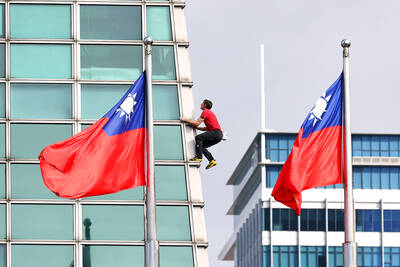
DAREDEVIL: Honnold said it had always been a dream of his to climb Taipei 101, while a Netflix producer said the skyscraper was ‘a real icon of this country’ US climber Alex Honnold yesterday took on Taiwan’s tallest building, becoming the first person to scale Taipei 101 without a rope, harness or safety net. Hundreds of spectators gathered at the base of the 101-story skyscraper to watch Honnold, 40, embark on his daredevil feat, which was also broadcast live on Netflix. Dressed in a red T-shirt and yellow custom-made climbing shoes, Honnold swiftly moved up the southeast face of the glass and steel building. At one point, he stepped onto a platform midway up to wave down at fans and onlookers who were taking photos. People watching from inside
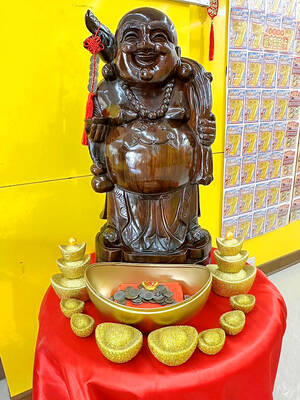
A Vietnamese migrant worker yesterday won NT$12 million (US$379,627) on a Lunar New Year scratch card in Kaohsiung as part of Taiwan Lottery Co’s (台灣彩券) “NT$12 Million Grand Fortune” (1200萬大吉利) game. The man was the first top-prize winner of the new game launched on Jan. 6 to mark the Lunar New Year. Three Vietnamese migrant workers visited a Taiwan Lottery shop on Xinyue Street in Kaohsiung’s Gangshan District (崗山), a store representative said. The player bought multiple tickets and, after winning nothing, held the final lottery ticket in one hand and rubbed the store’s statue of the Maitreya Buddha’s belly with the other,
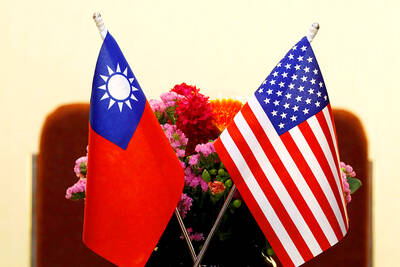
‘NATO-PLUS’: ‘Our strategic partners in the Indo-Pacific are facing increasing aggression by the Chinese Communist Party,’ US Representative Rob Wittman said The US House of Representatives on Monday released its version of the Consolidated Appropriations Act, which includes US$1.15 billion to support security cooperation with Taiwan. The omnibus act, covering US$1.2 trillion of spending, allocates US$1 billion for the Taiwan Security Cooperation Initiative, as well as US$150 million for the replacement of defense articles and reimbursement of defense services provided to Taiwan. The fund allocations were based on the US National Defense Authorization Act for fiscal 2026 that was passed by the US Congress last month and authorized up to US$1 billion to the US Defense Security Cooperation Agency in support of the

‘COMMITTED TO DETERRENCE’: Washington would stand by its allies, but it can only help as much as countries help themselves, Raymond Greene said The US is committed to deterrence in the first island chain, but it should not bear the burden alone, as “freedom is not free,” American Institute in Taiwan Director Raymond Greene said in a speech at the Institute for National Defense and Security Research’s “Strengthening Resilience: Defense as the Engine of Development” seminar in Taipei yesterday. In the speech, titled “Investing Together and a Secure and Prosperous Future,” Greene highlighted the contributions of US President Donald Trump’s administration to Taiwan’s defense efforts, including the establishment of supply chains for drones and autonomous systems, offers of security assistance and the expansion of


 RSS
RSS