


US President Barack Obama gave Americans a sign of how he’ll lead the country in the run up to next year’s election, as he used his State of the Union address to stake out ground in the political center and call on Republicans and Democrats to work together to revive the US economy.
The nationally televised speech on Tuesday night was Obama’s first appearance before Congress since opposition Republicans took control of the House of Representatives earlier this month. It marked the midpoint of his presidential term, as he rebounds from the Democrats’ electoral defeat in November. The speech also came as he begins positioning himself for next year’s re-election campaign.
Obama kept the focus on the economy, calling for both parties to unite behind his program of cuts and spending, saying: “We will move forward together or not at all.”
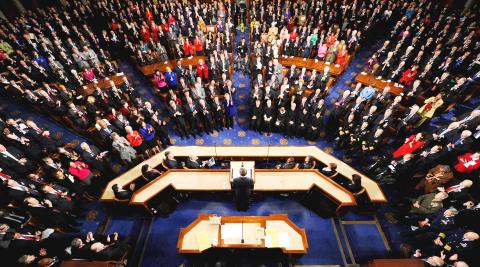
PHOTO: AFP
He proposed no major initiatives comparable to the health care overhaul that dominated the first two years of his presidency, instead outlining an agenda aimed at both ends of the political spectrum.
For Democrats, he defended his health care plan, opposed privatization of the Social Security pension program and called for ending tax cuts for the rich. He also proposed a burst of spending on education, research, technology and transportation to make the US more competitive with emerging economic powers like China and India.
However, Obama also backed some top priorities of Republicans. He called for freezing some federal spending, cutting the corporate tax rate, shaking up the federal government and eliminating lawmakers’ pet projects.
Though Obama won some cheers from Republicans, they remain dissatisfied with his efforts to cut the deficit, their core issue.
House Budget Committee Chairman Paul Ryan, giving the official Republican response, said the US was at “a tipping point” leading to a dire future if federal deficits aren’t trimmed.
Obama spoke to a television audience in the millions and a Congress sobered by the assassination attempt against one if its own members, Gabrielle Giffords. She was seriously wounded in the shooting rampage in Tucson, Arizona, that killed six people. Her seat sat empty.
Obama entered the House chamber to prolonged applause, and to the unusual sight of Republicans and Democrats seated next to one another rather than on different sides of the center aisle, in a show of support and civility following Giffords’ shooting. And he began on a graceful note, taking a moment to congratulate John Boehner, the new Republican speaker of the House.
Calling for a new day of cooperation, Obama said: “What comes of this moment will be determined not by whether we can sit together tonight but whether we can work together tomorrow.”
In a speech with little focus on national security, Obama appeared to close the door on keeping any significant US military presence in Iraq beyond the end of the year.
“This year, our civilians will forge a lasting partnership with the Iraqi people while we finish the job of bringing our troops out of Iraq,” he said.
The president reiterated his call for a comprehensive immigration bill, although there appears little appetite for it in Congress.

A signaling system malfunction disrupted high-speed rail (HSR) services beginning at 8am today, with trains temporarily reduced to three northbound and three southbound trains per hour as authorities conduct inspections. The malfunction occurred on a section of track in Miaoli County during pre-operation checks early this morning, forcing northbound and southbound trains to use a single track, the HSR operator said. The regular schedule has been replaced with three hourly trains offering only nonreserved seating in each direction, stopping at every station, it said, adding that business class cars would still have reserved seating. Departures from terminal stations are scheduled at the top

DRONE CENTRAL: Taiwan aims to become Asia’s democratic hub for drones, with most exports focused on high-quality military-grade models, an official said Taiwan’s drone industry is expected to expand significantly by 2030, producing 100,000 units per month and exporting half of them, the Ministry of Economic Affairs said yesterday. Current drone production capacity is about 15,000 units per month, but the industry can quickly scale up as demand increases, Industrial Development Administration Director-General Chiou Chyou-huey (邱求慧) told a news conference in Taipei. Taiwan’s drone output grew 2.5-fold last year to NT$12.9 billion (US$408.3 million) under a government program to develop the uncrewed vehicle sector, he said. The Executive Yuan in October last year approved plans to invest NT$44.2 billion into domestic production of uncrewed aerial

VERBOSE VESSELS: A CGA cutter and a China Coast Guard exchanged verbal barbs for more than a day in Taiwanese-controlled waters before the Chinese vessel left The Taiwanese and Chinese coast guards had a standoff near the strategically located Pratas Islands (Dongsha Islands, 東沙群島) in the north of the South China Sea, the Coast Guard Administration (CGA) said yesterday. The two sides engaged in intense radio exchanges over sovereignty claims during the 33-hour standoff. China Coast Guard vessel 3501 eventually left the restricted waters, 26.6 nautical miles (49.2km) west of the Pratas Islands, at 5pm yesterday, the CGA said. Lying approximately between southern Taiwan and Hong Kong, the Taiwan-controlled Pratas are seen by some security experts as vulnerable to Chinese attack due to their distance — more than
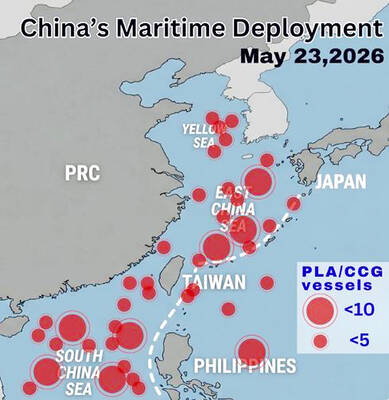
WARNING: China should stop engaging in actions that undermine regional peace and stability, as it would only build resentment among people across the Strait, the CGA said China has deployed more than 100 navy, coast guard and other vessels in waters from the Yellow Sea to the South China Sea and the western Pacific since US President Donald Trump and Chinese President Xi Jinping (習近平) met in Beijing, National Security Council Secretary-General Joseph Wu (吳釗燮) said yesterday. “In this part of the world, #China is the one & only PROBLEM wrecking the #StatusQuo & threatening regional peace & stability,” Wu wrote on X. In a separate post, he said Beijing was coercing Taiwan’s maritime domain, calling it illegal and provocative, after the Coast Guard Administration (CGA) expelled a


 RSS
RSS