


Heavy snow and frigid temperatures caused further disruption across northern Europe yesterday — stranding travelers, snarling traffic and shutting schools. More than 1,000 flights at Germany’s main airports in Frankfurt, Munich and Berlin were canceled and many more delayed after up to 40cm of fresh snow blanketed the country. Some 500 stranded passengers slept on cots at Frankfurt airport.
Airlines advised passengers to switch to trains if possible after the new snow added to two week’s worth of accumulation, but rail operator Deutsche Bahn, struggling to cope with packed trains and a crush of passengers, urged passengers to stay home.
Tempers flared as Germans accustomed to timely trains and planes were forced to wait in freezing stations or packed terminals, as the unusually heavy snow delayed millions of commuters.
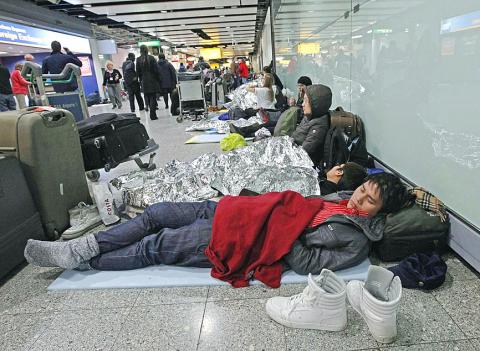
PHOTO: REUTERS
“The trains are always too late now,” said Lothar Ast, 57, a custodian shivering in a Berlin station. “They’re so crowded that you can’t get on and then you have to wait for another.”
Dorothea Fuerst, a Berlin sales clerk, added: “No one knows if the train will come or not. The train never arrives on time. Will it be 15 minutes or half an hour? That’s the question.”
Children’s sledges were sold out in Germany, retailers said.
“This much snow is only fun if you’re a kid,” Berlin lawyer Katja-Julia Fischer, 42, said. “It’s getting on my nerves.”
Germany’s most populous state, North-Rhine Westphalia, took the unusual step of banning trucks from motorways in a bid to keep passenger traffic rolling. A rail worker was killed in Berlin, run over by a train while trying to de-ice a switch.
Belgium also closed its motorways to truck traffic after there was a peak of 600km of traffic jams at the height of the rush hour yesterday morning in the Wallonia region.
In the UK, British Airways said the severe weather continued to cause significant disruption to operations. Only one of two runways at London Heathrow was operating after a snowstorm paralyzed the airport over the weekend, stranding thousands.
Other UK airports were open, but many flights were canceled or subject to long delays, and many passengers spent a second night at an airport terminal.
“There is the risk of further snow across parts of southern Britain tonight and through tomorrow,” Met Office chief forecaster Steve Willington said.
Northern France was also covered by heavy snow, disrupting road and rail traffic as Parisians braved clogged highways to reach their holiday destinations. Air travel was reduced at Paris’ two main airports, with Orly airport shutting down briefly and stranded travelers still camping out at Charles de Gaulle.
Train travel between Paris, London and Brussels on the Eurostar line was disrupted, partly because of speed restrictions, the company said on its Web site, adding that sales were closed for travel up to and including Friday.
In Poland, six people froze to death on Sunday night, raising the death toll to 114 in the last month.
Heavy snow also snarled Warsaw traffic again yesterday.
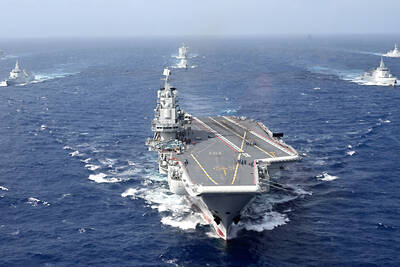
PROVOCATIVE: Chinese Deputy Ambassador to the UN Sun Lei accused Japan of sending military vessels to deliberately provoke tensions in the Taiwan Strait China denounced remarks by Japan and the EU about the South China Sea at a UN Security Council meeting on Monday, and accused Tokyo of provocative behavior in the Taiwan Strait and planning military expansion. Ayano Kunimitsu, a Japanese vice foreign minister, told the Council meeting on maritime security that Tokyo was seriously concerned about the situation in the East China and South China seas, and reiterated Japan’s opposition to any attempt to change the “status quo” by force, and obstruction of freedom of navigation and overflight. Stavros Lambrinidis, head of the EU delegation to the UN, also highlighted South China Sea
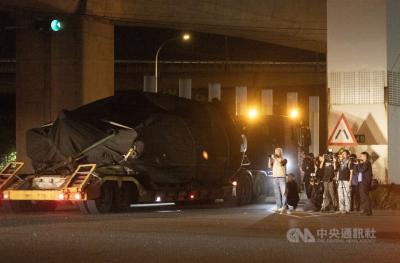
The final batch of 28 M1A2T Abrams tanks purchased from the US arrived at Taipei Port last night and were transported to the Armor Training Command in Hsinchu County’s Hukou Township (湖口), completing the military’s multi-year procurement of 108 of the tanks. Starting at 12:10am today, reporters observed more than a dozen civilian flatbed trailers departing from Taipei Port, each carrying an M1A2T tank covered with black waterproof tarps. Escorted by military vehicles, the convoy traveled via the West Coast Expressway to the Armor Training Command, with police implementing traffic control. The army operates about 1,000 tanks, including CM-11 Brave Tiger
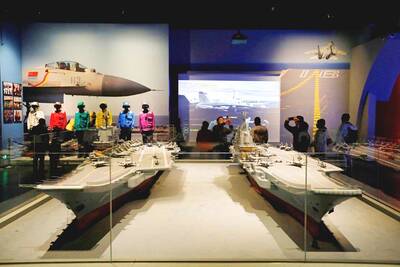
China on Wednesday teased in a video an aircraft carrier that could be its fourth, and the first using nuclear power, while making an allusion to Taiwan and vowing to further build up its islands, as it looks to boost maritime power, secure resources and bolster territorial claims. The video, issued on the eve of the 77th founding anniversary of the Chinese People’s Liberation Army Navy, featured fictional officers with names that are homophones of three commissioned aircraft carriers, the Liaoning (遼寧), Shandong (山東) and Fujian (福建). Titled Into the Deep, it showed a 19-year-old named “Hejian” (何劍) joining the group, sparking
Taiwan Semiconductor Manufacturing Co (TSMC, 台積電), the world’s largest contract chipmaker, said it expects its 2-nanometer (2nm) chip capacity to grow at a compound annual rate of 70 percent from this year to 2028. The projection comes as five fabs begin volume production of 2-nanometer chips this year — two in Hsinchu and three in Kaohsiung — TSMC senior vice president and deputy cochief operating officer Cliff Hou (侯永清) said at the company’s annual technology symposium in Silicon Valley, California, last week. Output in the first year of 2-nanometer production, which began in the fourth quarter of last year, is expected to


 RSS
RSS