


The US government has expressed serious concern over the fact that the Economic Cooperation Framework Agreement (ECFA) documents signed by Taiwan and China in June have yet to be submitted to the WTO as promised, Taiwan’s envoy to Washington said yesterday.
“Sending a notification about the ECFA to the WTO is the right thing to do,” Taiwan’s Representative to the US Jason Yuan (袁健生) told Democratic Progressive Party Legislator Huang Wei-cher (黃偉哲) at the legislature’s Foreign and National Defense Committee.
Huang had asked Yuan how he had explained to the US government that Taiwan had yet to notify the WTO of the EFCA, as promised by President Ma Ying-jeou (馬英九).
Ma made the promise during a July 1 press conference at the Presidential Office.
Yuan said he had conveyed US concerns to Taipei, adding that he did not know what had delayed the process of notification.
“The ECFA has to be consistent with the spirit enshrined in the WTO” and in line with the meaning attached to the accord, in that it must allow for the greater internationalization of Taiwan, Yuan said.
A Ministry of Economic Affairs official said in August that the ministry would handle the translation into English of the ECFA documents to be submitted to the WTO. Taipei would then notify Beijing of its English version to ensure there are no discrepancies between the translations before each side submitted its English version to the WTO, the official said.
On Nov. 30, American Institute in Taiwan Chairman Raymond Burghardt urged Taiwan to deliver on its promise in a speech in Taipei.
“Now that the agreement is in force, we encourage the parties [Taiwan and China] to notify the WTO of the ECFA in a manner consistent with the requirements for agreements that cover substantially all trade. We will be closely observing the ECFA process as it moves forward,” Burghardt said.
Honigmann Hong (洪財隆), an adjunct assistant professor of economics at National Tsing Hua University’s Center for Contemporary China, said the WTO Secretariat must be notified of the ECFA before Jan. 1, the date on which the “early harvest” program on tariff cuts contained in the deal comes into force.
WTO regulations require that members entering regional or bilateral trade agreements fulfill the “obligation of transparency” before commencement of the deals, Hong said.
To ensure compliance with WTO standards, once the WTO is notified of such agreements, signatories are required to take questions on the agreement from other WTO members, while the WTO Secretariat will present a detailed analysis of the agreement or factual presentation within a year, he said.
If the WTO were not notified of the ECFA, it would give substance to the fears held by some that trade between Taiwan and China is regarded as an “internal Chinese affair,” Hong said.
ADDITIONAL REPORTING BY STAFF WRITER
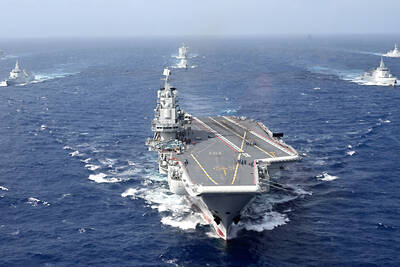
PROVOCATIVE: Chinese Deputy Ambassador to the UN Sun Lei accused Japan of sending military vessels to deliberately provoke tensions in the Taiwan Strait China denounced remarks by Japan and the EU about the South China Sea at a UN Security Council meeting on Monday, and accused Tokyo of provocative behavior in the Taiwan Strait and planning military expansion. Ayano Kunimitsu, a Japanese vice foreign minister, told the Council meeting on maritime security that Tokyo was seriously concerned about the situation in the East China and South China seas, and reiterated Japan’s opposition to any attempt to change the “status quo” by force, and obstruction of freedom of navigation and overflight. Stavros Lambrinidis, head of the EU delegation to the UN, also highlighted South China Sea
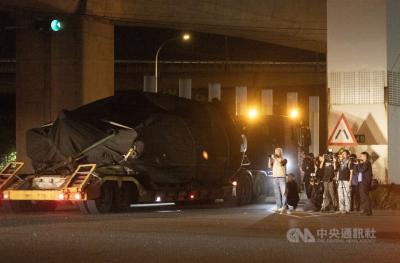
The final batch of 28 M1A2T Abrams tanks purchased from the US arrived at Taipei Port last night and were transported to the Armor Training Command in Hsinchu County’s Hukou Township (湖口), completing the military’s multi-year procurement of 108 of the tanks. Starting at 12:10am today, reporters observed more than a dozen civilian flatbed trailers departing from Taipei Port, each carrying an M1A2T tank covered with black waterproof tarps. Escorted by military vehicles, the convoy traveled via the West Coast Expressway to the Armor Training Command, with police implementing traffic control. The army operates about 1,000 tanks, including CM-11 Brave Tiger
Taiwan Semiconductor Manufacturing Co (TSMC, 台積電), the world’s largest contract chipmaker, said it expects its 2-nanometer (2nm) chip capacity to grow at a compound annual rate of 70 percent from this year to 2028. The projection comes as five fabs begin volume production of 2-nanometer chips this year — two in Hsinchu and three in Kaohsiung — TSMC senior vice president and deputy cochief operating officer Cliff Hou (侯永清) said at the company’s annual technology symposium in Silicon Valley, California, last week. Output in the first year of 2-nanometer production, which began in the fourth quarter of last year, is expected to
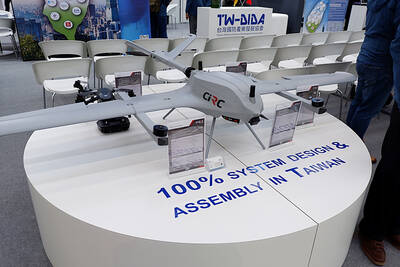
Taiwan’s drone exports surged past US$100 million in the first quarter, exceeding last year’s full-year total, with the Czech Republic emerging as the largest buyer, the Ministry of Economic Affairs said. Exports of complete drones reached US$115.85 million in the period, about 1.2 times the total recorded for all of last year, the ministry said in a report. Exports to the Czech Republic accounted for about US$100 million, far outpacing other markets. Poland, last year’s top destination, recorded about US$11.75 million in the first quarter. Taiwan’s drone exports have expanded rapidly in the past few years, with last year’s total


 RSS
RSS