


China yesterday denounced a visit by two local Japanese lawmakers to disputed islands in the East China Sea at the heart of a territorial row between Asian nations.
The chain of isles, known as the Diaoyutais (釣魚台) in Taiwan, Diaoyu in China and Senkaku in Japan, are claimed by Taiwan, China and Japan. Chinese Foreign Ministry spokeswoman Jiang Yu (姜瑜) said they have been an integral part of China since ancient times.
“The misdeed by the two local Japanese representatives violates China’s territorial integrity,” Jiang said in the statement on the ministry’s Web site. “China has made a solemn representation and a strong protest to Japan.”
The lawmakers, who went to the islands by boat on Friday, are members of the Ishigaki city council in Okinawa, Japanese broadcaster Fuji TV said. Japan considers Ishigaki city responsible for the administration of the uninhabited isles.
Japan’s policy is not to allow anyone to land on the islands, Japan’s Chief Cabinet Secretary Yoshito Sengoku told reporters on Friday, adding that the coast guard was looking into it.
Hitoshi Nakama and Yoichi Minosoko, members of the municipal assembly of Ishigaki, Okinawa Prefecture, were on Minami Kojima in the East China Sea for around 40 minutes early on Friday, Jiji Press and Kyodo News said.
Television footage showed Nakama, 61, and Minosoko, 29, swimming from their fishing boat in life vests to reach the island.
Nakama and Minosoko were quoted by Jiji Press as saying they felt they needed to make the visit as assemblymen in the district supervising the islands.

The Tourism Administration yesterday announced that it would reward repeat international visitors with incentives of up to NT$8,000 to boost inbound tourism. The incentives are available to all international tourists, it said, adding that repeat visitors would be rewarded with NT$5,000 and would receive an additional NT$3,000 if they bring travel companions. The nation received 2,990,657 inbound visitors during the first quarter, marking a 3.8 percent increase from the same period last year, agency data showed. Japanese nationals are among groups visiting Taiwan the most. About 1.48 million Japanese tourists arrived last year, a year-on-year increase of more than 12

66 FIGHTER JETS: The aircraft is likely undergoing preparations for its transfer to Taiwan — a significant step forward in the nation’s modernization program, a lawmaker said The first of Taiwan’s order of F-16V Block 70 aircraft has been sighted in Texas ahead of delivery, Democratic Progressive Party (DPP) Legislator Wang Ting-yu (王定宇) said. Taiwan’s first F-16V Block 70 two-seat aircraft, tail number 6831, was seen flying from Lockheed Martin’s production facility in Greenville, South Carolina, to Naval Air Station Joint Reserve Base Fort Worth in Texas, Wang wrote on Facebook yesterday. The plane is likely undergoing preparations for its transfer to Taiwan, marking a significant step forward in the Republic of China Air Force’s modernization program, Wang said, citing military analysts. The F-16V Block 70 is a new-build version

‘BRAZEN’: The holiday did not stop China from activities that infringe on Taiwan’s maritime jurisdiction, but the CGA is ready to defend the nation, Kuan Bi-ling said Beijing is intensifying maritime pressure on Taiwan, but the nation will never yield, Ocean Affairs Council Deputy Minister Sung Chen-en (宋承恩) said. The Coast Guard Administration (CGA) has adopted a “shadowing and monitoring” approach to avoid falling into a Chinese trap to escalate tensions and deepen the conflict, Sung said in an interview published yesterday in the Chinese-language Liberty Times (the Taipei Times’ sister newspaper). China Coast Guard formations patrolling waters east of Taiwan, as well as official Chinese vessels entering areas around Itu Aba Island (Taiping Island, 太平島) and Pratas Islands (Dongsha Islands, 東沙群島) show Beijing’s attempts to significantly step up
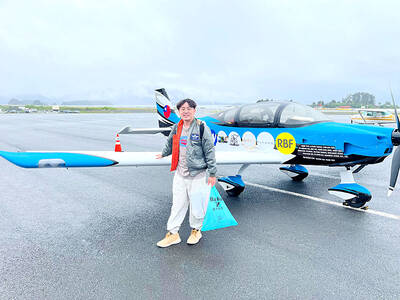
Taiwanese aviator Roger Lin (林睿哲) returned to Taiwan on Saturday after completing a nine-day round-the-world journey in a single-engine aircraft, becoming the first Taiwanese pilot to achieve the feat. Lin departed on June 5 from Los Angeles, California, and continued through Alaska, Japan, Taiwan, the Philippines, Indonesia, Malaysia, Thailand, Nepal, Jordan, Norway, Iceland and Canada before landing at the Taipei International Airport (Songshan) via Los Angeles and Japan. Lin shared numerous photos and videos of his journey on a Facebook page titled “Pilot Roger’s Around the World Flight,” including a video showing his aircraft flying over the Danjiang Bridge and


 RSS
RSS