


The suspected gunman in the shooting of Chinese Nationalist Party (KMT) Central Committee member Sean Lien (連勝文) has told investigators that it was a case of mistaken identity and that he was aiming for a KMT politician — claims that have allegedly been corroborated by two polygraph tests, reports said yesterday.
Citing unspecified sources, the Chinese-language United Daily News (UDN) reported yesterday that based on two lie detector tests administered by police over the weekend, “it was almost certain” that the shooting was a case of mistaken identity.
The newspaper said the suspect, Lin Cheng-wei (林正偉) — also known as Ma Mien (馬面) — told investigators he was involved in a land dispute with members of KMT Taipei County Deputy Speaker Chen Hung-yuan’s (陳鴻源) family. This version of events, the newspaper reported, was confirmed by the lie detector tests and “several witnesses.”
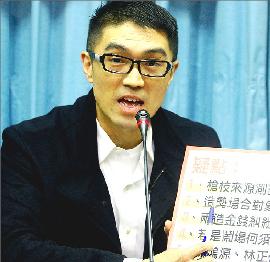
PHOTO: CNA
Sean Lien was shot at the rally for Chen the night before the special municipality elections on Nov. 27.
Lin told investigators Chen still owed him a large sum of money and that he brought the pistol to the election rally to “vent his anger.” During questioning by police, Lin insisted that he mistook Lien, a son of former vice president Lien Chan (連戰), for Chen and fired the gun into his face, the UDN report said.
The Banciao District Prosecutors’ Office has confirmed that two polygraph tests were administered over the weekend and that four witnesses have so far been questioned. However, it said that those were preliminary findings and additional evidence was required before the investigation could be closed.
“[Prosecutors] are still actively working toward understanding the suspect’s motives for the crime and whether any other accomplices were involved,” the office said in a statement yesterday.
The shooting initially gave rise to speculation that it was staged by KMT politicians, coming as it did just hours before the special municipality elections, in which the KMT retained the three special municipalities of Taipei City, Sinbei City and Greater Taichung, while the Democratic Progressive Party (DPP) kept two — Greater Tainan and Greater Kaohsiung.
Just after the shooting, some members of the KMT and the pan-blue media, hinting that the DPP may have been behind the shooting, told the electorate to say “no to violence” through their vote the next day.
Politicians from both parties, as well as the media, have been engaged in a bitter dispute over whether the shooting, which left a 29-year-old bystander dead, had an impact on the outcome of the elections.
KMT lawmakers yesterday called on investigators to release some of the evidence to the public, including seized video footage of the incident, saying it would help dispel doubts over whether the former vice president’s son was the intended target.
Sean Lien, who has since made a steady recovery and was discharged from hospital on Sunday night, maintains he was the intended target of his attacker.
“Sean Lien believes in his heart that the shooter came solely for him,” KMT Legislator Hsieh Kuo-liang (謝國樑) told a press conference, held after he met the victim earlier in the morning.
Releasing the video footage would clear up any misconceptions, he said.
On comments reportedly made by Sean Lien that he heard the shooter call out his name prior to pulling the trigger, Hsieh said he could have misheard because dozens of other supporters were yelling his name at the time.
The shooting occurred just as Sean Lien was being introduced at the campaign event.
Also supporting the possibility of mistaken identity, KMT Legislator Lin Te-fu (林德福), who was present at the scene, said Sean Lien was shot just as he had walked up to the stage after swapping seats with the deputy speaker.
Standing center stage, under the glare of the lights, it “wasn’t impossible” for the shooter to mistake his target, Lin Te-fu said.
The dispute over the suspected shooter’s target and motive could leave some KMT politicians red-faced after several implied that it was a political shooting.
The DPP has said it has not ruled out filing lawsuits over several remarks made that night.
Footage obtained by the Taipei Times of the popular TV talk show Speaking Your Mind at 2100 on the night of the incident showed KMT Legislator Chiu Yi (邱毅) saying DPP Chairperson Tsai Ing-wen (蔡英文), who was running as candidate for Sinbei City mayor, condoned the shooting, adding that it was heartbreaking to see such an incident take place in “democratic and civilized Taiwan.”
“Could it be possible that [Tsai] is a two-sided character? On one side, [she] emphasizes reasonable dialogue, but on the other side, [she] turns a blind eye and agitates supporters to conduct such a violent act,” Chiu said on the show, minutes after the incident.
If claims that the KMT deputy speaker was the intended target were true and that the shooting was not politically motivated, DPP lawmakers said KMT politicians would “need to do some explaining.”
Otherwise, some DPP lawmakers said, they could be found guilty of trying to influence the election.
“[The suspect] passed the lie detector test, but the KMT appears to have failed the same test,” DPP Legislator Huang Wei-cher (黃偉哲) said. “This whole incident had nothing whatsoever to do with the DPP, but through political manipulation, the KMT managed to create an advantage for itself in the vote.”
This interpretation of events appears to have rattled members of the Lien family, who said through a family friend yesterday that Sean Lien was clearly the intended target. The friend, Lee Te-wei (李德偉), said Sean Lien did not rule out personally explaining his side of events in the near future.
“A mistaken shooting could take place at 5m, 10m, 20m or even 100m away,” he said, referring to the incident that day. “But no one will hold a gun up to [the victim’s] head and mistake the target.”
ADDITIONAL REPORTING BY STAFF WRITER
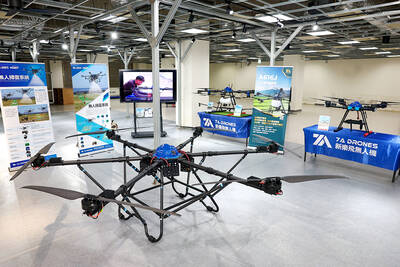
DRONE CENTRAL: Taiwan aims to become Asia’s democratic hub for drones, with most exports focused on high-quality military-grade models, an official said Taiwan’s drone industry is expected to expand significantly by 2030, producing 100,000 units per month and exporting half of them, the Ministry of Economic Affairs said yesterday. Current drone production capacity is about 15,000 units per month, but the industry can quickly scale up as demand increases, Industrial Development Administration Director-General Chiou Chyou-huey (邱求慧) told a news conference in Taipei. Taiwan’s drone output grew 2.5-fold last year to NT$12.9 billion (US$408.3 million) under a government program to develop the uncrewed vehicle sector, he said. The Executive Yuan in October last year approved plans to invest NT$44.2 billion into domestic production of uncrewed aerial
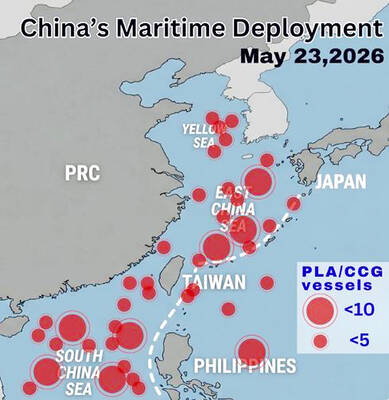
WARNING: China should stop engaging in actions that undermine regional peace and stability, as it would only build resentment among people across the Strait, the CGA said China has deployed more than 100 navy, coast guard and other vessels in waters from the Yellow Sea to the South China Sea and the western Pacific since US President Donald Trump and Chinese President Xi Jinping (習近平) met in Beijing, National Security Council Secretary-General Joseph Wu (吳釗燮) said yesterday. “In this part of the world, #China is the one & only PROBLEM wrecking the #StatusQuo & threatening regional peace & stability,” Wu wrote on X. In a separate post, he said Beijing was coercing Taiwan’s maritime domain, calling it illegal and provocative, after the Coast Guard Administration (CGA) expelled a

VERBOSE VESSELS: A CGA cutter and a China Coast Guard exchanged verbal barbs for more than a day in Taiwanese-controlled waters before the Chinese vessel left The Taiwanese and Chinese coast guards had a standoff near the strategically located Pratas Islands (Dongsha Islands, 東沙群島) in the north of the South China Sea, the Coast Guard Administration (CGA) said yesterday. The two sides engaged in intense radio exchanges over sovereignty claims during the 33-hour standoff. China Coast Guard vessel 3501 eventually left the restricted waters, 26.6 nautical miles (49.2km) west of the Pratas Islands, at 5pm yesterday, the CGA said. Lying approximately between southern Taiwan and Hong Kong, the Taiwan-controlled Pratas are seen by some security experts as vulnerable to Chinese attack due to their distance — more than
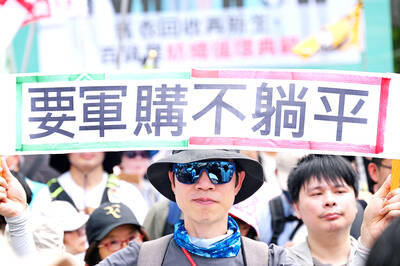
More than 8,000 people took part in a rally in Taipei yesterday to express support for more defense spending, after the opposition slashed the Cabinet’s proposed NT$1.25 trillion (US$39.6 billion) special defense budget and capped it at NT$780 billion. The demonstrators urged the Cabinet to propose another bill. Taiwan Economic Democracy Union convener Lai Chung-chiang (賴中強) said the main problem of the passed budget plan is the removal of funding for critical items, not just that the total amount is smaller. Critical budget items included purchasing or developing uncrewed vehicles, Strong Bow (強弓) missile systems, additional ammunition, artificial intelligence-powered combat systems and Taiwan-US


 RSS
RSS