


A US think tank has urged Taiwan to adopt a “hellscape” strategy that would flood the Taiwan Strait with drones and other uncrewed systems to deter invasion by China.
In its report, Hellscape for Taiwan, published on Thursday, the Center for a New American Security said Taipei’s asymmetric defense approach — often described as a “porcupine strategy” — needs to evolve to keep pace with the growing capabilities of the Chinese People’s Liberation Army.
The “hellscape” strategy involves saturating the air and waters around Taiwan with thousands of drones and other platforms capable of striking invading forces from multiple domains at once.
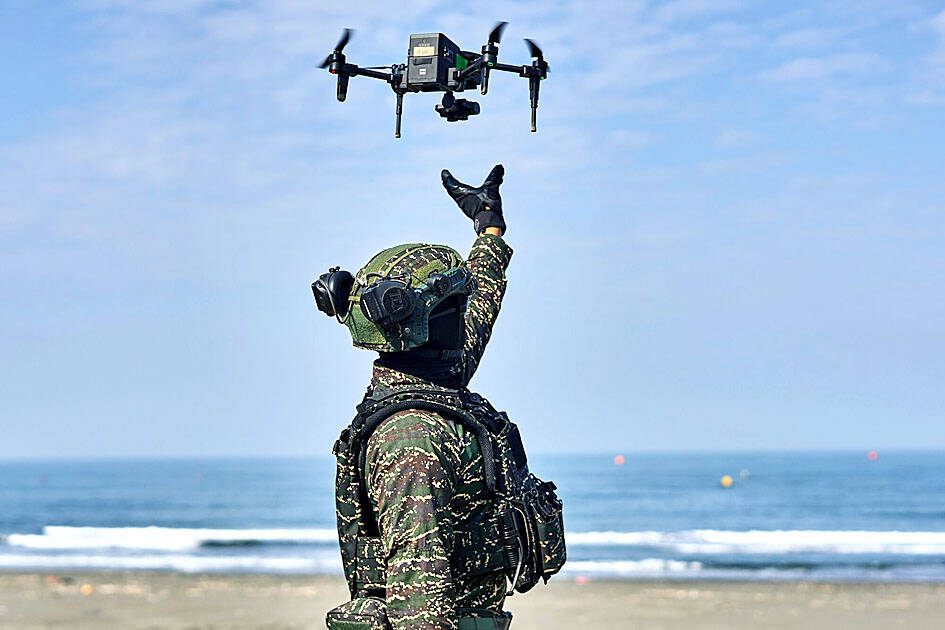
Photo: An Rong Xu, Bloomberg
Long-range aerial, surface and undersea drones would target Chinese ships and aircraft well before they reach Taiwan’s shores, it said.
As invaders move closer, mines, loitering munitions and short-range systems would disrupt, weaken and kill forces attempting amphibious landings, the report said.
The goal is to deny China air and sea superiority, and to impose such heavy losses that an invasion would become prohibitively costly, it said.
Taiwan must be prepared to defend itself even in the early stages of a cross-strait conflict, when outside assistance could be delayed or contested, it added.
Rather than relying primarily on high-end, limited platforms such as advanced fighter jets or large surface ships, the hellscape concept emphasizes quantity, dispersion and resilience, the report said.
The report called for mass production of affordable drones — including “long-range strike systems” and “first-person-view attack drones” — that could operate in contested communications environments.
It also recommended building domestic manufacturing capacity and integrating uncrewed systems into a doctrine that links sensors, shooters and command networks.
Although China has rapidly modernized its navy, air force and missile forces over the past two decades, significant uncertainties remain about its ability to execute and sustain a large-scale operation, especially in the face of Taiwanese counterattacks and possible US intervention, the report said.
Taiwan’s government has plans consistent with the report’s recommendations regarding drones.
As part of a proposed NT$1.25 trillion (US$40 billion) special defense budget, Taiwan wants to purchase more than 200,000 uncrewed aerial vehicles and more than 1,000 uncrewed surface vehicles, many of them produced domestically.
The report outlined several scenarios China might consider instead of an immediate, all-out invasion.
One option was a blockade to choke off Taiwan’s trade and energy supplies, pressuring the government into political concessions without a risky amphibious assault.
Another possibility was a limited operation to take Taiwan’s outlying islands, testing international resolve while avoiding the enormous costs of invading Taiwan proper.
A full invasion would likely only happen if Chinese leaders assessed that peaceful unification was no longer plausible and that military conditions — including readiness, logistics and deterrence of outside powers — were favorable, the report said.
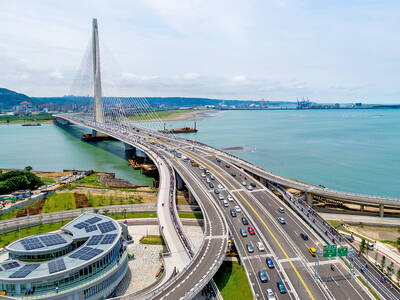
The Ministry of Transportation and Communications yesterday inaugurated the Danjiang Bridge across the Tamsui River in New Taipei City, saying that the structure would be an architectural icon and traffic artery for Taiwan. Feted as a major engineering achievement, the Danjiang Bridge is 920m long, 211m tall at the top of its pylon, and is the longest single-pylon asymmetric cable-stayed bridge in the world, the government’s Web site for the structure said. It was designed by late Iraqi-British architect Zaha Hadid. The structure, with a maximum deck of 70m, accommodates road and light rail traffic, and affords a 200m navigation channel for boats,
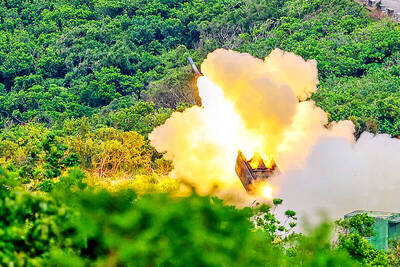
PRECISION STRIKES: The most significant reason to deploy HIMARS to outlying islands is to establish a ‘dead zone’ that the PLA would not dare enter, a source said A High Mobility Artillery Rocket System (HIMARS) would be deployed to Penghu County and Dongyin Island (東引) in Lienchiang County (Matsu) to force the Chinese military to retreat at least 100km from the coastline, a military source said yesterday. Taiwan has been procuring HIMARS and Army Tactical Missile Systems (ATACMS) from the US in batches. Once all batches have been delivered, Taiwan would possess 111 HIMARS units and 504 ATACMS, which have a range of 300km. Considering that “offense is the best defense,” the military plans to forward-deploy the systems to outlying islands such as Penghu and Dongyin so that

WHAT WAS ALL THAT FOR? Jaw Shaw-kong said that Cheng Li-wen had pushed for more drastic cuts and attacked him, just for the outcome to be nearly identical to his bill The legislature yesterday passed a supplementary budget bill to fund the purchase of separate packages of US military equipment, with the combined amount of spending capped at NT$780 billion (US$24.8 billion). The Chinese Nationalist Party (KMT) and Taiwan People’s Party (TPP) used their legislative majority to pass the bill, which runs until 2033 and has two main funding provisions. One was for NT$300 billion of arms sales already approved by the US for Taiwan on Dec. 17 last year, the other was for NT$480 billion for another arms package expected to be announced by Washington. The bill, which fell short of the NT$1.25

‘CLEAR MESSAGE’: The bill would set up an interagency ‘tiger team’ to review sanctions tools and other economic options to help deter any Chinese aggression toward Taiwan US Representative Young Kim has introduced a bill to deter Chinese aggression against Taiwan, calling for an interagency “tiger team” to preplan coordinated sanctions and economic measures in response to possible Chinese military or political action against Taiwan. “[Chinese President] Xi Jinping [習近平] has directed the People’s Liberation Army to be ready to invade Taiwan by 2027. China has a plan. America should have one too,” Kim said in a news release on Thursday last week. She introduced the “Deter PRC [People’s Republic of China] aggression against Taiwan act” to “ensure the US has a coordinated sanctions strategy ready should


 RSS
RSS