


Releasing its second annual White Paper yesterday, the Japanese Chamber of Commerce and Industry (JCCI) in Taipei urged Taiwan to sign more free-trade agreements (FTA) with regional economies, especially Japan, after Taipei signed the Economic Cooperation Framework Agreement (ECFA) with China in June.
Japanese firms are eager to work with Taiwanese firms to tap into Chinese and Southeast Asian markets, especially in the wake of the ECFA signing, JCCI senior director Kyota Kishimoto said.
“Taiwanese firms have the competitive advantage in China, in terms of contact networks and experience in personnel management and sales channels,” Kishimoto said.
“There had been many successful business models of Taiwanese-Japanese ventures in China in the past and the ECFA now serves as a catalyst for more Japanese firms to work with Taiwanese peers,” he said.
If Taiwan inks more FTAs with other regional economies, it would increase the country’s attractiveness, he added, saying JCCI executives are set to fly to Tokyo next week to hand in the White Paper to the Japanese government, after submitting it to the Council of Economic Planning and Development (CEPD) yesterday morning.
Taiwan and Singapore agreed to study the impact of a bilateral economic cooperation agreement under the WTO framework, Minister of Economic Affairs Shih Yen-shiang (施顏祥) said last month, saying details would be made public at the appropriate time.
While Japanese enterprises in Taiwan are hoping for a FTA with Japan, the chamber said that there are obstacles and that the FTA should not be restricted to mere “formalities.”
For a start, both parties should push for the signing of agreements to protect bilateral investment activities, safeguard intellectual property rights and reduce business taxes.
“From what we know, Taiwan and Japan have kicked off negotiations on certain areas,” chamber secretary-general Yukio Yamamoto said.
Vice Minister of Economic Affairs Lin Sheng-chung (林聖忠) told the Taipei Times that he welcomed such a call from the private sector.
“Signing FTAs with regional economies has been the country’s policy and Japan is one of our targets,” Lin said, adding that the ministry, however, has yet to receive official information on a Taiwan-Japan FTA for the moment.
Council of Economic Planning and Development Minister Christina Liu (劉憶如) said that the government would finish a review in response to the White Paper’s suggestions in March, including the proposal that Taiwan sign tax agreements and FTAs with Japan and that both sides engage in leadership discussions.
“The council received the White Paper today and we will work more closely with related government departments to discuss the content and give them a response as soon as possible,” Liu told reporters after a meeting with the chamber.
Liu said that the government was scheduled to send a delegation to Japan in March to seek investors and highlight the impact of the ECFA on Taiwan-Japan trade relations.
She said that the CEPD will invite Straits Exchange Foundation (SEF) Chairman Chiang Pin-kung (江丙坤) to join the delegation to help promote the ECFA in Japanese in hopes that more Japanese enterprises will have a better understanding of the cross-strait trade pact.
The chamber was founded in March 1971 with 143 corporate members. It now has 410.
The chamber said Japanese enterprises have been actively investing in Taiwan this year, with a shift from manufacturing-oriented businesses toward more service-oriented ones.
Fast Retailing Co, Japan’s biggest clothing retailer, launched its first outlet of the popular Uniqlo casual wear brand last month in Taipei.
Japan’s top hot-spring inn, Kagaya, has joined hands with real-estate developer Radium Life Tech Co (日勝生) to open a hotel called Kagaya Peitou (加賀屋北投) next month.

NATIONAL SECURITY THREAT: An official said that Guan Guan’s comments had gone beyond the threshold of free speech, as she advocated for the destruction of the ROC China-born media influencer Guan Guan’s (關關) residency permit has been revoked for repeatedly posting pro-China content that threatens national security, the National Immigration Agency said yesterday. Guan Guan has said many controversial things in her videos posted to Douyin (抖音), including “the red flag will soon be painted all over Taiwan” and “Taiwan is an inseparable part of China,” while expressing hope for expedited “reunification.” The agency received multiple reports alleging that Guan Guan had advocated for armed reunification last year. After investigating, the agency last month issued a notice requiring her to appear and account for her actions. Guan Guan appeared as required,
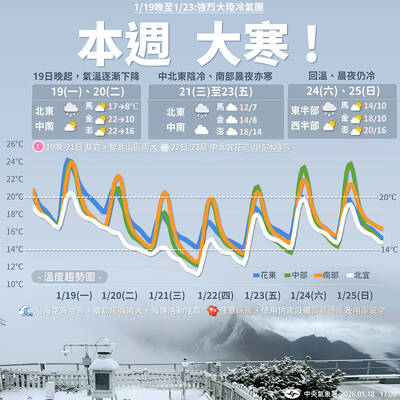
A strong cold air mass is expected to arrive tonight, bringing a change in weather and a drop in temperature, the Central Weather Administration (CWA) said. The coldest time would be early on Thursday morning, with temperatures in some areas dipping as low as 8°C, it said. Daytime highs yesterday were 22°C to 24°C in northern and eastern Taiwan, and about 25°C to 28°C in the central and southern regions, it said. However, nighttime lows would dip to about 15°C to 16°C in central and northern Taiwan as well as the northeast, and 17°C to 19°C elsewhere, it said. Tropical Storm Nokaen, currently
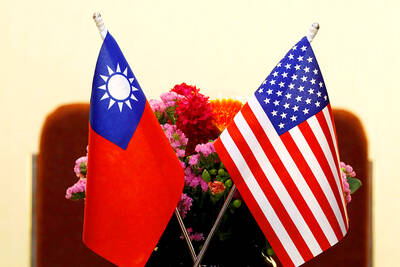
‘NATO-PLUS’: ‘Our strategic partners in the Indo-Pacific are facing increasing aggression by the Chinese Communist Party,’ US Representative Rob Wittman said The US House of Representatives on Monday released its version of the Consolidated Appropriations Act, which includes US$1.15 billion to support security cooperation with Taiwan. The omnibus act, covering US$1.2 trillion of spending, allocates US$1 billion for the Taiwan Security Cooperation Initiative, as well as US$150 million for the replacement of defense articles and reimbursement of defense services provided to Taiwan. The fund allocations were based on the US National Defense Authorization Act for fiscal 2026 that was passed by the US Congress last month and authorized up to US$1 billion to the US Defense Security Cooperation Agency in support of the
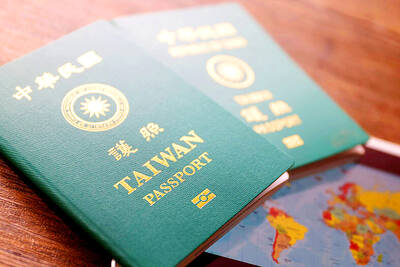
PAPERS, PLEASE: The gang exploited the high value of the passports, selling them at inflated prices to Chinese buyers, who would treat them as ‘invisibility cloaks’ The Yilan District Court has handed four members of a syndicate prison terms ranging from one year and two months to two years and two months for their involvement in a scheme to purchase Taiwanese passports and resell them abroad at a massive markup. A Chinese human smuggling syndicate purchased Taiwanese passports through local criminal networks, exploiting the passports’ visa-free travel privileges to turn a profit of more than 20 times the original price, the court said. Such criminal organizations enable people to impersonate Taiwanese when entering and exiting Taiwan and other countries, undermining social order and the credibility of the nation’s


 RSS
RSS