

Anti-South Korea sentiment in Taiwan sparked by the controversial disqualification of Taiwanese taekwondo athlete Yang Shu-chun (楊淑君) at the Asian Games has expanded from cyberspace and spread into the real world, as unidentified people threw eggs at the Taipei Korean School yesterday morning.
The egg-throwing incident was the latest of a series of anti-South Korea moves by angry Taiwanese, who have called for a boycott of South Korean goods, foods, TV programs and entertainers, including posts on the Facebook page of Cheongwadae — South Korea’s presidential office — which were later removed, with most users accusing the country of treating Yang unfairly.
The anti-South Korea sentiment rose to a fever pitch after the Asian Taekwondo Union (ATU) posted a press release on on its Web site on Thursday accusing Taiwan and Yang of committing a “shocking act of deception” inflamed the situation.
World Taekwondo Federation (WTF) secretary-general Yang Jin-suk of South Korea, who has given different explanations as to why Yang was disqualified, also earned the wrath of some Taiwanese.
To keep the uproar under control, the National Police Agency said it had tightened security for South Korea’s representative office in Taipei.
On Friday, the Korean Mission in Taipei issued a document to South Korean expatriates and associations in Taiwan urging them to be discreet in word and deed to ensure their safety in view of the anti-South Korean sentiment caused by the Yang incident.
A South Korean official with the Korean Mission in Taipei — South Korea’s representative office in the country in the absence of diplomatic ties — declined to elaborate on why the warning was necessary. There are about 3,000 South Koreans studying and working in Taiwan, according to the official, who declined to be named.
A South Korean surnamed Lee, who lives in Taipei City’s Wanhua District (萬華), said many of his compatriots are puzzled as to why Taiwanese are venting their anger over the Yang incident at South Koreans.
“Many Koreans in Taiwan can’t understand this,” Lee said, because Yang’s sensors were first called into question by ATU vice president Zhao Lei (趙磊), a Chinese national, and because judge Hong Sung Chon (洪性天) is a Philippine national, despite being of Korean descent.
Lee, formerly a director at the Taipei Korean School — the target of the egg-throwing incident — said he did not think it was a good way to express dissatisfaction with the ATU’s ruling against Yang.
“Neither was it a good example for children,” Lee said.
“Throwing eggs will only leave school children with the impression that they can also resort to this type of behavior to settle controversy,” Lee said.
Lee has lived in Taiwan for more than 20 years since his parents immigrated to Taiwan.
“I sympathized with Taiwanese on the disqualification verdict because I thought it was a controversial ruling. I don’t think that [the anti-Korean behavior] is irrational. It reflects the real feelings of Taiwanese people toward the matter,” Lee said in a phone interview with the Taipei Times.
Lee said he also hopes the controversy ends up with a “good result” and a “fair ruling” through the normal appeal channel.
“It was a pity that the matter degenerated into [anti-Korean sentiment],” Lee said.
At a separate setting, Democratic Progressive Party Legislator Tsai Huang-liang (蔡煌瑯) said Zhao was the central figure behind Yang’s controversial disqualification.
“Various evidence suggests the whole thing is a conspiracy by Zhao so that his student Wu Jingyu (吳靜鈺) could win the gold medal,” Tsai alleged.
Yang, one of Taiwan’s top gold medal hopes at the Asian Games, was disqualified on Wednesday over allegations that she used extra sensors on her electronic socks.
Video of her bout revealed, -however, that the sensors were not attached to her socks during her battle with a Vietnamese opponent, in which Yang was leading 9-0 when the bout was halted, and followed by an abrupt announcement that Yang was disqualified.
The event was eventually won by Wu.
Pointing out that there were no South Korean players competing in the same category as Yang, Tsai said he suspected Hong accommodated Zhao’s scheme to curry favor with China.
“While there are many protests from Taiwanese venting their anger online at South Korea, Taiwanese should open their eyes wide, think through the cause-and-effect and realize that China is actually the one behind the whole incident,” he said.
The Ministry of Foreign Affairs yesterday urged Taiwanese to express their opinions peacefully.
The ATU’s ruling had nothing to do with the South Korean government and its people, the ministry said.
ADDITIONAL REPORTING BY CHEN HUI-PING AND CNA
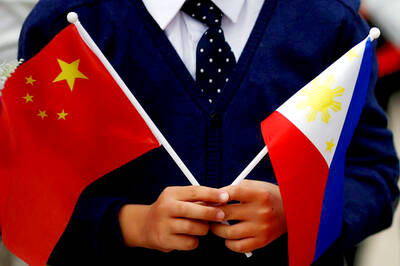
The Philippine Coast Guard yesterday said it has deployed its largest vessel and an aircraft to challenge a Chinese research ship operating off northern Batanes near Taiwan, adding that a Chinese coast guard vessel had also moved in. The Philippine operation “disrupted the vessel’s unauthorized marine scientific research and compelled it to leave its loitering position,” said Jay Tarriela, Philippine Coast Guard spokesperson on South China Sea issues. The Philippine Coast Guard said the BRP Teresa Magbanua and an aircraft were deployed to counter the Chinese vessel, which it said had remained about 37 nautical miles northwest of Itbayat Island since Monday. The
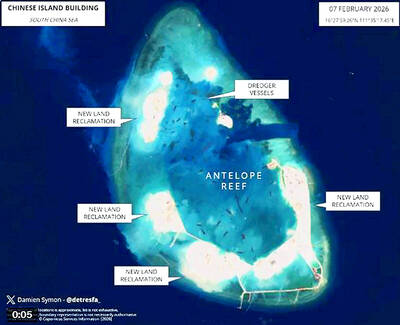
RUNWAY: Analysts said the first aircraft landing is expected by the middle of next year, while Chinese state media said it would serve civilian needs Chinese construction of a runway on Antelope Reef (Lingyang Reef, 羚羊礁) in the Paracel Islands (Xisha Islands, 西沙群島), is well under way with analysts estimating it could be completed by the middle of next year, strengthening Beijing’s military control over the disputed South China Sea. Satellite images reviewed by Reuters show grading work, piles of gravel and concrete, and compaction cranes in operation to build a full-scale runway that military attaches and security analysts say could be one of China’s most important offshore bases in the region. The images, taken on Friday last week by commercial satellite imagery provider Vantor, also show

SHIFTING COOPERATION: With the new arrangement, US representatives would be able to participate directly in defense discussions, including weapons procurement Taiwan-US military cooperation is deepening, with the Pentagon expected to station personnel at the Ministry of National Defense (MND), sources said. The NT$470 million (US$14.77 million) joint program is scheduled to run from this year through 2028, under which the Pentagon would dispatch representatives from the Office of the Under Secretary of Defense for Policy and the Institute for Defense Analyses, a senior military official said on condition of anonymity, adding that one representative from each organization would be stationed at the ministry’s headquarters. The Office of the Under Secretary of Defense for Policy is one of the US’ bodies responsible for

The Presidential Office today condemned China's transnational repression after an alleged Chinese foreign agent was arrested in California yesterday on suspicion of surveilling President William Lai's (賴清德) son, Lai Ting-yu (賴廷與), the FBI said. The 34-year-old woman, named Wanying Heather Zhang (張婉瑩), was arrested on suspicion of acting as an unregistered foreign agent, US news agency CBS reported. She was apprehended at Los Angeles International Airport yesterday attempting to fly to Shanghai, it said. This represents a “typical case” of China’s transnational repression, Presidential Office spokeswoman Karen Kuo (郭雅慧) said today. "Our country expresses the strongest condemnation of such barbaric conduct that


 RSS
RSS