


Former president Chen Shui-bian (陳水扁) is set to stay in prison for at least 11 years after the Supreme Court yesterday upheld a bribery conviction in a land purchase scandal.
Supporters of the former president said they were devastated by the ruling, which can no longer be appealed. Chen’s office called the verdict — which came just days after a local court cleared him in another bribery case — politically motivated.
In the verdict, the Supreme Court agreed with the lower court’s ruling that the former president and his wife, Wu Shu-jen (吳淑珍), accepted bribes of up to NT$300 million (US$10 million) in return for helping facilitate a land deal between the government and a property development company.
The deal saw Taiwan Cement Corp (台泥) chairman Leslie Koo (辜成允), whose company was in financial difficulties at the time, pay the money to a close friend of the former first lady. In return, the former president pressured a government-run science park to rent and then purchase a plot of land in Taoyuan County that Koo managed, the ruling by the lower court said.
Koo had testified that the amount was originally given as commission, rather than a bribe.
In the unexpected decision made yesterday afternoon, the Supreme Court ruled that both Chen and his wife should serve 11 years in prison, a reduction of a year from the sentence handed down by the lower court, over their roles in the scandal and that they should each pay NT$150 million.
Tsai Ming-che (蔡銘哲), Wu’s friend who acted as the middleman in the case, was given an eight-month prison sentence, while former Hsinchu Science Park head James Lee (李界木) was handed a 42-month sentence.
In the same ruling, the court also sentenced Chen and his wife to eight years in prison for accepting a bribe of NT$10 million from former Taipei Financial Center Corp (台北金融大樓公司) chairwoman Diana Chen (陳敏薰) in exchange for helping her secure an appointment at a securities firm.
In that case, Wu was also handed a seven-month sentence for money laundering.
Diana Chen had insisted during the trial that the amount was given to the former first lady as a political donation for the Democratic Progressive Party (DPP) during Chen Shui-bian’s tenure as party chairman. Prosecutors said the NT$10 million was instead promptly wired overseas.
As of press time, it was still unclear whether the sentences would be served consecutively or concurrently.
Speaking to the press immediately following the ruling, in one of several suits the former president is fighting, Chen Shui-bian’s office secretary, Chiang Chih-ming (江志銘), said the ruling was politically motivated.
“Many of his [Chen Shui-bian’s] supporters have told me that they will not accept this verdict,” Chiang said.
Chen Sung-shan (陳淞山), Chen Shui-bian’s former office manager who last week visited the former president at the Taipei Detention Center, where the former president has been held since December 2008, said Chen Shui-bian had not expected the ruling to come so soon.
Just hours before the ruling was announced, Chen Shui-bian’s office had issued the latest version of the former president’s bi-monthly diary, in which he claimed he should be found innocent because both cases were unrelated to his presidential powers.
He wrote that the courts should not confuse his “moral responsibilities with his legal responsibilities,” adding that the ruling should be based on a strict definition of the law “and not according to what society wants.”
Commenting on the verdict, the former president’s son, Chen Chih-chung (陳致中), currently running for election to the Greater Kaohsiung council as an independent, called on the public to “show their anger” by voting against President Ma Ying-jeou’s (馬英九) administration in the upcoming special municipality elections.
Meanwhile, the Presidential Office, the Chinese Nationalist Party (KMT) caucus and the Democratic Progressive Party (DPP) all said that they respected the court’s decision.
Declining to comment on whether the ruling would impact the upcoming elections, DPP spokesman Lin Yu-chang (林右昌) said that “both parties, regardless of color, have already learned to calmly and reasonably deal with Chen Shui-bian’s legal troubles.”
Yesterday’s ruling came a week after the Taipei District Court acquitted Chen Shui-bian on a separate case of taking NT$600 million for helping facilitate bank mergers. The Taipei District Court also cleared him of embezzling diplomatic funds in June. Prosecutors have said they will appeal both rulings.
Three other cases, including charges related to another land deal, money laundering and embezzling secret diplomatic funds, for which the Taiwan High Court originally ruled the former president should serve a 20-year sentence, were returned to the lower court by the Supreme Court for another ruling yesterday.

The National Chungshan Institute of Science and Technology yesterday showcased its locally developed variants of the Vision 60 robotic patrol dog, which it plans to deploy on the nation’s outlying territories in the South China Sea. The variants were produced under the Joint Lab project — created by the institute and domestic companies — and assembled with domestically produced motors, lenses and artificial intelligence (AI) systems alongside licensed tech from the US, Missile and Rocket Systems Research Division deputy director Jen Kuo-kang (任國光) told the media event at a military base in Taipei’s Dazhi (大直) area. Taiwan has built up its strengths

RIGHT DIRECTION: Taiwan’s efforts to prevent forced labor include a proposal to ‘fully prohibit’ employers from withholding workers’ documents, an official said Taiwan is to establish a mechanism to restrict imports of goods linked to forced labor, the Executive Yuan said yesterday, after the US proposed imposing additional tariffs on Taiwanese goods over labor concerns. “The Ministry of Labor and the Ministry of Economic Affairs are to establish an interministerial review procedure,” Executive Yuan spokesperson Michelle Lee (李慧芝) said at a news briefing in Taipei. “The government is to use the Foreign Trade Act [貿易法] as the legal basis to restrict imports of goods produced with forced labor” and bring its supply chain governance more in line with international standards on human rights, resilience

NOT IMMEDIATE: Taiwan has a chance to appeal the proposed 10 percent tariff before it starts, while other countries face a 12.5 percent tariff from the trade office Taiwan is among 60 economies determined by the US to have failed to impose or enforce a ban on the importation of goods produced with forced labor, according to a notice released on Tuesday by the Office of the US Trade Representative (USTR), which proposed imposing an additional 10 percent or more tariff on them. The USTR in a statement said that following an investigation, it had determined under Section 301 of the Trade Act of 1974 that the failure of the 60 economies to impose and effectively enforce a prohibition on the importation of goods produced with forced labor is
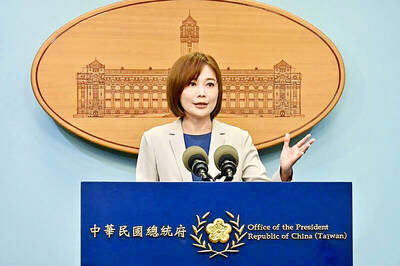
TIT-FOR-TAT: The US allegedly revoked the visa of a Chinese national working at Xinhua News Agency in the US in response to Beijing’s expulsion of Vivian Wang The Presidential Office yesterday condemned China for expelling a New York Times correspondent from Beijing following the newspaper’s interview with President William Lai (賴清德), saying the move highlighted Beijing’s suppression of press freedom and its threat to international news media. Taiwan has noted a series of recent incidents in which Beijing used similar tactics to “threaten and pressure international media outlets and journalists,” Presidential Office spokeswoman Karen Kuo (郭雅慧) said in a statement. “This concerns not only press freedom and freedom of expression, but also the safety of journalists, and Taiwan and relevant partners are paying close attention to the situation,” she


 RSS
RSS