


Two Democratic Progressive Party (DPP) proposals demanding that China apologize over a recent spat at the Tokyo International Film Festival and urging Beijing to release Chinese dissident Liu Xiaobo (劉曉波) both failed to be passed at the legislature yesterday.
Pan Men-an (潘孟安), a DPP caucus whip who initiated the motions, accused the Chinese Nationalist Party (KMT) caucus of impeding the passage of the two proposals by using rules of procedure in an attempt to “conceal its [the KMT’s] unfavorable position” so as to avoid the action influencing this month’s special municipality elections.
The KMT caucus was actually opposed to the two proposals, but “it did not dare to oppose them publicly” as that might lead to a loss of votes in the election, Pan said.
In one proposal, the DPP caucus proposed the government demand an apology from China over the incident in which Jiang Ping (江平), the head of the Chinese delegation attending the Tokyo International Film Festival, demanded that the Taiwanese delegation have its title changed to “Chinese Taipei” or “Taiwan, China.”
The DPP caucus also demanded the government suspend all ongoing negotiations with China until it offers an official apology to Taiwan.
In the other proposal, the DPP caucus demanded that the KMT government ask China to release Liu without delay so he could receive his Nobel Peace Prize in person and to approve the International Covenant on Economic, Social and Cultural Rights and the International Covenant on Civil and Political Rights, as well as draw up concrete measures to improve its human rights record.
Rather than deliberate the two proposals at yesterday’s legislative session, the KMT caucus initiated a vote referring them to inter-party negotiations, which means the two proposals could not be placed on a plenary session for deliberation for another month.
Pan said he expects the KMT caucus to oppose the two proposals after the negotiation period is over “as it always pays lip service to defending the country’s sovereignty and democratic values, until it comes to pushing China to address the issues.”
KMT caucus whip Lin Tsang-min (林滄敏) said his caucus did not oppose the two proposals, but deemed it necessary to deliberate them more cautiously.
KMT Legislative caucus whip Lin Yi-shih (林益世) said the DPP had “overacted” to the film festival spat when it demanded the suspension of all cross-strait negotiations until China apologizes.
“Could it be that the DPP wishes that Taiwan terminate all trade and economic interactions with the mainland and the implementation of the Economic Cooperation Framework Agreement? If so, Taiwan would lose more than it would gain,” Lin said.
In other developments, the legislature yesterday approved an agreement on legal cooperation on civil matters that the nation signed with Vietnam in April.
An amendment to the Teachers’ Act (教師法) also passed the legislature, in which teachers accused of sexual assault will face having their pay suspended during the period the cases are under investigation and will not get their pay returned when the investigation is completed.
An amendment to the Security Exchange Act (證券交易法) was also passed that requires companies listed on the Taiwan Stock Exchange and the over-the-counter market to set up a commission to observe pay moderation of top executives.
The legislature also amended the Military Service Act (兵役法), extending the time men of conscription age are allowed to go abroad for tourism from two months to four months, and to attend international competitions overseas from three months to six months.
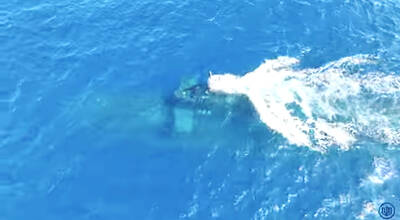
CSBC Corp, Taiwan (台灣國際造船) yesterday released the first video documenting the submerged sea trials of Taiwan’s indigenous defense submarine prototype, the Hai Kun (海鯤), or Narwhal, showing underwater navigation and the launch of countermeasures. The footage shows the vessel’s first dive, steering and control system tests, and the raising and lowering of the periscope and antenna masts. It offered a rare look at the progress in the submarine’s sea acceptance tests. The Hai Kun carried out its first shallow-water diving trial late last month and has since completed four submerged tests, CSBC said. The newly released video compiles images recorded from Jan. 29 to
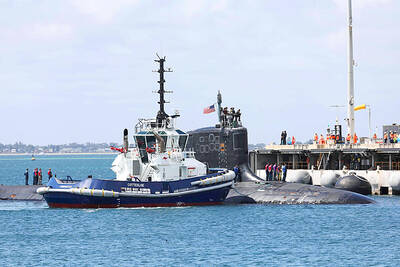
DETERRENCE EFFORTS: Washington and partners hope demonstrations of force would convince Beijing that military action against Taiwan would carry high costs The US is considering using HMAS Stirling in Western Australia as a forward base to strengthen its naval posture in a potential conflict with China, particularly over Taiwan, the Wall Street Journal reported on Saturday. As part of its Indo-Pacific strategy, Washington plans to deploy up to four nuclear-powered submarines at Stirling starting in 2027, providing a base near potential hot spots such as Taiwan and the South China Sea. The move also aims to enhance military integration with Pacific allies under the Australia-UK-US trilateral security partnership, the report said. Currently, US submarines operate from Guam, but the island could
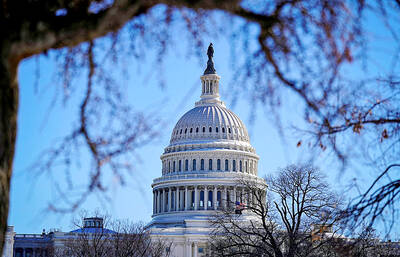
RESTRAINTS: Should China’s actions pose any threat to Taiwan’s security, economic or social systems, China would be excluded from major financial institutions, the bill says The US House of Representatives on Monday passed the PROTECT Taiwan Act, which states that Washington would exclude China from participating in major global financial organizations if its actions directly threaten Taiwan’s security. The bill, proposed by Republican Representative Frank Lucas, passed with 395 votes in favor and two against. It stipulates that if China’s actions pose any threat to Taiwan’s security, economic or social systems, the US would, “to the maximum extent practicable,” exclude Beijing from international financial institutions, including the G20, the Bank for International Settlements and the Financial Stability Board. The bill makes it clear that China must be prepared

Taiwanese trade negotiators told Washington that Taipei would not relocate 40 percent of its semiconductor production to the US, and that its most advanced technologies would remain in the nation, Vice Premier Cheng Li-chiun (鄭麗君) said on Sunday. “I told the US side very clearly — that’s impossible,” Cheng, who led the negotiation team, said in an interview that aired on Sunday night on Chinese Television System. Cheng was referring to remarks last month by US Secretary of Commerce Howard Lutnick, in which he said his goal was to bring 40 percent of Taiwan’s chip supply chain to the US Taiwan’s almost


 RSS
RSS