


Mexican soldiers gunned down a top drug lord in a rare victory against the country’s brutal cartels, as the US consulate in the blood-soaked border region closed yesterday for security reasons.
Drug kingpin Ignacio “Nacho” Coronel, a key figure in Mexico’s Sinaloa drug gang, was slain as he tried to escape during an army raid outside the western city of Guadalajara, defense officials said.
Authorities said Coronel was killed after opening fire on troops who returned fire during the raid. Coronel killed one soldier and wounded another, before being shot dead himself, officials said.
The US and Mexican governments both had outstanding arrest warrants for Coronel, while US authorities had offered a US$5 million reward for information leading to his capture.
His death, seen a major blow against Mexico’s powerful drug syndicates, came on the same day that the US indefinitely closed its consulate in the violence-hit main border city of Ciudad Juarez for a “security review.”
“The facility will be closed all day on Friday, July 30, and remain closed until the security review is completed,” the US embassy in Mexico City said in a statement.
The statement failed to specify what information or concerns prompted it to shutter the consulate, but said that “American citizens are advised to avoid the area around the consulate general until it reopens.”
About 50 US citizens — mostly of Mexican origin — have been killed and about 30 others kidnapped since January 2008, according to figures released by regional authorities.
The nation has been gripped by drug-related bloodshed since Mexican President Felipe Calderon launched a military clampdown on the powerful drug gangs after taking office in December 2006, especially in Ciudad Juarez.
The brutal drug violence so far this year has left about 7,000 people dead, compared with 9,000 killed in all of last year. About 25,000 people have died in spiraling suspected drug violence since 2006.
In a sign of the growing violence in Ciudad Juarez, Mexico’s notorious crime capital, three people linked to the US consulate were killed in March.
Lesley Enriquez, an American working at the consulate in Juarez, her American husband Arthur Redelfs, and Jorge Alberto Salcido, the Mexican husband of another US consular employee, were gunned down in ambushes just minutes apart after leaving a birthday party in the Mexican city.
US and Mexican investigators said they suspected members of the Los Aztecas gang of carrying out the hit.
Just two weeks ago, suspected drug gang members launched a car bomb attack on police in Ciudad Juarez, killing two police and two medics in the first incident of its kind in the city.
Coronel’s death marks the sharpest blow against the Sinaloa drug cartel since the start of the drugs war by Calderon — who was in Guadalajara on Thursday to meet businesspeople and inaugurate a new stadium.
Coronel, 56, allegedly controlled the group’s cocaine trafficking along the so-called “Pacific route” directing vast drug-running operations from western Mexico into the US.

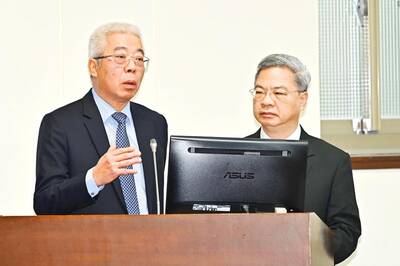
Taiwan has arranged for about 8 million barrels of crude oil, or about one-third of its monthly needs, to be shipped from the Red Sea this month to bypass the Strait of Hormuz and ease domestic supply pressures, CPC Corp, Taiwan (CPC, 台灣中油) said yesterday. The state-run oil company has worked with Middle Eastern suppliers to secure routes other than the Strait of Hormuz, through which about 20 percent of the world’s oil and liquefied natural gas typically passes, CPC chairman Fang Jeng-zen (方振仁) said at a meeting of the legislature’s Economics Committee in Taipei. Suppliers in Saudi Arabia have indicated they

South Korea has adjusted its electronic arrival card system to no longer list Taiwan as a part of China, a move that the Ministry of Foreign Affairs said would help facilitate exchanges between the two sides. South Korea previously listed “Taiwan” as “Taiwan (China)” in the drop-down menus of its online arrival card system, where people had to fill out where they came from and their next destination. The ministry had requested South Korea make a revision and said it would change South Korea’s name on Taiwan’s online immigration system from “Republic of Korea” to “Korea (South),” should the issue not be

Tainan, Taipei and New Taipei City recorded the highest fines nationwide for illegal accommodations in the first quarter of this year, with fines issued in the three cities each exceeding NT$7 million (US$220,639), Tourism Administration data showed. Among them, Taipei had the highest number of illegal short-term rental units, with 410. There were 3,280 legally registered hotels nationwide in the first quarter, down by 14 properties, or 0.43 percent, from a year earlier, likely indicating operators exiting the market, the agency said. However, the number of unregistered properties rose to 1,174, including 314 illegal hotels and 860 illegal short-term rental

AIR ALERT: China’s reservation of airspace over the Yellow Sea and East China Sea could be an attempt to test the US’ response ahead of a Trump-Xi meeting, the NSB head said China’s attempts to infiltrate Taiwan are systematic, planned and targeted, with activity shifting from recruiting mid-level military officers to rank-and-file enlisted personnel, National Security Bureau (NSB) Director-General Tsai Ming-yen (蔡明彥) said yesterday. The Chinese Communist Party’s (CCP) integrates national security, intelligence operations and “united front” efforts into a dense network to conduct intelligence gathering and espionage in Taiwan, Tsai said at a meeting of the legislature’s Foreign Affairs and National Defense Committee. It uses specific networks to screen targets through exchange activities and recruiting local collaborators to establish intelligence-gathering organizations, he said. China is also shifting who it targets to lower-ranking military personnel,


 RSS
RSS