


North Korea threatened the US and South Korea yesterday with a “physical response” to planned weekend naval exercises as tensions with Pyongyang rose in the aftermath of the sinking of a South Korean warship blamed on the North.
In Vietnam for a Southeast Asian regional security forum, US Secretary of State Hillary Rodham Clinton and a North Korean official traded barbs over the ship incident, the upcoming military drills and the imposition of new US sanctions against the North.
The spokesman for the North Korean delegation to the talks, Ri Tong-il, repeated Pyongyang’s denial of responsibility for the March sinking of the ship that killed 46 South Korean sailors and said the upcoming military drills were a violation of its sovereignty that harkened back to the days of 19th-century “gunboat diplomacy.”
The exercises will be “another expression of hostile policy against” North Korea, Ri told reporters in Hanoi. “There will be physical response against the threat imposed by the United States militarily.”
Clinton responded by saying the US was willing to meet and negotiate with the North, but that this type of threat only heightens tensions. Progress in the short term seems unlikely, given the circumstances, she said.
“It is distressing when North Korea continues its threats and causes so much anxiety among its neighbors and the larger region,” she told reporters. “But we will demonstrate once again with our military exercises ... that the United States stands in firm support of the defense of South Korea and we will continue to do so.”
Shortly before Ri spoke, Clinton had lashed out against belligerent acts by the North, warning that it must reverse a “campaign of provocative, dangerous behavior” if it wants improved relations with its neighbors and the US.
She said stability in the region, particularly on the Korean Peninsula, depends in large part on convincing an “isolated and belligerent” North Korea to alter course and return to nuclear disarmament talks.
Peaceful resolution of the issues on the Korean Peninsula will be possible only if North Korea fundamentally changes its behavior, Clinton told the gathering of top officials from ASEAN and the US, China, Japan, North and South Korea and Russia.
In addition to North Korea’s behavior and its nuclear program, Clinton raised concerns about potential atomic collaboration between the North and Myanmar, which is restricted by UN agreements. Numerous reports in recent months have suggested that Myanmar’s military rulers are attempting to develop nuclear weapons with North Korean help.
Clinton said “recent events” had called into question Myanmar’s pledges to abide by its international commitments, including UN sanctions, the requirements of its nuclear watchdog, the International Atomic Energy Agency, and the Nuclear Non-Proliferation Treaty.
“It is critical that Burma [Myanmar] hear from you, its neighbors, about the need to comply with” those obligations, Clinton told the forum.

Right-wing political scientist Laura Fernandez on Sunday won Costa Rica’s presidential election by a landslide, after promising to crack down on rising violence linked to the cocaine trade. Fernandez’s nearest rival, economist Alvaro Ramos, conceded defeat as results showed the ruling party far exceeding the threshold of 40 percent needed to avoid a runoff. With 94 percent of polling stations counted, the political heir of outgoing Costa Rican President Rodrigo Chaves had captured 48.3 percent of the vote compared with Ramos’ 33.4 percent, the Supreme Electoral Tribunal said. As soon as the first results were announced, members of Fernandez’s Sovereign People’s Party
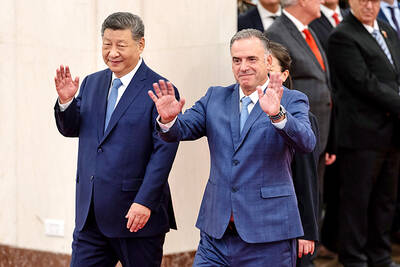
EMERGING FIELDS: The Chinese president said that the two countries would explore cooperation in green technology, the digital economy and artificial intelligence Chinese President Xi Jinping (習近平) yesterday called for an “equal and orderly multipolar world” in the face of “unilateral bullying,” in an apparent jab at the US. Xi was speaking during talks in Beijing with Uruguayan President Yamandu Orsi, the first South American leader to visit China since US special forces captured then-Venezuelan president Nicolas Maduro last month — an operation that Beijing condemned as a violation of sovereignty. Orsi follows a slew of leaders to have visited China seeking to boost ties with the world’s second-largest economy to hedge against US President Donald Trump’s increasingly unpredictable administration. “The international situation is fraught
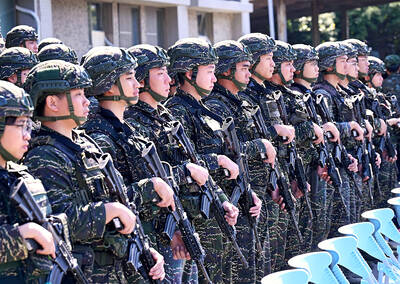
MORE RESPONSIBILITY: Draftees would be expected to fight alongside professional soldiers, likely requiring the transformation of some training brigades into combat units The armed forces are to start incorporating new conscripts into combined arms brigades this year to enhance combat readiness, the Executive Yuan’s latest policy report said. The new policy would affect Taiwanese men entering the military for their compulsory service, which was extended to one year under reforms by then-president Tsai Ing-wen (蔡英文) in 2022. The conscripts would be trained to operate machine guns, uncrewed aerial vehicles, anti-tank guided missile launchers and Stinger air defense systems, the report said, adding that the basic training would be lengthened to eight weeks. After basic training, conscripts would be sorted into infantry battalions that would take
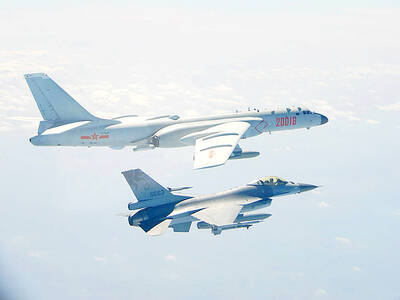
GROWING AMBITIONS: The scale and tempo of the operations show that the Strait has become the core theater for China to expand its security interests, the report said Chinese military aircraft incursions around Taiwan have surged nearly 15-fold over the past five years, according to a report released yesterday by the Democratic Progressive Party’s (DPP) Department of China Affairs. Sorties in the Taiwan Strait were previously irregular, totaling 380 in 2020, but have since evolved into routine operations, the report showed. “This demonstrates that the Taiwan Strait has become both the starting point and testing ground for Beijing’s expansionist ambitions,” it said. Driven by military expansionism, China is systematically pursuing actions aimed at altering the regional “status quo,” the department said, adding that Taiwan represents the most critical link in China’s


 RSS
RSS