


Following a series of suicides by Chinese employees at the Foxconn (富士康) plant in Shenzhen, Guangdong Province, more than 150 academics and researchers yesterday called for an end to sweatshops and urged the government to stop offering subsidies and economic incentives to companies like Hon Hai Precision Industry Co (鴻海精密).
The petition, which was initiated on June 6 by Lin Thung-hong (林宗弘), associate research fellow at Academia Sinica’s Institute of Sociology, and Daniel Yang (楊友仁), associate professor of sociology at Tunghai University, said comments by Premier Wu Den-yih (吳敦義) that he “hopes everyone will give [Hon Hai chairman] Terry Gou (郭台銘) encouragement” was a form of complicity in corporate exploitation of human labor and encouraged Taiwanese companies to violate labor rights.
Six professors and researchers from the fields of sociology, public policy and others yesterday attended a press conference to petition the government not to turn a blind eye to violations of workers’ rights to avoid harming Taiwan’s international image in the name of economic growth.
“When Yahoo provided its lists [of personal information] to the Chinese government, they were grilled at a congressional hearing [in the US],” Lin said. “However, throughout the entire Foxconn crisis, the people who acted with the most indifference are Taiwanese government officials.”
Lin said Foxconn’s treatment of its workers constituted a form of financial crime, but rather than getting punished, the government is offering subsidies and favorable policies to allow Hon Hai to bring its production facilities back to Taiwan and continue to expand its operations.
Huang Te-pei (黃德北), professor and director at Shih Hsin University’s Graduate Institute for Social Transformation Studies, called Gou “the shame of Taiwan” and said that all advertisements that feature endorsements by Gou should be taken down.
“The Taiwanese government should not encourage Hon Hai to bring its factories back to Taiwan, along with all the social problems associated with its treatment of its workers,” Huang said.
He said that even though Hon Hai had announced wage increases in response to the suicides at the Shenzhen plant, the root of the problem — the almost perpetual overtime that workers must put in if they want to earn enough to support the high cost of living in the city — persists.
Consumers should boycott goods made by companies like Apple, which buys Hon Hai’s products and indirectly contributes to workers’ exploitation, until Apple’s suppliers can make significant improvements in labor conditions, the petition said.
Academics also said that Hon Hai should open its factories to independent academics so they could conduct investigations into working conditions there.
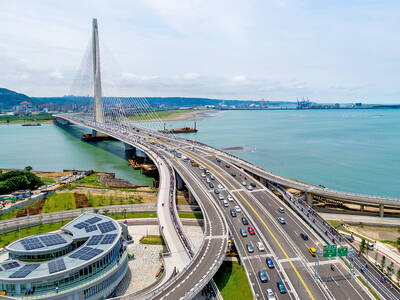
The Ministry of Transportation and Communications yesterday inaugurated the Danjiang Bridge across the Tamsui River in New Taipei City, saying that the structure would be an architectural icon and traffic artery for Taiwan. Feted as a major engineering achievement, the Danjiang Bridge is 920m long, 211m tall at the top of its pylon, and is the longest single-pylon asymmetric cable-stayed bridge in the world, the government’s Web site for the structure said. It was designed by late Iraqi-British architect Zaha Hadid. The structure, with a maximum deck of 70m, accommodates road and light rail traffic, and affords a 200m navigation channel for boats,
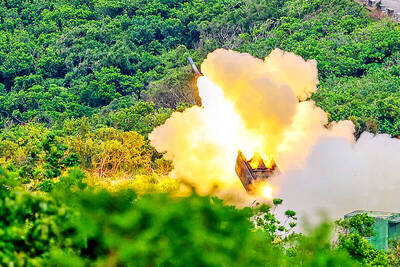
PRECISION STRIKES: The most significant reason to deploy HIMARS to outlying islands is to establish a ‘dead zone’ that the PLA would not dare enter, a source said A High Mobility Artillery Rocket System (HIMARS) would be deployed to Penghu County and Dongyin Island (東引) in Lienchiang County (Matsu) to force the Chinese military to retreat at least 100km from the coastline, a military source said yesterday. Taiwan has been procuring HIMARS and Army Tactical Missile Systems (ATACMS) from the US in batches. Once all batches have been delivered, Taiwan would possess 111 HIMARS units and 504 ATACMS, which have a range of 300km. Considering that “offense is the best defense,” the military plans to forward-deploy the systems to outlying islands such as Penghu and Dongyin so that
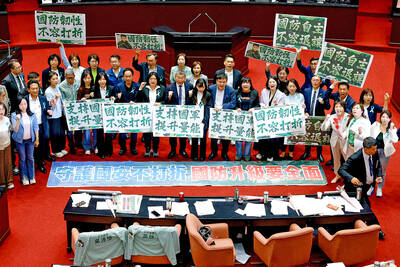
WHAT WAS ALL THAT FOR? Jaw Shaw-kong said that Cheng Li-wen had pushed for more drastic cuts and attacked him, just for the outcome to be nearly identical to his bill The legislature yesterday passed a supplementary budget bill to fund the purchase of separate packages of US military equipment, with the combined amount of spending capped at NT$780 billion (US$24.8 billion). The Chinese Nationalist Party (KMT) and Taiwan People’s Party (TPP) used their legislative majority to pass the bill, which runs until 2033 and has two main funding provisions. One was for NT$300 billion of arms sales already approved by the US for Taiwan on Dec. 17 last year, the other was for NT$480 billion for another arms package expected to be announced by Washington. The bill, which fell short of the NT$1.25

‘CLEAR MESSAGE’: The bill would set up an interagency ‘tiger team’ to review sanctions tools and other economic options to help deter any Chinese aggression toward Taiwan US Representative Young Kim has introduced a bill to deter Chinese aggression against Taiwan, calling for an interagency “tiger team” to preplan coordinated sanctions and economic measures in response to possible Chinese military or political action against Taiwan. “[Chinese President] Xi Jinping [習近平] has directed the People’s Liberation Army to be ready to invade Taiwan by 2027. China has a plan. America should have one too,” Kim said in a news release on Thursday last week. She introduced the “Deter PRC [People’s Republic of China] aggression against Taiwan act” to “ensure the US has a coordinated sanctions strategy ready should


 RSS
RSS