


An Afghan passenger plane carrying 44 people, including six foreigners, crashed yesterday in a mountainous northern region where poor weather was hampering efforts to locate it, officials said. There was no immediate word on casualties.
Rescuers were on their way to the crash site near the 3,800m- high Salang Pass, a major route through the Hindu Kush mountains that connects the capital to the north. The plane, on a flight from the northern city of Kunduz, went down about 100km from Kabul, Kabul International Airport Police Chief Mohammed Asif Jabar Khil said.
Interior ministry spokesman Zemeri Bashary said the plane was operated by Pamir Airways, a private Afghan airline. He said the Afghan government asked NATO for assistance.
NATO said a manned fixed-wing aircraft had been dispatched to the last known position of the missing plane, but poor weather was hampering the aerial search.
Two NATO helicopters have been dispatched to the area and other helicopters with the international coalition are on standby at Bagram Air Field and the Kabul airport to assist in any rescue effort, NATO said in a statement.
“The weather is very bad,” said General Rajab, commander of the Salang Pass for the Afghan Ministry of Public Works, who goes by only one name. “It is snowing. There is flooding.”
Kabul-based Pamir Airways started operations in 1995. According to its Web site, the airline uses Antonov AN-24 aircraft on all its Kunduz-to-Kabul flights. The two-engine turboprop can carry a maximum of 52 passengers, according to the Aviation Safety Network.
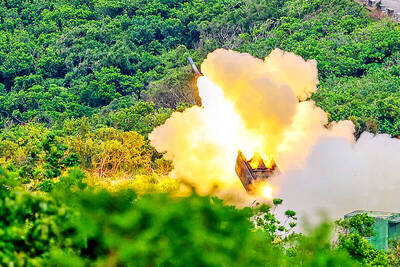
PRECISION STRIKES: The most significant reason to deploy HIMARS to outlying islands is to establish a ‘dead zone’ that the PLA would not dare enter, a source said A High Mobility Artillery Rocket System (HIMARS) would be deployed to Penghu County and Dongyin Island (東引) in Lienchiang County (Matsu) to force the Chinese military to retreat at least 100km from the coastline, a military source said yesterday. Taiwan has been procuring HIMARS and Army Tactical Missile Systems (ATACMS) from the US in batches. Once all batches have been delivered, Taiwan would possess 111 HIMARS units and 504 ATACMS, which have a range of 300km. Considering that “offense is the best defense,” the military plans to forward-deploy the systems to outlying islands such as Penghu and Dongyin so that

WHAT WAS ALL THAT FOR? Jaw Shaw-kong said that Cheng Li-wen had pushed for more drastic cuts and attacked him, just for the outcome to be nearly identical to his bill The legislature yesterday passed a supplementary budget bill to fund the purchase of separate packages of US military equipment, with the combined amount of spending capped at NT$780 billion (US$24.8 billion). The Chinese Nationalist Party (KMT) and Taiwan People’s Party (TPP) used their legislative majority to pass the bill, which runs until 2033 and has two main funding provisions. One was for NT$300 billion of arms sales already approved by the US for Taiwan on Dec. 17 last year, the other was for NT$480 billion for another arms package expected to be announced by Washington. The bill, which fell short of the NT$1.25

‘CLEAR MESSAGE’: The bill would set up an interagency ‘tiger team’ to review sanctions tools and other economic options to help deter any Chinese aggression toward Taiwan US Representative Young Kim has introduced a bill to deter Chinese aggression against Taiwan, calling for an interagency “tiger team” to preplan coordinated sanctions and economic measures in response to possible Chinese military or political action against Taiwan. “[Chinese President] Xi Jinping [習近平] has directed the People’s Liberation Army to be ready to invade Taiwan by 2027. China has a plan. America should have one too,” Kim said in a news release on Thursday last week. She introduced the “Deter PRC [People’s Republic of China] aggression against Taiwan act” to “ensure the US has a coordinated sanctions strategy ready should

A former television news host and six military personnel — active and retired — have been indicted on espionage charges, Kaohsiung prosecutors said yesterday. Lin Chen-you (林宸佑), a former CTi News host and YouTuber, last year allegedly made videos at the direction of a Chinese agent criticizing the Democratic Progressive Party’s recall campaign, the Ciaotou District Prosecutors’ Office told a news conference in Kaohsiung. He allegedly received 4,325 tether coins for the videos from an unidentified person surnamed Huang (黃), believed to be an agent of a hostile foreign power, they said. Lin, also known as Ma Te (馬德), has a show named


 RSS
RSS