


Scuffles broke out on the legislative floor again yesterday over the two controversial bills that aimed to bring Chinese students to Taiwan and to recognize Chinese credentials.
Lawmakers brawled at the Education and Culture Committee as legislative staffers of the committee were trying to read through the minutes of last Wednesday’s session and have legislators confirm that the committee session last week had completed the preliminary review of the two proposals.
Staging a filibuster, Democratic Progressive Party (DPP) legislators occupied the convener’s podium and besieged the legislative staffers amid pushing by Chinese Nationalist Party (KMT) legislators.
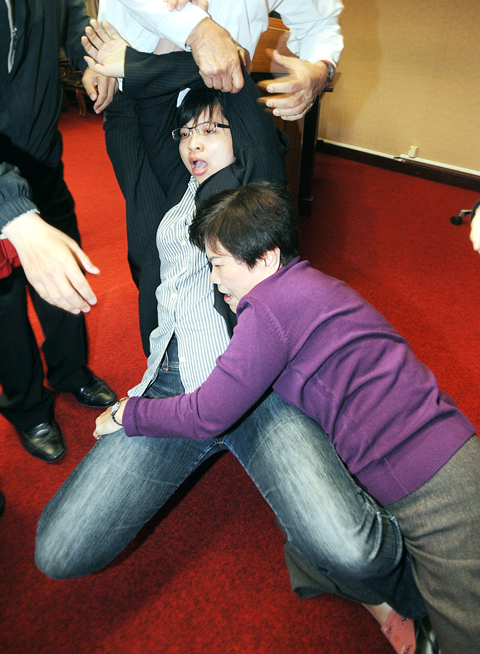
PHOTO: FANG PIN-CHAO, TAIPEI TIMES
At another side of the conference room, DPP Legislator Chiu Yi-ying (邱議瑩) chased KMT Legislator Lu Hsueh-chang (呂學樟), shouting “the KMT should be ashamed” as Lu was leaving for the conference room’s lounge.
Lu at first told Chiu to mind her manners as a woman, but later pushed Chiu to the ground while Chiu kept yelling “shame on [President] Ma Ying-jeou (馬英九)” and “shame on the KMT administration.”
DPP Legislator William Lai (賴清德), who was at the scene, urged Lu to apologize for “hitting a woman,” but Lu refused, arguing that Chiu was accusing him of being shameless.
Meanwhile, KMT Legislator Chao Li-yun (趙麗雲), one of the conveners of the committee, burst into tears, saying that “we are paid to do something instead of being paid to fight.”
Yesterday’s session was the committee’s first meeting after the KMT and the DPP brawled on Wednesday last week when the committee was scheduled to review proposed amendments to the University Act (大學法) and the Vocational School Act (專科學校法) that would allow Taiwanese schools to recruit Chinese students and give recognition to Chinese credentials.
Minister of Education Wu Ching-chi (吳清基) gave a short briefing to the committee during the conflict last week, while Chao later announced that the two bills would be referred to cross-party negotiations — a necessary procedure before the bills can be put to the second reading.
The DPP questioned whether the committee had completed the necessary preliminary review process, while the KMT insisted that the bills had passed committee review. KMT Legislator Chiang Yi-hsiung (江義雄), the other head of the committee, called for a break as yesterday’s conflict escalated. He resumed the meeting shortly afterwards and announced that the minutes had been confirmed — a move meaning that the committee confirmed the referral.
DPP caucus whip Chai Trong-rong (蔡同榮) protested at the result, saying the meeting should be considered invalid as Chiang, who should have presided over yesterday’s session, was not present when legislative staffers read through the minutes.
KMT caucus whip Lin Yi-shih (林益世) dismissed the DPP’s criticism, saying that the committee had followed due procedure.
“DPP legislators, why don’t you just quit and go home? Aren’t you ashamed of being on the government’s payroll [while getting into fights on the legislative floor]?” he asked.

‘NO SECURITY RISK’: The Railway Bureau reassured the public that the technicians’ activities were limited to technical guidance and did not involve sensitive systems The Railway Bureau yesterday said it had invited eight Chinese technicians to assist with an airport MRT construction project. The bureau issued the confirmation after an Internet user said Chinese nationals had entered the construction zone of Taiwan Taoyuan International Airport’s Terminal 3 project. They asked why “individuals from an enemy state” were allowed access to such a major national infrastructure project, which raised serious concerns over Taiwan’s industrial safety, sensitive systems and information security. The bureau’s Northern Region Engineering Branch Office said subcontractor Taiwan Handle Industrial Co (台灣手把工業) of the Taoyuan airport MRT’s “Contract No. CU05 Project A14 Station Civil, MEP &

A US uncrewed surface vessel (USV) encountered multiple Chinese warships during an autonomous transit of the Taiwan Strait, US defense company Seasats said in a statement on Wednesday. Seasats announced that a Lightfish USV had completed the first autonomous transit of the Taiwan Strait. Over five days, the USV traversed the entire length of the Strait while constantly monitoring surface vessel traffic, the company said. The Lightfish encountered multiple Chinese warships, one of which was a Chinese People’s Liberation Army Navy (PLAN) Type 056 corvette, it said. The Chinese vessels were operating “well within Taiwan’s exclusive economic zone without transmitting their identity via the
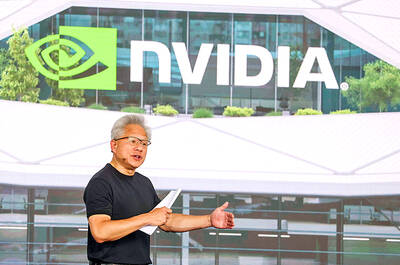
‘BOOMING’: ’ The number of partners we have here is incredible. You can see from their stock prices. They’re doing so well, they’re so happy,’ Jensen Huang said Nvidia Corp’s spending in Taiwan has ballooned to about US$150 billion a year, 10 times the US$10 billion to US$15 billion the company spent five years ago, Nvidia chief executive officer Jensen Huang (黃仁勳) said yesterday, suggesting Taiwan’s strategic importance in the global artificial intelligence (AI) supply chain. “Taiwan is the epicenter of the AI revolution. This is where the chips come, packaging comes. This is where the systems are made. This is where AI supercomputers were created,” Huang said at a meeting for the company’s employees in Beitou-Shilin Technology Park (北投士林科技園區) in Taipei, the planned site of Nvidia’s Taipei headquarters. “Taiwan
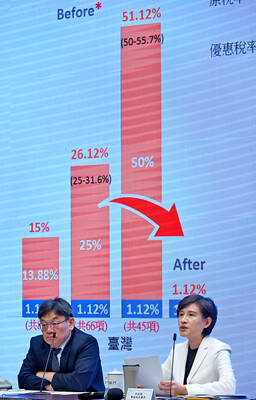
GREATER REACH? Auto parts and wood products would face tariffs of up to 15%, matching those targeting the EU, Japan and South Korea, Vice Premier said The US has announced that preferential tariff treatment for Taiwan’s non-semiconductor Section 232 goods would take effect retroactively from May 1, the Executive Yuan said yesterday. The US government yesterday posted a notice on the Federal Register’s public inspection Web site previewing tariff concessions for Taiwan under a memorandum of understanding (MOU) on Taiwan-US investment after two months of negotiations. The MOU signed on Jan. 15 stipulated three major preferential tariff arrangements: a 15 percent “reciprocal” tariff rate for Taiwan without stacking most-favored nation (MFN) rates; preferential Section 232 treatment for semiconductors and related products; and preferential Section 232 treatment for non-semiconductor


 RSS
RSS