


A Chinese court jailed four Rio Tinto staff for seven to 14 years yesterday for taking bribes and stealing commercial secrets, a sentence Australia said was harsh.
The Shanghai Intermediate People’s Court sentenced China-born Stern Hu (胡士泰), who headed Rio Tinto’s iron ore operations in China, to 10 years in jail, with parts of a seven-year bribery term and a five-year secrets sentence running concurrently.
It handed down jail terms of 14 years to Wang Yong (王勇), eight years to Ge Minqiang (葛民強) and seven years to Liu Caikui (劉才魁), all Chinese nationals.
The four men, dressed casually in sports jackets, stood for the verdicts, which came nine months after they were first detained.
Rio Tinto immediately sacked the four and voiced hope the case wouldn’t affect its vital trade with China.
“In accordance with our policies we will terminate their employment,” said Sam Walsh, the company’s iron ore chief executive, in a statement, describing their behavior as “deplorable.”
Rio chief executive Tom Albanese said ethical behavior was “at the heart of everything we do” as he stressed the importance of the company’s relationship with China, the world’s biggest market for iron ore.
Internal investigation had shown that all wrongdoing was outside company systems, Rio said.
Canberra acknowledged there was convincing evidence of corruption, adding that ties with Beijing would not be hurt by the verdict in a trial that has been closely tied up with politics and diplomacy.
However, Australian Foreign Minister Stephen Smith said he still had “serious unanswered questions” about the most controversial part of the trial, covering the stealing of commercial secrets, which was held behind closed doors.
Smith said China had missed a chance to clarify its secretive and often confusing rules about what constitutes a secret.
“This was an opportunity for China to bring some clarity to the notion or question of commercial secrets,” he told a news conference in Canberra, referring to a decision to close the portion of the trial dealing with commercial secrets to Australian diplomats.
“As China emerges into the global economy, the international business community needs to understand with certainty what the rules are in China,” he said.
“On any measure, this is a very tough sentence. It is a tough sentence by Australian standards. As far as Chinese sentencing practice is concerned, it is within the ambit or within the range,” he said.
“I don’t believe the decision that has been made or has occurred will have any substantial or indeed any adverse implications for Australia’s bilateral relationship with China,” Smith said.
The court said the defendants helped obtain information from confidential strategy meetings of the China Iron and Steel Association, which represents the steel industry in price negotiations.
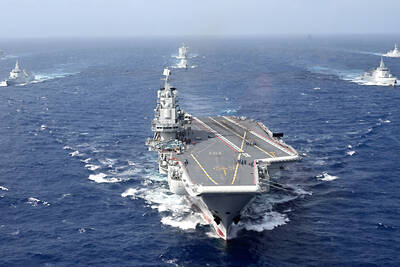
PROVOCATIVE: Chinese Deputy Ambassador to the UN Sun Lei accused Japan of sending military vessels to deliberately provoke tensions in the Taiwan Strait China denounced remarks by Japan and the EU about the South China Sea at a UN Security Council meeting on Monday, and accused Tokyo of provocative behavior in the Taiwan Strait and planning military expansion. Ayano Kunimitsu, a Japanese vice foreign minister, told the Council meeting on maritime security that Tokyo was seriously concerned about the situation in the East China and South China seas, and reiterated Japan’s opposition to any attempt to change the “status quo” by force, and obstruction of freedom of navigation and overflight. Stavros Lambrinidis, head of the EU delegation to the UN, also highlighted South China Sea
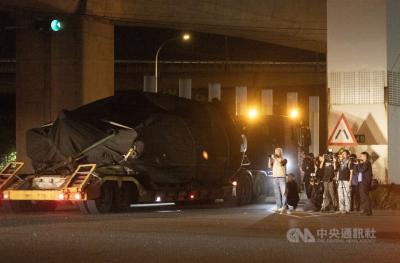
The final batch of 28 M1A2T Abrams tanks purchased from the US arrived at Taipei Port last night and were transported to the Armor Training Command in Hsinchu County’s Hukou Township (湖口), completing the military’s multi-year procurement of 108 of the tanks. Starting at 12:10am today, reporters observed more than a dozen civilian flatbed trailers departing from Taipei Port, each carrying an M1A2T tank covered with black waterproof tarps. Escorted by military vehicles, the convoy traveled via the West Coast Expressway to the Armor Training Command, with police implementing traffic control. The army operates about 1,000 tanks, including CM-11 Brave Tiger
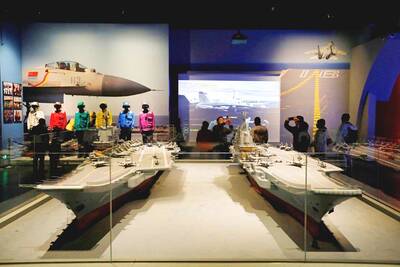
China on Wednesday teased in a video an aircraft carrier that could be its fourth, and the first using nuclear power, while making an allusion to Taiwan and vowing to further build up its islands, as it looks to boost maritime power, secure resources and bolster territorial claims. The video, issued on the eve of the 77th founding anniversary of the Chinese People’s Liberation Army Navy, featured fictional officers with names that are homophones of three commissioned aircraft carriers, the Liaoning (遼寧), Shandong (山東) and Fujian (福建). Titled Into the Deep, it showed a 19-year-old named “Hejian” (何劍) joining the group, sparking
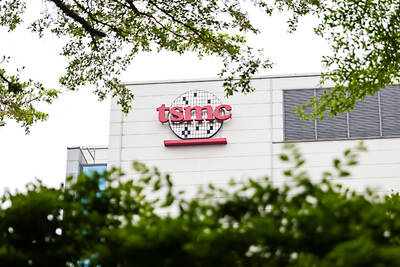
Taiwan Semiconductor Manufacturing Co (TSMC, 台積電), the world’s largest contract chipmaker, said it expects its 2-nanometer (2nm) chip capacity to grow at a compound annual rate of 70 percent from this year to 2028. The projection comes as five fabs begin volume production of 2-nanometer chips this year — two in Hsinchu and three in Kaohsiung — TSMC senior vice president and deputy cochief operating officer Cliff Hou (侯永清) said at the company’s annual technology symposium in Silicon Valley, California, last week. Output in the first year of 2-nanometer production, which began in the fourth quarter of last year, is expected to


 RSS
RSS