


Former National Security Council (NSC) secretary-general Su Chi (蘇起) yesterday confirmed he would attend the Boao Forum in China next month, saying that he wanted to energize himself and make some friends.
Local media reported yesterday that Su was likely to participate in the Boao Forum scheduled for April 9 to April 11 in Hainan Province.
Confirming the report, Su, who had previously commented he could “resurface” after leaving his post at the NSC, said he could now speak and act more freely. After visiting China, Su said he would also attend several international conferences in Europe and the US.
The Presidential Office yesterday declined to comment on whether Su would attend the forum, saying Su was no longer a public official.
Asked whether it was President Ma Ying-jeou’s (馬英九) idea to send Su to the event, Presidential Office Spokesman Lo Chih-chiang (羅智強) said he was in no position to make any remark on the matter because Su no longer served at the NSC.
Ma doubles as the Chinese Nationalist Party (KMT) chairman.
The annual event is a communication channel between the KMT and the Chinese Communist Party.
Mainland Affairs Council (MAC) Deputy Minister Liu Te-shun (劉德勳) said there was no law barring Su from going to China as long as he obtained the permission of the National Immigration Agency (NIA).
Liu said public servants whose jobs involved sensitive matters — such as national security or cross-strait affairs — must obtain permission from the NIA before they visit China.
Each agency sets different time periods for such a requirement, Liu said. At the MAC, Liu said applicants must seek the NIA’s permission if they wish to visit China within three years of leaving their posts at the council. Former officials no longer need to do so three years after their departure, he said.
Su stepped down on Feb. 11 amid calls for his resignation. Citing health and family reasons, Su at the time declined to confirm whether his resignation was linked to the furor over US beef imports. Critics had long urged Su to resign to shoulder responsibility for the fallout over a US beef protocol because he proposed signing it without obtaining public support.
The legislature passed an amendment to the Act Governing Food Sanitation (食品衛生管理法) on Jan. 5 barring imports of specific beef products from countries with documented cases of mad cow disease in the past decade. The vote reversed the deal the Ma administration had signed with Washington in October.
KMT Legislator Lo Shu-lei (羅淑蕾) yesterday questioned the appropriateness of Su participating at the Boao Forum.
Lo told reporters that Ma should prevent Su from traveling to the meeting.
“There are many talented personnel in the KMT. Su is not the only one,” Lo said.
Democratic Progressive Party Legislator Tsai Huang-liang (蔡煌瑯) said it would be “very inappropriate for Su to attend the forum” given that Su was a senior NSC official with access to state secrets.
“I suspect Su is being sent by President Ma to discuss secret deals at the forum and I call on the public to boycott Su’s trip,” Tsai said.
ADDITIONAL REPORTING BY FLORA WANG AND RICH CHANG

CREDIT-GRABBER: China said its coast guard rescued the crew of a fishing vessel that caught fire, who were actually rescued by a nearby Taiwanese boat and the CGA Maritime search and rescue operations do not have borders, and China should not use a shipwreck to infringe upon Taiwanese sovereignty, the Coast Guard Administration (CGA) said yesterday. The coast guard made the statement in response to the China Coast Guard (CCG) saying it saved a Taiwanese fishing boat. The Chuan Yu No. 6 (全漁6號), a fishing vessel registered in Keelung, on Thursday caught fire and sank in waters northeast of Diaoyutai Islands (釣魚台). The vessel left Keelung’s Badouzih Fishing Harbor (八斗子漁港) at 3:35pm on Sunday last week, with seven people on board — a 62-year-old Taiwanese captain surnamed Chang (張) and six

RISKY BUSINESS: The ‘incentives’ include initiatives that get suspended for no reason, creating uncertainty and resulting in considerable losses for Taiwanese, the MAC said China’s “incentives” failed to sway sentiment in Taiwan, as willingness to work in China hit a record low of 1.6 percent, a Ministry of Labor survey showed. The Directorate-General of Budget, Accounting and Statistics (DGBAS) also reported that the number of Taiwanese workers in China has nearly halved from a peak of 430,000 in 2012 to an estimated 231,000 in 2024. That marked a new low in the proportion of Taiwanese going abroad to work. The ministry’s annual survey on “Labor Life and Employment Status” includes questions respondents’ willingness to seek employment overseas. Willingness to work in China has steadily declined from

LEVERAGE: China did not ‘need to fire a shot’ to deny Taiwan airspace over Africa when it owns ‘half the continent’s debt,’ a US official said, calling it economic warfare The EU has raised concerns about overflight rights following the delay of President William Lai’s (賴清德) planned state visit to the Kingdom of Eswatini after three African nations denied overflight clearance for his charter at the last minute. Taiwanese allies Paraguay and Saint Kitts and Nevis, as well as several US lawmakers and the Inter-Parliamentary Alliance on China (IPAC) condemned China for allegedly pressuring the countries. Lai was scheduled to fly directly to Taiwan’s only African ally from yesterday to Sunday to celebrate the 40th anniversary of King Mswati III’s accession and his 58th birthday, but Seychelles, Mauritius and Madagascar suddenly revoked
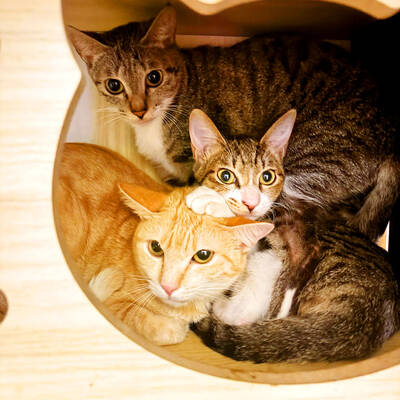
The number of pet cats in Taiwan surpassed that of pet dogs for the first time last year, reaching 1,742,033, a 32.8 percent increase from 2023, the Ministry of Agriculture said yesterday, citing a survey. By contrast, the number of pet dogs declined slightly by 1.2 percent over the same period to 1,462,528, the ministry said. Despite the shift, households with dogs still slightly outnumber those with cats by 1.2 percent. However, while the number of households with multiple dogs has remained relatively stable, households keeping more than two cats have increased, contributing to the overall rise in the feline population. The trend


 RSS
RSS