


The overall monitoring indicators for the nation’s economic climate were rated as “yellow-red,” with the total score soaring to 37 points last month, the highest level since June 2004 and the first use of the colors in 25 months, the Council for Economic Planning and Development (CEPD) said yesterday.
Among the nine components, the industrial production index, custom-cleared exports, imports of machinery and electrical equipment and manufacturing sales saw a year-on-year increase amid the global recovery, the CEPD said.
“The abrupt increase was the result of the low comparison base in the same period last year, so we cannot say that the domestic economy is nearing overheating, but it is certainly recovering at a modest pace,” said Hung Jui-bin (洪瑞彬), director-general of the council’s economic research department.
Hung attributed the steady recovery to improvements in production and trade, in addition to continuously improving international financial conditions.
“This is an unusual case, as it usually takes a while for a ‘yellow-blue’ light — representing economic slowdown — to change to ‘yellow-red’ – slight overheating,” Huang said.
The score came close to the benchmark 38 points for a “red” light, which represents overheating, he said.
Among the nine components, the exports indicator recorded the largest growth at 17.4 points, flashing the first red light in 21 months, with direct and indirect finance and non-agricultural employment still remaining “blue,” the CEPD said.
The leading index stood at 102.7 last month, up 0.7 percent from October, the CEPD said, adding that its annualized six-month rate of change dropped for the second consecutive month to 19.6 percent by 0.3 percentage points.
The coincident index stood at 101.9 points, up 1.1 percent from the previous month, while its trend-adjusted index rose for the 10th consecutive month, up 1.3 percent to 103.8 points, the CEPD said.
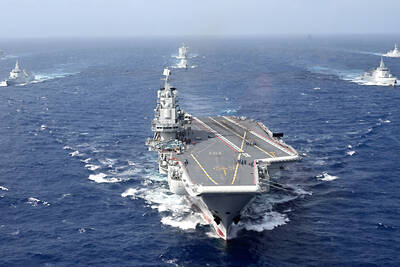
PROVOCATIVE: Chinese Deputy Ambassador to the UN Sun Lei accused Japan of sending military vessels to deliberately provoke tensions in the Taiwan Strait China denounced remarks by Japan and the EU about the South China Sea at a UN Security Council meeting on Monday, and accused Tokyo of provocative behavior in the Taiwan Strait and planning military expansion. Ayano Kunimitsu, a Japanese vice foreign minister, told the Council meeting on maritime security that Tokyo was seriously concerned about the situation in the East China and South China seas, and reiterated Japan’s opposition to any attempt to change the “status quo” by force, and obstruction of freedom of navigation and overflight. Stavros Lambrinidis, head of the EU delegation to the UN, also highlighted South China Sea

The final batch of 28 M1A2T Abrams tanks purchased from the US arrived at Taipei Port last night and were transported to the Armor Training Command in Hsinchu County’s Hukou Township (湖口), completing the military’s multi-year procurement of 108 of the tanks. Starting at 12:10am today, reporters observed more than a dozen civilian flatbed trailers departing from Taipei Port, each carrying an M1A2T tank covered with black waterproof tarps. Escorted by military vehicles, the convoy traveled via the West Coast Expressway to the Armor Training Command, with police implementing traffic control. The army operates about 1,000 tanks, including CM-11 Brave Tiger
Taiwan Semiconductor Manufacturing Co (TSMC, 台積電), the world’s largest contract chipmaker, said it expects its 2-nanometer (2nm) chip capacity to grow at a compound annual rate of 70 percent from this year to 2028. The projection comes as five fabs begin volume production of 2-nanometer chips this year — two in Hsinchu and three in Kaohsiung — TSMC senior vice president and deputy cochief operating officer Cliff Hou (侯永清) said at the company’s annual technology symposium in Silicon Valley, California, last week. Output in the first year of 2-nanometer production, which began in the fourth quarter of last year, is expected to
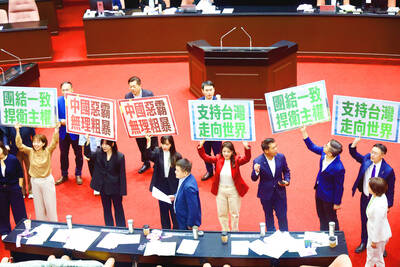
ESWATINI TRIP: The ‘irresponsible actions’ of three African nations set a dangerous precedent and they should be held accountable, a US representative said The US Senate Foreign Relations Committee on Thursday urged Washington not to normalize Chinese pressure, while a US lawmaker called on the US government to hold countries accountable for yielding to Beijing’s pressure to block President William Lai’s (賴清德) planned trip to Eswatini. Lai had been scheduled to visit Eswatini to attend birthday events for King Mswati III of Eswatini this week, but on Tuesday, the eve of his planned departure on Wednesday, the Presidential Office said the trip was “suspended” after the Seychelles, Mauritius and Madagascar unexpectedly withdrew overflight permission. “China reportedly pressured Mauritius, Seychelles, and Madagascar to deny airspace access


 RSS
RSS