


Asian leaders discussed plans at a summit yesterday to “lead the world” by forming an EU-style community, as China and India tried to cool a border spat.
Japanese Prime Minister Yukio Hatoyama pressed his regional counterparts to move towards the creation of an East Asian bloc and to take advantage of the region’s more rapid recovery from the global recession compared with the West.
“It would be meaningful for us to have the aspiration that East Asia is going to lead the world,” Hatoyama told the Bangkok Post newspaper.
The community would involve the 10-member ASEAN with regional partners China, Japan, South Korea, India, Australia and New Zealand, Japanese officials have said.
As the Japanese premier outlined his proposals, however, there was debate at the summit in the Thai beach resort of Hua Hin over whether the grouping would also include the US.
Hatoyama said Tokyo’s alliance with Washington was the “cornerstone” of Japanese policy but urged the region to “try to reduce as much as possible the gaps, the disparities that exist amongst the Asian countries.”
East Asian nations would carry out a feasibility study for a huge free-trade zone covering ASEAN, China, Japan and South Korea and also for a larger, looser grouping also involving India, Australia and New Zealand, officials said.
ASEAN leaders have been discussing plans to create their own political and economic community for Southeast Asia by 2015. They also launched the region’s first ever human rights watchdog.
Increased integration has been a recurring theme of the meetings in Thailand, but rancorous rows over borders and human rights have dogged the summit.
Chinese premier Wen Jiabao (溫家寶) agreed with his Indian counterpart Manmohan Singh during talks on the sidelines of the summit yesterday to work toward narrowing differences on a long-simmering border dispute, Chinese state media reported.
Beijing has voiced its opposition to a recent visit by Singh to Arunachal Pradesh, an Indian border state at the core of the dispute, and to a planned visit there next month by exiled Tibetan spiritual leader the Dalai Lama.
Thailand and Cambodia, however, remained at loggerheads over the fate of fugitive former Thai leader Thaksin Shinawatra,
This follows Cambodian Premier Hun Sen’s offer to Thaksin of a job as his economic adviser.

Taiwan is projected to lose a working-age population of about 6.67 million people in two waves of retirement in the coming years, as the nation confronts accelerating demographic decline and a shortage of younger workers to take their place, the Ministry of the Interior said. Taiwan experienced its largest baby boom between 1958 and 1966, when the population grew by 3.78 million, followed by a second surge of 2.89 million between 1976 and 1982, ministry data showed. In 2023, the first of those baby boom generations — those born in the late 1950s and early 1960s — began to enter retirement, triggering
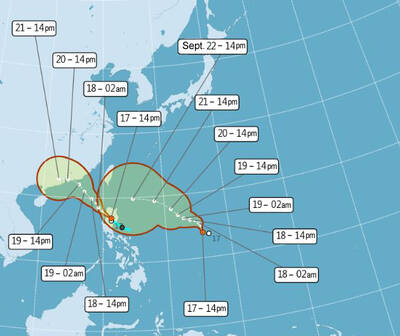
One of two tropical depressions that formed off Taiwan yesterday morning could turn into a moderate typhoon by the weekend, the Central Weather Administration (CWA) said yesterday. Tropical Depression No. 21 formed at 8am about 1,850km off the southeast coast, CWA forecaster Lee Meng-hsuan (李孟軒) said. The weather system is expected to move northwest as it builds momentum, possibly intensifying this weekend into a typhoon, which would be called Mitag, Lee said. The radius of the storm is expected to reach almost 200km, she said. It is forecast to approach the southeast of Taiwan on Monday next week and pass through the Bashi Channel
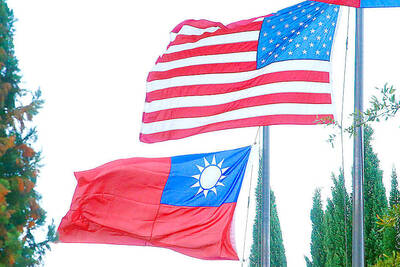
NO CHANGE: The TRA makes clear that the US does not consider the status of Taiwan to have been determined by WWII-era documents, a former AIT deputy director said The American Institute in Taiwan’s (AIT) comments that World War-II era documents do not determine Taiwan’s political status accurately conveyed the US’ stance, the US Department of State said. An AIT spokesperson on Saturday said that a Chinese official mischaracterized World War II-era documents as stating that Taiwan was ceded to the China. The remarks from the US’ de facto embassy in Taiwan drew criticism from the Ma Ying-jeou Foundation, whose director said the comments put Taiwan in danger. The Chinese-language United Daily News yesterday reported that a US State Department spokesperson confirmed the AIT’s position. They added that the US would continue to
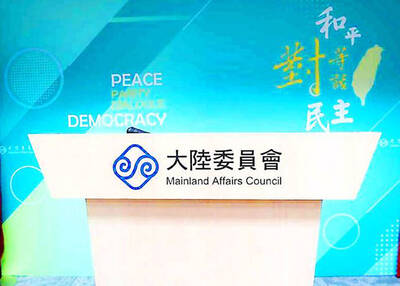
The number of Chinese spouses applying for dependent residency as well as long-term residency in Taiwan has decreased, the Mainland Affairs Council said yesterday, adding that the reduction of Chinese spouses staying or living in Taiwan is only one facet reflecting the general decrease in the number of people willing to get married in Taiwan. The number of Chinese spouses applying for dependent residency last year was 7,123, down by 2,931, or 29.15 percent, from the previous year. The same census showed that the number of Chinese spouses applying for long-term residency and receiving approval last year stood at 2,973, down 1,520,


 RSS
RSS