


The terrorism trial of Zimbabwean Prime Minister Morgan Tsvangirai’s aide Roy Bennett was postponed yesterday, in a case that has unleashed Zimbabwe’s greatest political crisis since the unity government formed.
The delay comes a day after Tsvangirai suspended ties with “unreliable” Zimbabwean President Robert Mugabe’s camp after eight months of fragile partnership amid unresolved disputes over key posts and a crackdown on his supporters.
“It has been agreed by [all] concerned that the matter be postponed. Instead of starting Monday, it starts at a later date,” one of Bennett’s lawyers, Beatrice Mtetwa, told reporters outside the Harare high court.
The Zimbabwe high court on Friday ordered the release of Bennett, who was arrested in February on his return to Zimbabwe, after his bail was revoked by the Mutare magistrate’s court two days earlier.
Tsvangirai earlier shelved cooperation with Mugabe’s ZANU-PF, saying Bennett’s case showed the “fiction of the credibility and integrity” of the partnership with his long-term rival.
“It has brought home the reality that as a movement, we have an unreliable and unrepentant partner,” he told journalists.
“It is our right to disengage from a dishonest and unreliable partner.”
Tsvangirai said he would remain in government but only resume ties once the unity pact was fully in place and all disputes were resolved, which include key posts and a crackdown against his supporters.
Bennett, a white former farmer whose land was seized under Mugabe’s controversial land reforms, was released on Friday.
Bennett’s case immediately became a symbol of the challenges facing the power-sharing pact after his arrest in February, an hour before the unity government swearing-in.
The MDC treasurer was detained on his return from three years in South Africa, where he fled after being implicated in a plot to kill Mugabe.
The state is pushing for his trial to start on Oct. 27 but Mtetwa said the defense wanted more time to prepare.
Meanwhile, Mugabe’s wife was reportedly back in Hong Kong yesterday for the first time since being given diplomatic immunity over an alleged assault.
HONG KONG TRIP
Grace Mugabe, 43, arrived in Hong Kong with an entourage of eight companions on Friday morning and is staying at an undisclosed location, the South China Morning Post reported.
She was escorted through a VIP entrance at Hong Kong International Airport after arriving on a Cathay Pacific flight from Johannesburg, the newspaper said. Her daughter Bona is a university student in Hong Kong.
Grace Mugabe’s visit is her first since January, when she allegedly assaulted British photographer Richard Jones when he took pictures of her shopping close to the luxury hotel where she was staying.
News of Grace Mugabe’s Asian holiday and alleged assault made headlines worldwide at a time when Zimbabwe was suffering from chronic poverty, a cholera epidemic and a political crisis.
She was granted diplomatic immunity as wife of the Zimbabwean president, sparking outrage among legislators and human rights activists.

Right-wing political scientist Laura Fernandez on Sunday won Costa Rica’s presidential election by a landslide, after promising to crack down on rising violence linked to the cocaine trade. Fernandez’s nearest rival, economist Alvaro Ramos, conceded defeat as results showed the ruling party far exceeding the threshold of 40 percent needed to avoid a runoff. With 94 percent of polling stations counted, the political heir of outgoing Costa Rican President Rodrigo Chaves had captured 48.3 percent of the vote compared with Ramos’ 33.4 percent, the Supreme Electoral Tribunal said. As soon as the first results were announced, members of Fernandez’s Sovereign People’s Party
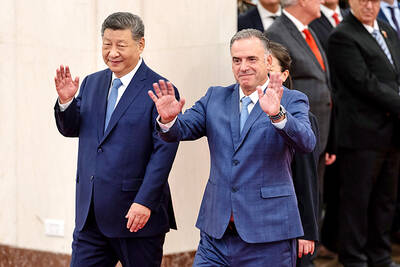
EMERGING FIELDS: The Chinese president said that the two countries would explore cooperation in green technology, the digital economy and artificial intelligence Chinese President Xi Jinping (習近平) yesterday called for an “equal and orderly multipolar world” in the face of “unilateral bullying,” in an apparent jab at the US. Xi was speaking during talks in Beijing with Uruguayan President Yamandu Orsi, the first South American leader to visit China since US special forces captured then-Venezuelan president Nicolas Maduro last month — an operation that Beijing condemned as a violation of sovereignty. Orsi follows a slew of leaders to have visited China seeking to boost ties with the world’s second-largest economy to hedge against US President Donald Trump’s increasingly unpredictable administration. “The international situation is fraught
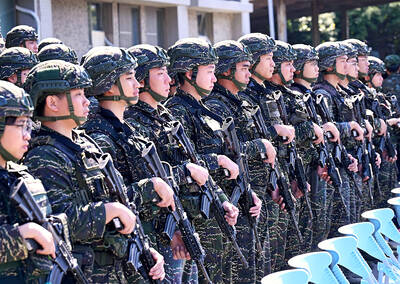
MORE RESPONSIBILITY: Draftees would be expected to fight alongside professional soldiers, likely requiring the transformation of some training brigades into combat units The armed forces are to start incorporating new conscripts into combined arms brigades this year to enhance combat readiness, the Executive Yuan’s latest policy report said. The new policy would affect Taiwanese men entering the military for their compulsory service, which was extended to one year under reforms by then-president Tsai Ing-wen (蔡英文) in 2022. The conscripts would be trained to operate machine guns, uncrewed aerial vehicles, anti-tank guided missile launchers and Stinger air defense systems, the report said, adding that the basic training would be lengthened to eight weeks. After basic training, conscripts would be sorted into infantry battalions that would take
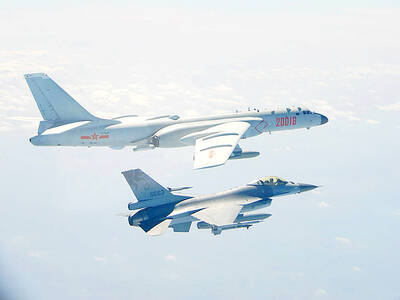
GROWING AMBITIONS: The scale and tempo of the operations show that the Strait has become the core theater for China to expand its security interests, the report said Chinese military aircraft incursions around Taiwan have surged nearly 15-fold over the past five years, according to a report released yesterday by the Democratic Progressive Party’s (DPP) Department of China Affairs. Sorties in the Taiwan Strait were previously irregular, totaling 380 in 2020, but have since evolved into routine operations, the report showed. “This demonstrates that the Taiwan Strait has become both the starting point and testing ground for Beijing’s expansionist ambitions,” it said. Driven by military expansionism, China is systematically pursuing actions aimed at altering the regional “status quo,” the department said, adding that Taiwan represents the most critical link in China’s


 RSS
RSS