


US President Barack Obama told top lawmakers on Tuesday not to politicize his deliberations on whether to send thousands more troops to Afghanistan, but failed to quell raging debate on the unpopular war.
Obama’s meeting with Democratic and Republican power brokers did little to bridge flagrant party divisions over Afghan strategy and reflected the lonely nature of what will be the most fateful decision of his presidency so far.
The White House talks came as Obama plunges deeper into an exhaustive, weeks-long review of Afghan policy, against a backdrop of rising troop deaths, a quickening Taliban insurgency and public anxiety over the course of the war.
“Given the importance of the policy to our security — and to our troops — the president said that he will be rigorous and deliberate, while moving forward with a sense of urgency,” a senior Obama administration official said.
Obama also warned lawmakers not to misrepresent the options — as Republicans demand swift action on troop deployments and some Democrats campaign openly against escalating the war.
“The president reiterated that we need this debate to be honest and dispense with the straw man argument that this is about either doubling down or leaving Afghanistan,” the official said.
The meeting with lawmakers took place on the eve of the eighth anniversary of former US president George W. Bush’s 2001 announcement of the start of air strikes in Afghanistan, following the Sept. 11, 2001, attacks.
Yesterday, Obama was to hold the latest meeting of his war council, including Vice President Joe Biden, Secretary of State Hillary Clinton and Secretary of Defense Robert Gates in the secure White House Situation Room.
Obama must decide whether to meet a request by the military for up to 40,000 more soldiers for a conflict that his commander on the ground, US General Stanley McChrystal, has warned could be lost within a year without more men.
Many Democrats oppose adding to the 68,000 US troops who will be in Afghanistan by the end of the year, fearing a long, unpopular war will turn into a quagmire or drain Obama’s hopes for a reforming presidency.
Republicans want Obama to act fast to send more soldiers, warning failure to do so would endanger US security and invite military defeat.
As debate flares over war strategy within and between the administration and the military, the president warned his eventual decision would not please everyone in Washington, or in the country, the official said.
High-profile leaders who emerged from the White House talks all praised Obama for inviting them — but their comments revealed deep divides over the war pervading Washington.
Republican Senator John McCain warned against one option Obama is thought to be considering — a focused counterterrorism campaign against al-Qaeda, rather than a full-scale counterinsurgency approach favored by McChrystal.
“The fact is, we all know if the Taliban comes back, al-Qaeda will come back,” McCain said, drawing parallels between Afghanistan and the under-resourced US effort in Iraq blamed for fanning the insurgency.
“I am very convinced that General McChrystal’s analysis is not only correct but should be implemented as quickly as possible,” he said.
Democratic Senate Majority leader Harry Reid sought to argue that all the meeting’s participants were on the same page.
“Everyone, Democrats and Republicans, said ‘whatever decision you make we’ll support it basically,’” Reid said.
But Republican Senate leader Mitch McConnell said his party would make up its mind only when the new strategy was clear.
And Eric Cantor, a top Republican in the House of Representatives, said Republicans would only back Obama if he dispatched more troops.
“We were here to express our support for the president and his committing to the mission up front, and expressed our support to work with him if he makes the right decision,” Cantor told CNN.
Democratic House Speaker Nancy Pelosi, who earlier warned of grave reservations in her party about escalating the war, also declined to give an undertaking to support Obama’s decision.
“There was agreement that it’s a difficult decision for the president to make,” she told reporters outside the White House. “Whether we agreed with it or vote for it remains to be seen, when we see what the president puts forth.”
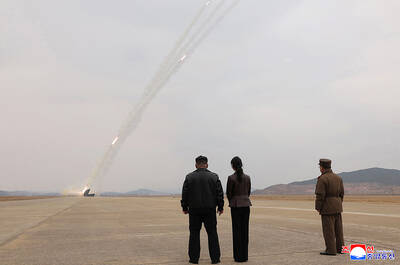
North Korea tested nuclear-capable rocket launchers, state media reported yesterday, a day after Seoul detected the launch of about 10 ballistic missiles. The test comes after South Korean and US forces launched their springtime military drills, due to run until Thursday. North Korean leader Kim Jong-un on Saturday oversaw the testing of the multiple rocket launcher system (MRLS), the Korean Central News Agency (KCNA) said. The test involved 12 600mm-caliber ultra-precision multiple rocket launchers and two artillery companies, it said. Kim said the drill gave Pyongyang’s enemies, within the 420km striking range, a sense of “uneasiness” and “a deep understanding

RECOGNITION: Former Fijian prime minister Mahendra Chaudhry said that Taiwan’s New Southbound Policy serves as a stabilizing force in the Indo-Pacific region Taiwan can lead the unification of the Chinese people, Nobel Peace Prize laureate and former Polish president Lech Walesa said in Taipei yesterday, adding that as the world order is changing, peaceful discussion would find good solutions, and that the use of force and coercion would always fail. Walesa made the remarks during his keynote address at a luncheon of the Yushan Forum in Taipei, titled “Indo-Pacific Partnership Prospects: Taiwan’s Values, Technology and Resilience,” organized by the Taiwan-Asia Exchange Foundation with the Ministry of Foreign Affairs. Walesa said that he had been at the forefront of a big peaceful revolution and “if

North Korea yesterday fired about 10 ballistic missiles to the sea toward Japan, the South Korean Joint Chiefs of Staff (JCS) said, days after Pyongyang warned of “terrible consequences” over ongoing South Korea-US military drills. Pyongyang recently dashed hopes of a diplomatic thaw with Seoul, Washington’s security ally, describing its latest peace efforts as a “clumsy, deceptive farce.” Seoul’s military detected “around 10 ballistic missiles launched from the Sunan area in North Korea toward the East Sea [Sea of Japan] at around 1:20pm,” JCS said in a statement, referring to South Korea’s name for the body of water. The missiles

‘UNWAVERING FRIENDSHIP’: A representative of a Japanese group that co-organized a memorial, said he hopes Japanese never forget Taiwan’s kindness President William Lai (賴清德) yesterday marked the 15th anniversary of the Tohoku earthquake and tsunami, urging continued cooperation between Taiwan and Japan on disaster prevention and humanitarian assistance. Lai wrote on social media that Taiwan and Japan have always helped each other in the aftermath of major disasters. The magnitude 9 earthquake struck northeastern Japan on March 11, 2011, triggering a massive tsunami that claimed more than 19,000 lives, according to data from Japanese authorities. Following the disaster, Taiwan donated more than US$240 million in aid, making it one of the largest contributors of financial assistance to Japan. In addition to cash donations and


 RSS
RSS