

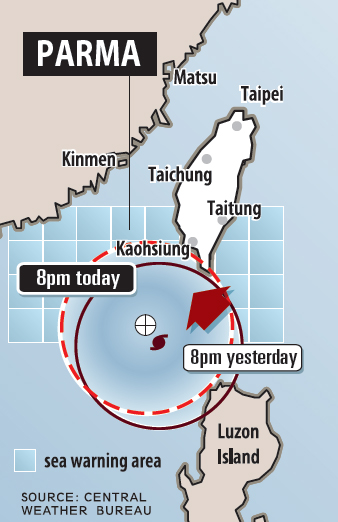
The Central Weather Bureau (CWB) issued a land warning for Typhoon Parma in the Hengchun Peninsula yesterday and said the storm would bring strong winds and heavy rain as it made a slow approach north.
The weather system, with winds gusting up to 155kph, was 270km south of Oluanbi (鵝鑾鼻) as of 9:15pm, moving slowly in a north-northwesterly direction, the bureau said.
“The typhoon is forecast to move along the [northern] track until Monday night and then turn southwest,” CWB forecaster Hsiao Chia-sen (蕭家森) said. “In the next two to three days, the typhoon may move slowly and hover around the Bashi Channel.”
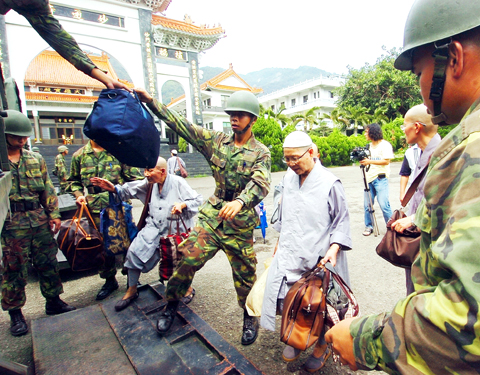
PHOTO: HUANG CHIH-YUAN, TAIPEI TIMES
He urged residents of Hengchun Township (恆春) to take precautions against powerful winds and rains.
Residents in northern and eastern parts of Taiwan should also be on guard against heavy rains brought by the typhoon, he said.
Authorities suspended air and sea links with outlying islands yesterday and about 55 international flights were either canceled or delayed.
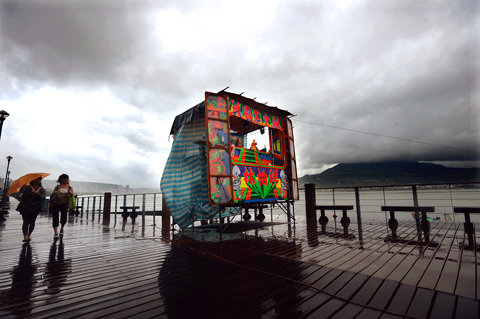
PHOTO: LIN CHENG-KUNG, TAIPEI TIMES
The Directorate General of Highways was closely monitoring 60 highways, including roads leading to Alishan and the Southern Cross-Island Highway.
The roads would be closed if necessary, it said.
Following criticism of the government’s handling of Typhoon Morakot and its aftermath, authorities started evacuations in four central and southern counties on Saturday after the weather bureau said the typhoon could bring torrential rains and trigger landslides.
Evacuation from potentially hazardous areas — especially those devastated by Morakot — continued as strong winds and rain brought by the approaching typhoon began in parts of the country yesterday. Evacuation of more than 400 residents in Laiji Village (來吉) and Alishan Township (阿里山) in Chiayi County began early yesterday morning after the bureau issued the first land warning for Parma.
Laiji, as well as several other villages in the region, was completely cut off in August as all the roads leading to the mountainous village were damaged by mudslides triggered by rains brought by Morakot. The roads remained damaged for nearly a month and the villages relied on helicopters and manpower for food and other necessities.
Fearing a repeat scenario, residents in those parts of the country most devastated in August were more eager to evacuate this time, police and rescue workers said, adding that many had already left before evacuation orders were issued.
At press time, 440 Laiji villagers were staying in temples and army bases in Chiayi. The Chiayi County Government said it planned to evacuate 2,629 people and had set up 30 shelters across the country.
Meanwhile, the Kaohsiung County Government said it had evacuated more than 700 people from potentially hazardous areas including Liouguei (六龜), Taoyuan (桃源), Maolin (茂林), Jiasian (甲仙) and Namasiya townships.
People were also evacuated from Nantou, Pingtung and Taitung counties.
Although most people cooperated with evacuation orders, a 92-year-old woman in Shenmu Village (神木), Nantou County’s Sinyi Township (信義), initially refused to leave.
“I don’t want to leave, I’ve never left the village, it’s safe here,” the woman told the village chief and rescue workers when they visited her house and asked her to leave.
She only agreed after hours of persuasion by her children and grandchildren.
The Ministry of National Defense also deployed some 200 soldiers from elite units to remote villages while putting 35,000 on standby.
At a press conference held at the Central Emergency Operation Center yesterday, Premier Wu Den-yih (吳敦義) said he had told the Pingtung County Government to draw up measures to prevent people from surfing, fishing and watching the waves along the coast.
He said he had ordered the Water Resources Agency to cooperate with the Taitung and Pingtung county governments in dredging rivers in eastern Taiwan ahead of the typhoon.
Wu said President Ma Ying-jeou (馬英九) was very concerned about possible damage if the typhoon brought torrential rain.
The CWB dispatched 25 weather experts to assist local emergency operation centers, Wu said.
“If it turns out that the typhoon spares us, the entire country will have held a thorough [disaster prevention] drill,” Wu said.
“And if the typhoon does hit, we need to mitigate the damage it causes,” he said.
While the Taipei City Government has stockpiled sandbags for residents to keep floodwater from reaching their homes, Taipei Mayor Hau Lung-bin (郝龍斌) said it was unlikely that the city would declare a typhoon day today because the rainfall in Taipei had not exceeded the city’s standard for closing workplaces and schools — 78mm per hour.
At press time, Pingtung County’s Hengchun, Checheng (車城), Manjhou (滿州), Fangshan (枋山), Shihzih (獅子) and Mutan (牡丹) townships, Taitung County’s Daren Township (達仁) were the only ones declaring today a typhoon day, canceling work and classes.
Wu also warned of possible mudslides in Hualien after a major earthquake off the coast of Hualien early yesterday morning.
While the bureau put the magnitude at 6.3 on the Richter scale, the US Geological Survey said it was 6.1, after first gauging it at 6.2.
The survey said the quake, which struck at 1:36am yesterday, was centered about 29km south of Hualien.
It was strong enough to wake some people in Taipei.
“We do not have reports of casualties or damage,” an official from the CWB said.
The bureau warned residents in coastal areas to be on the lookout for large waves, but did not issue a tsunami warning.
“Judging from the [mudslide] situations after the 921 Earthquake [on Sept. 29, 1999], earthquakes could induce more landslides,” Wu said.

Taiwan, which accounts for more than half of the global outsourced semiconductor assembly and testing market, is well-positioned to develop copackaged optics (CPO) and manufacture precision silicon photonics chips, the Ministry of Economic Affairs said yesterday. Silicon photonics are emerging as a mainstream optical communications technology and is seen as key to overcoming bottlenecks in AI computing power. The technology is a key project under the government’s New 10 Major AI Infrastructure Projects, with industry, government, academia and research institutions working to overcome critical technological hurdles and build a self-reliant silicon photonics supply chain, the ministry said. Nvidia Corp in March invested US$4
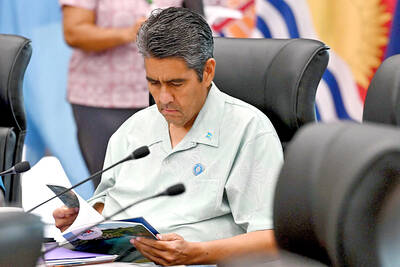
Palau’s president yesterday called for a “unified” Pacific response to a missile test by China in July, while Taiwan and its Pacific allies a day earlier at the Pacific Islands Forum (PIF) reaffirmed their commitment to peace, stability and prosperity. China gave only a handful of nations short notice before test-firing an intercontinental ballistic missile in July, sparking condemnation from several Pacific leaders. The 18-member PIF being held in Palau was expected to release a communique after press time last night, with a formal response to the test possibly included. Palau, which invited Taiwan to attend sideline events as an aid partner, urged
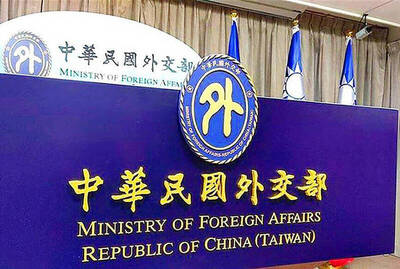
China’s continued efforts to inject geopolitical rivalry into the region and disrupt Pacific nations’ discussions of regional issues warrant greater international attention, a foreign affairs official said yesterday. Minister of Foreign Affairs Lin Chia-lung (林佳龍) last week led a delegation to diplomatic ally Palau to attend events related to the 55th Pacific Islands Forum (PIF) summit. However, the absence of some member-state leaders has been interpreted by some people as a sign of fracturing in Pacific unity. Thirteen PIF members were represented by their heads of state or government, while Fiji, New Caledonia, Vanuatu and Samoa sent ministerial-level representatives, a diplomatic official

STATE DEPARTMENT: A US official said that Washington would provide more than US$150m for Pacific island nations, with Minister Lin Chia-lung welcoming the plans The US Department of State has announced partnerships with Taiwan on two Palau projects after Washington pledged more than US$150 million for Pacific island nations. Following the opening of the 55th Pacific Islands Forum (PIF) Leaders Meeting in Palau on Sunday, the department on Tuesday issued a statement titled “Promoting Pacific Prosperity: US Engagement at the Pacific Islands Forum,” which said that the US’ commitment to the security and prosperity of Pacific island nations “is steadfast and enduring, and remains a core pillar of its ‘America first’ foreign policy.” Meanwhile, US Deputy Secretary of State Christopher Landau announced at the PIF Partners


 RSS
RSS