

The Taipei District Court yesterday handed down prison sentences ranging from six months to one-and-a-half years to members of former president Chen Shui-bian’s (陳水扁) family and former Taipei Financial Center Corp (台北金融大樓公司) chairwoman Diana Chen (陳敏薰) for perjury.
The former president’s son, Chen Chih-chung (陳致中), daughter Chen Hsing-yu (陳幸妤) and son-in-law Chao Chien-ming (趙建銘) each received six-month prison sentences, which were half the length of one year following commutation.
Although they do not qualify for a scheme that lets those convicted to terms of six months or less pay a fine rather than serve jail time, they will be able to take advantage of a new program that allows convicts to do community service rather than go to jail.
Former first lady Wu Shu-jen (吳淑珍), convicted for instigating perjury, received a one-year jail sentence, which was half the sentence following commutation.
As the former first family committed perjury before April 24, 2007, and because the offenses they committed were eligible for commutation, they met the requirements of the 2007 Sentence Commutation (罪犯減刑條例) and had their sentences reduced by half.
All sentences can be appealed.
Presiding Judge Chen Hsing-pang (陳興邦) said Chen Chih-chung, Chen Hsing-yu and Chao Chien-ming followed the former first lady’s instructions in giving false testimony in 2005 when questioned about the presidential “state affairs fund,” a public fund earmarked for the president’s official use and for which Chen Shui-bian has been accused of embezzling from during his presidency.
They were listed as defendants on June 3 and indicted on July 17.
The former first lady was charged with instigating perjury for allegedly instructing her children to lie during a probe into the embezzlement charges against both herself and her husband.
Diana Chen received the full sentence of one year and six months because she committed perjury after Apr. 24, 2007, and therefore did not qualify for a reduced sentence. Her refusal to admit to the charges against her in exchange for a lighter sentence also resulted in her receiving a longer prison sentence than the others.
Prosecutors said she purposely gave false testimony during questioning last year about the former first family’s alleged money-laundering activities. They also said Diana Chen bribed the former first lady with NT$10 million (US$300,000) to obtain her position as chairwoman of Taipei Financial Center Corp.
Chen Shui-bian stands accused of embezzling public funds, money laundering, accepting bribes on a land deal, influence peddling and forgery.
The District Court will announce its verdict on Sept. 11.
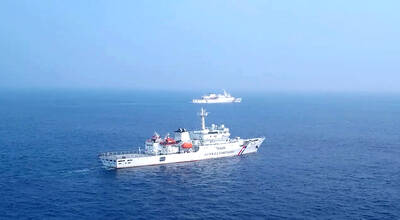
PATROL PARTNERS: The ‘Chiayi’ and the ‘Penghu’ departed for a two-day joint patrol of Palau’s exclusive economic zone, the CGA’s second diplomatic visit to the country The Coast Guard Administration (CGA) set a record for its southernmost deployment of a coast guard vessel as the vessels Chiayi and the Penghu reached Palau’s Pulo Anna Island on Saturday in a cooperative exercise between the two countries. The island, about 217 nautical miles (401km) southwest of Koror in the Palauan state of Sonsorol and 1,220 nautical miles from Taiwan’s southernmost point, Oluanpi (鵝鑾鼻), is the furthest south a CGA vessel has sailed. The two vessels are in Palau for the coast guard’s second diplomatic visit to the country. They docked at Malakal Harbor on Tuesday last week. The coast guard
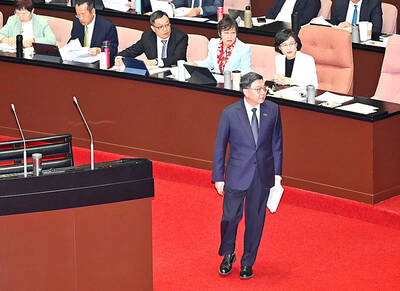
The government is monitoring online rumors that a pneumonic plague outbreak has spread from Russia into China, and it might enhance quarantine measures, Premier Cho Jung-tai (卓榮泰) said yesterday. During a legislative meeting, Democratic Progressive Party Legislator Wang Ting-yu (王定宇) said that rumors had circulated that the disease had spread across several Chinese provinces. He asked Cho whether the government was prepared to prevent the disease spreading to Taiwan, given the volume of traffic between the two sides, and how concerned the government was about the alleged outbreak. The Ministry of Health and Welfare had implemented border quarantine measures after briefing the Executive
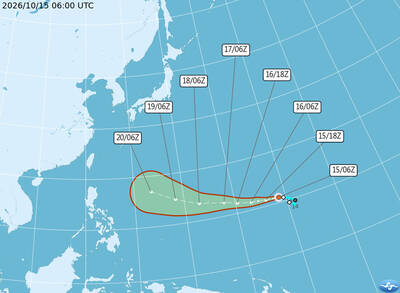
EAST OF GUAM: Tropical Storm Champi is forecast to strengthen into a typhoon, but its effect on Taiwan is uncertain due to the presence of a high-pressure system Tropical Storm Champi formed yesterday and has the potential to increase in strength, the Central Weather Administration (CWA) said yesterday. Forecasters are closely monitoring a Pacific high-pressure system that would dictate whether the storm turns north or moves toward Taiwan next week, the CWA said. The most likely scenario is that it turns northward after passing the Ryukyu Islands, CWA forecaster Cheng Chieh-jen (鄭傑仁) said. As of 8pm yesterday, Champi was east of Guam moving west-northwest at 20kph, CWA data showed. It had maximum sustained winds near the center of 72kph and gusts of up to 101kph, the data showed. If the Pacific high-pressure system
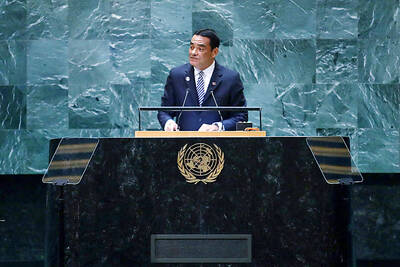
RIGHT TO DIPLOMACY: Under the UN Charter, every state has the right to conduct foreign policy free from external pressure, Belize said in a statement Belize and Paraguay on Monday condemned Beijing sanctions over their countries’ ties with Taiwan, saying China’s actions create unnecessary tensions. Earlier on Monday, Beijing announced sanctions against Paraguayan Minister of Information and Communication Technologies Gustavo Villate and Belizean Minister of Foreign Affairs Francis Fonseca. The Paraguayan Ministry of Foreign Affairs said it rejected the sanctions, writing on X that they created unnecessary friction. It added that it reaffirmed its support for Taiwan and its commitment to democratic values and principles. Villate told the Spanish-language Paraguayan daily ABC Color the sanctions were “predictable” and linked them to several cooperation projects between Taiwan and Paraguay. The projects


 RSS
RSS