


Two truck bombs targeting a tiny sect in a village in northern Iraq and a spate of bloody bombings in Baghdad killed at least 42 people yesterday and wounded nearly 250, police said.
In the deadliest single attack, two booby-trapped trucks exploded before dawn in the village of Khaznah, east of the restive northern Iraqi city of Mosul, leaving 28 people dead and 155 wounded.
The massive blasts leveled 35 houses and gouged deep craters into the ground of the prosperous village of 3,000, home to members of the small Shabak community, a sect of Kurdish origin.
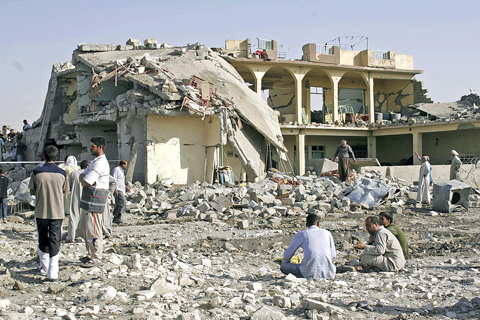
PHOTO: AP
Falah Ridha, a 23-year-old nurse wounded in the attack, said he was the only survivor of 12 people in his family home.
“Eleven people in my family were killed when their house collapsed. All of them woke up after the first bomb, but the second bomb was very close to my house, it was like an earthquake,” he said. “No one else escaped, just me.”
Mohammed Kadhem, 37, said: “I was sleeping on the roof and I woke up as if there was an earthquake. After that I saw a plume of smoke and dust spreading everywhere.”
“A minute later another bomb went off, knocking me off the roof onto the ground,” he said.
Another resident, Assaad Salem, said: “I had just finished my prayers and was trying to sleep when the first bomb went off ... Then the other bomb went off and I thought this is doomsday, this is the end of all life.”
Mosul has been the frequent target of attacks despite a marked decline in violence elsewhere in the country, and US commanders describe it as the last urban bastion of al-Qaeda loyalists in Iraq.
The country’s second city with a population of about 1.6 million, Mosul is mainly Sunni — both Arab and Kurdish — but it also has significant Christian and Shiite Turkmen minorities.
In Baghdad, two bombs went off as day workers gathered in the morning to look for jobs.
The first bomb, hidden inside a bag of cement, exploded at Hay al-Amel in the west of the capital, killing seven people and injuring 46.
The second attack, a car bomb in Shurta Arbaa in the north of the city, killed nine people and wounded 36 others.
A third bombing at a market in the southern suburb of Saidiyah killed three people and wounded 14.
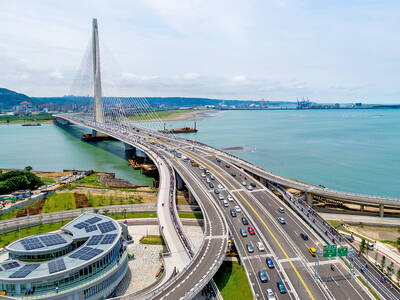
The Ministry of Transportation and Communications yesterday inaugurated the Danjiang Bridge across the Tamsui River in New Taipei City, saying that the structure would be an architectural icon and traffic artery for Taiwan. Feted as a major engineering achievement, the Danjiang Bridge is 920m long, 211m tall at the top of its pylon, and is the longest single-pylon asymmetric cable-stayed bridge in the world, the government’s Web site for the structure said. It was designed by late Iraqi-British architect Zaha Hadid. The structure, with a maximum deck of 70m, accommodates road and light rail traffic, and affords a 200m navigation channel for boats,
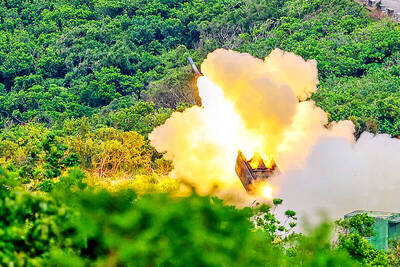
PRECISION STRIKES: The most significant reason to deploy HIMARS to outlying islands is to establish a ‘dead zone’ that the PLA would not dare enter, a source said A High Mobility Artillery Rocket System (HIMARS) would be deployed to Penghu County and Dongyin Island (東引) in Lienchiang County (Matsu) to force the Chinese military to retreat at least 100km from the coastline, a military source said yesterday. Taiwan has been procuring HIMARS and Army Tactical Missile Systems (ATACMS) from the US in batches. Once all batches have been delivered, Taiwan would possess 111 HIMARS units and 504 ATACMS, which have a range of 300km. Considering that “offense is the best defense,” the military plans to forward-deploy the systems to outlying islands such as Penghu and Dongyin so that

Taiwan Semiconductor Manufacturing Co (TSMC, 台積電), the world’s largest foundry service provider, yesterday said that global semiconductor revenue is projected to hit US$1.5 trillion in 2030, after the figure exceeds US$1 trillion this year, as artificial intelligence (AI) demand boosts consumption of token and compute power. “We are still at the beginning of the AI revolution, but we already see a significant impact across the whole semiconductor ecosystem,” TSMC deputy cochief operating officer Kevin Zhang (張曉強) said at the company’s annual technology symposium in Hsinchu City. “It is fair to say that in the past decade, smartphones and other mobile devices were

‘CLEAR MESSAGE’: The bill would set up an interagency ‘tiger team’ to review sanctions tools and other economic options to help deter any Chinese aggression toward Taiwan US Representative Young Kim has introduced a bill to deter Chinese aggression against Taiwan, calling for an interagency “tiger team” to preplan coordinated sanctions and economic measures in response to possible Chinese military or political action against Taiwan. “[Chinese President] Xi Jinping [習近平] has directed the People’s Liberation Army to be ready to invade Taiwan by 2027. China has a plan. America should have one too,” Kim said in a news release on Thursday last week. She introduced the “Deter PRC [People’s Republic of China] aggression against Taiwan act” to “ensure the US has a coordinated sanctions strategy ready should


 RSS
RSS