


Premier Liu Chao-shiuan (劉兆玄) said in an interview with Dow Jones Newswires on Thursday that Taiwan could consider including the Chinese yuan in its foreign exchange (forex) reserves, but his view was not shared by other government officials.
During the interview, Liu said Taiwan could consider including the yuan in its foreign exchange reserves as cross-strait ties expand at an unprecedented pace.
“This can be considered, although we don’t have a time frame at the moment,” Liu was quoted as saying in the interview.
When contacted by the Taipei Times by telephone for elaboration yesterday, Vice Premier Paul Chiu (邱正雄) said he didn’t understand why Liu mentioned the subject.
“It was just [Liu’s] idea and he has said no time frame was set, which meant there are many conditions that need to be met before action is taken,” Chiu said.
Earlier yesterday, when approached by reporters for comment, Chiu said the yuan was not an internationally circulated currency because China has not opened its capital account.
“We are unable to find out whether [China] will open its capital account or predict the degree of circulation of Chinese yuan in the future. [Given these, including the yuan in foreign exchange reserves] is just an idea at present,” Chiu said.
The central bank yesterday also flatly rejected the yuan idea.
In a brief statement posted on its Web site, the central bank said it had no plan to include yuan in its foreign exchange reserves because it is not a “freely convertible currency,” stressing that no counterpart around the world has included the currency.
The central bank also dismissed local media reports claiming the US dollar dominated the nation’s foreign exchange reserves at 60 percent, while the euro and the Japanese yen account for 30 percent, with various other currencies filling the remainder.
“The reports are inaccurate,” the statement said.
The nation’s forex reserves totaled US$321.09 billion at the end of last month, the central bank said on Aug. 5. Taiwan holds the world’s fourth-largest forex reserves, behind only those of China, Japan and Russia.
Earlier this week, the Legislature’s Organic Laws and Statutes Bureau published its assessment report on cross-strait financial ties and recommended the central bank convert part of the foreign exchange reserves into Chinese yuan. The bureau said the central bank could deposit its foreign exchange reserves denominated in yuan in Taiwanese banks to be set up in China to help them gain a more secure foothold in the Chinese market.
An official yesterday said on condition of anonymity that the yuan issue was not a story worth pursuing because he believed that Liu was asked a question on a topic he was not familiar with and he gave an indefinite answer.
“I didn’t see any reason why we should regard yuan as a foreign exchange reserve currency. Normally only internationally circulated currencies are components in a country’s foreign exchange reserve investment portfolio,” the official said.
An aide to Liu said she was not able to elaborate on what Liu had meant because she “was not aware” that the issue had been discussed in the office.
Chen Kuo-ming (陳國明), director of the Government Information Office’s Liaison Office, who was present during the Dow Jones interview, said that Liu had made the comment because he had been asked a question.
"I did not feel that Liu was making an announcement when he talked about the issue, neither did I think he was sending up a trial balloon. The question was brought up following some other questions regarding cross-strait issues, and Liu’s attitudes on these questions had been the same — he is open to discussion and has no time frame,” Chen said, referring to other questions asked during the interview on issues about a cross-strait financial memorandum of understanding (MOU) and economic cooperation framework agreement, among others.
Jack Huang (黃蔭基), head of research at SinoPac Financial Holdings Co (永豐金控), said yesterday he didn’t think Liu had raised the yuan issue during the interview on purpose, although he gave his support to the idea because companies and people would have easier access to the Chinese currency and the central bank would increase its income from interest.
Norman Yin (殷乃平), a money and banking professor at National Chengchih University, said he believed Liu’s proposal did not come out of nowhere.
Liu might have meant that Taiwan and China would establish a foreign exchange (FX) swap, an agreement that China has signed with seven or eight countries, like Russia and South Korea, Yin said.
FX swap is a mechanism whereby two parties exchange agreed-upon amounts of two currencies as a spot transaction, simultaneously agreeing to unwind the exchange at future dates.
Yin said the FX swap was already included in the cross-strait negotiation on signing the financial MOU, the details of which are still unclear.
He said Taiwan and China would benefit from the FX swap as trade and investment could be conducted without converting their currencies to US dollars.
“The FX swap would help businesspeople save on conversion costs. With the mechanism in place, we also won’t see a surge in the nation’s foreign exchange holdings in US dollars when cross-strait trade picks up. The US dollar’s exchange rate is not that stable, and more and more people are losing their confidence in the greenback,” Yin said.

The subsidiary of Taiwan Semiconductor Manufacturing Co (TSMC, 台積電) in Kumamoto, Japan, turned a profit in the first quarter of this year, marking the first time the first fab of the unit has become profitable since mass production started at the end of 2024. According to the contract chipmaker’s financial statement released on Friday, Japan Advanced Semiconductor Manufacturing Inc (JASM), a joint venture running the fab in Kumamoto, posted NT$951 million (US$30.19 million) in profit in the January-to-March period, compared with a loss of NT$1.39 billion in the previous quarter, and a loss of NT$3.25 billion in the first quarter of

DRONE CENTRAL: Taiwan aims to become Asia’s democratic hub for drones, with most exports focused on high-quality military-grade models, an official said Taiwan’s drone industry is expected to expand significantly by 2030, producing 100,000 units per month and exporting half of them, the Ministry of Economic Affairs said yesterday. Current drone production capacity is about 15,000 units per month, but the industry can quickly scale up as demand increases, Industrial Development Administration Director-General Chiou Chyou-huey (邱求慧) told a news conference in Taipei. Taiwan’s drone output grew 2.5-fold last year to NT$12.9 billion (US$408.3 million) under a government program to develop the uncrewed vehicle sector, he said. The Executive Yuan in October last year approved plans to invest NT$44.2 billion into domestic production of uncrewed aerial
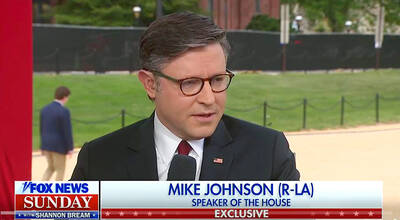
RESOLUTE BACKING: Two Republican senators are planning to introduce legislation that would impose immediate sanctions on China if it attempts to invade Taiwan US House of Representatives Speaker Mike Johnson on Sunday reaffirmed US congressional support for Taiwan, saying the US and “all freedom-loving people” have a stake in preventing China from seizing Taiwan by force. Johnson made the remarks in an interview with Fox News Sunday on US President Donald Trump’s summit with Chinese President Xi Jinping (習近平) last week. In an interview that aired on Friday on Fox News, just as Trump wrapped up a high-stakes visit to China, he said he has yet to green-light a new US$14 billion arms package to Taiwan and that it “depends on China.” “It’s a very good
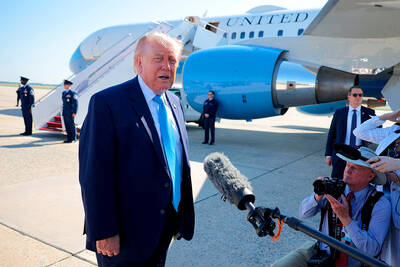
US President Donald Trump yesterday said he would speak to President William Lai (賴清德) as his administration considers whether to move ahead with a US$14 billion weapons sale to Taiwan — a potential arms deal that has drawn criticism from China. “Well, I’ll speak to him. I speak to everybody,” Trump told reporters yesterday when asked if he had any plans to call his counterpart, although he did not offer a time frame for when such a conversation could take place. Trump previously said he would speak to the person “that’s running Taiwan,” without specifying who he meant. “We have that situation very


 RSS
RSS