


The Democratic Progressive Party (DPP) yesterday issued a statement condemning Beijing for using force on protesters in Xinjiang and called on President Ma Ying-jeou (馬英九) to follow suit.
The DPP also called on the Ma administration to discuss democracy and human rights in cross-strait talks and make them prerequisites for improving relations with China.
The party said Uighurs have been slaughtered for protesting China’s rule in Xinjiang.
The DPP said Beijing must face the incident honestly, be transparent, compensate victims immediately and release those arrested.
Beijing must value democracy, freedom and human rights as China integrates economically into international society, the party said.
The DPP said that to push economic relations with China, the Ma government had turned a blind eye to human rights abuses.
The Ma government had led the world to believe Taiwan stands with China over its violations of human rights, while Taiwan’s democracy and human rights were being jeopardized, the party said.
According to DPP Legislator Chen Ting-fei (陳亭妃), Ma said in a statement to mark the 20th anniversary of the Tiananmen Square Massacre that China deserved praise for its progress on human rights. With Beijing launching another brutal crackdown in Xinjiang, she said Ma should apologize for this.
Presidential Office Spokesman Wang Yu-chi (王郁琦) declined to comment on the DPP’s request that Ma condemn China.
In response to the DPP’s call for the Ma administration to include human rights issues in cross-strait negotiations, Wang said the issue would be handled by the Mainland Affairs Council.
Mainland Affairs Council spokesman Liu Te-hsun (劉德勳) urged all sides in Xinjiang to settle their differences peacefully.
Liu said the MAC had commissioned the Straits Exchange Foundation to ascertain the security of Taiwanese businessmen in the region. So far, all are safe.
Chinese Nationalist Party (KMT) spokesman Lee Chien-jung (李建榮) yesterday called on China to handle the incident with care.
“We are not happy to see unrest in any region and we hope the incident will be settled soon,” he said.
He also urged the government to ensure the safety of Taiwanese visitors in the region.
Meanwhile, Uighur human rights activist and dissident Wuer Kaixi (吾爾開希) said yesterday the crackdown on Uighurs reflected unresolved friction between Han Chinese and Uighurs.
Speaking in Taipei, Wuer Kaixi strongly condemned Beijing’s use of force and said China was probably concealing the true death toll.
ADDITIONAL REPORTING BY MO YAN-CHIH

‘NO SECURITY RISK’: The Railway Bureau reassured the public that the technicians’ activities were limited to technical guidance and did not involve sensitive systems The Railway Bureau yesterday said it had invited eight Chinese technicians to assist with an airport MRT construction project. The bureau issued the confirmation after an Internet user said Chinese nationals had entered the construction zone of Taiwan Taoyuan International Airport’s Terminal 3 project. They asked why “individuals from an enemy state” were allowed access to such a major national infrastructure project, which raised serious concerns over Taiwan’s industrial safety, sensitive systems and information security. The bureau’s Northern Region Engineering Branch Office said subcontractor Taiwan Handle Industrial Co (台灣手把工業) of the Taoyuan airport MRT’s “Contract No. CU05 Project A14 Station Civil, MEP &

A US uncrewed surface vessel (USV) encountered multiple Chinese warships during an autonomous transit of the Taiwan Strait, US defense company Seasats said in a statement on Wednesday. Seasats announced that a Lightfish USV had completed the first autonomous transit of the Taiwan Strait. Over five days, the USV traversed the entire length of the Strait while constantly monitoring surface vessel traffic, the company said. The Lightfish encountered multiple Chinese warships, one of which was a Chinese People’s Liberation Army Navy (PLAN) Type 056 corvette, it said. The Chinese vessels were operating “well within Taiwan’s exclusive economic zone without transmitting their identity via the
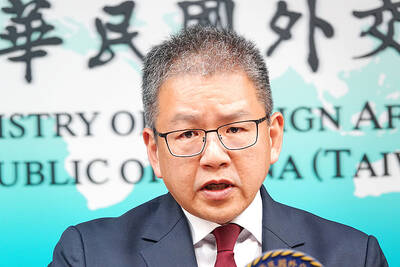
Taiwan is still in the process of assessing the possibility of recruiting workers from Eswatini, the Ministry of Foreign Affairs said yesterday, adding that its goal is to help Eswatini upgrade its vocational training centers. If there are plans to recruit workers from Eswatini, safeguarding national security, protecting public health and ensuring the employment rights of Taiwanese would be prerequisites, Department of West Asian and African Affairs Director-General Yen Chia-liang (顏嘉良) told a news conference. Key considerations would also include filling labor shortages in specific industries, and fostering bilateral professional and technical exchanges, he said. Yen was asked about the progress of labor
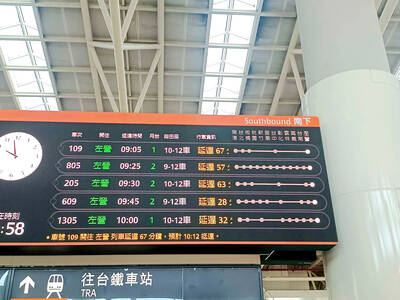
The nation’s usually punctual high-speed rail system yesterday was hit by major disruptions after all scheduled services were canceled and replaced with three hourly trains offering only non-reserved seating, affecting more than 200,000 passengers. Preliminary findings indicate the disruption was caused by a faulty power module in a track switch control cabinet, Taiwan High-Speed Rail Corp (THSRC) said, adding that as a full system inspection could only be conducted after operations end for the day, a decision on whether normal service would resume today would be announced before the first train departs. During a routine inspection early yesterday, a switch signal abnormality


 RSS
RSS