


President Ma Ying-jeou (馬英九) said yesterday the government will draw up a two-stage plan to establish a ministry of oceanic affairs to oversee all maritime and fishery matters.
Ma made the remarks after presiding over an anti-terror exercise in Kaohsiung Harbor that replaced a live-fire military drill meant to simulate a Chinese attack.
“Setting up a ministry of oceanic affairs was a campaign pledge. It will be actualized through a two-stage plan,” he said. “In the first phase, a council on oceanic affairs will be set up. The council will then become a ministry of oceanic affairs when the time is ripe.”
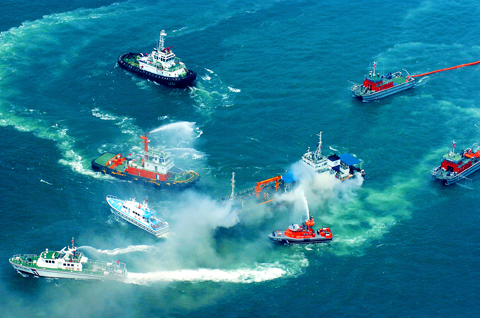
PHOTO: CHANG CHUNG-YI, TAIPEI TIMES
Meanwhile, the government will appropriate NT$25 billion (US$767 million) by 2017 to acquire larger vessels to boost the Coast Guard Administration (CGA), he said, because the coast guard shoulders responsibility for the nation’s sea security alongside the navy.
During the drill at Hsinkuang Wharf (新光碼頭), speedboat-borne “terrorists” hijacked an oil tanker belonging to state-run CPC Corp, Taiwan and a cruise boat hired for next month’s 2009 World Games.
The “terrorists,” holding 23 hostages, then tried to dock at the wharf and launch a land attack.
Coast guard personnel launched a counter-assault by blocking off the wharf to stop the attackers from landing, while coast guard cutters surrounded the two hijacked ships. Helicopters hovered overhead to monitor the situation, while officers began negotiations with the terrorists.
Coast guard special unit divers then swam to the hijacked vessels, while other personnel prepared to descend by rope from the helicopters. A joint water and air assault was successful and the hostages were rescued — including some who were “pushed” into the sea — while the “terrorists” committed suicide by detonating bombs they were wearing.
Coast guard cutters quickly doused fires triggered by the “bombs” on the ships, while more helicopters dropped rope-mop oil skimmers around the ships to prevent possible oil leaks.
The CGA said 995 personnel took part in the drill, which involved eight helicopters and a total of 37 cruisers, cutters and other ships.
“It was very impressive. The officers were well trained and performed well,” Ma said afterwards.
Later yesterday, Ma visited National Kaohsiung Hospitality College, where he outlined his vision of Taiwan becoming a “tourism island” through a concerted effort by the private and public sectors.
“With reconciliation between the two sides of the Taiwan Strait, we no longer need to spend time worrying about war,” Ma said in an address to the school’s faculty and students.
“It is therefore necessary for the authorities to make tourism one of our six flagship industries to develop Taiwan into a global tourist attraction,” he said.
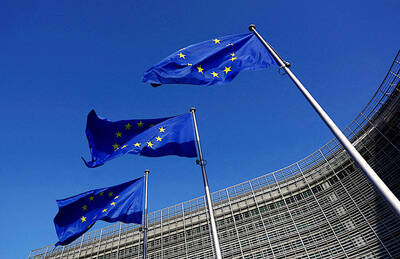
LEVERAGE: China did not ‘need to fire a shot’ to deny Taiwan airspace over Africa when it owns ‘half the continent’s debt,’ a US official said, calling it economic warfare The EU has raised concerns about overflight rights following the delay of President William Lai’s (賴清德) planned state visit to the Kingdom of Eswatini after three African nations denied overflight clearance for his charter at the last minute. Taiwanese allies Paraguay and Saint Kitts and Nevis, as well as several US lawmakers and the Inter-Parliamentary Alliance on China (IPAC) condemned China for allegedly pressuring the countries. Lai was scheduled to fly directly to Taiwan’s only African ally from yesterday to Sunday to celebrate the 40th anniversary of King Mswati III’s accession and his 58th birthday, but Seychelles, Mauritius and Madagascar suddenly revoked
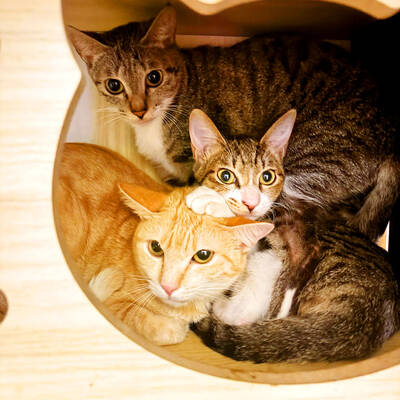
The number of pet cats in Taiwan surpassed that of pet dogs for the first time last year, reaching 1,742,033, a 32.8 percent increase from 2023, the Ministry of Agriculture said yesterday, citing a survey. By contrast, the number of pet dogs declined slightly by 1.2 percent over the same period to 1,462,528, the ministry said. Despite the shift, households with dogs still slightly outnumber those with cats by 1.2 percent. However, while the number of households with multiple dogs has remained relatively stable, households keeping more than two cats have increased, contributing to the overall rise in the feline population. The trend
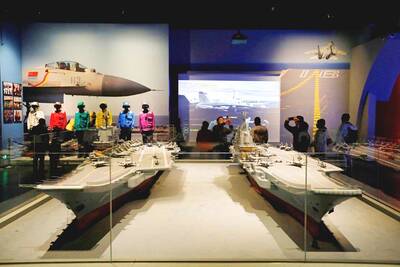
China on Wednesday teased in a video an aircraft carrier that could be its fourth, and the first using nuclear power, while making an allusion to Taiwan and vowing to further build up its islands, as it looks to boost maritime power, secure resources and bolster territorial claims. The video, issued on the eve of the 77th founding anniversary of the Chinese People’s Liberation Army Navy, featured fictional officers with names that are homophones of three commissioned aircraft carriers, the Liaoning (遼寧), Shandong (山東) and Fujian (福建). Titled Into the Deep, it showed a 19-year-old named “Hejian” (何劍) joining the group, sparking
Taiwan has signed six arms procurement offers from the US totaling more than NT$208 billion (US$6.59 billion) covering long-range precision strike systems, missile stockpile replenishment and joint production of large-caliber ammunition, the Ministry of National Defense said yesterday. The government’s proposed NT$1.25 trillion special defense budget has been stalled in the Legislative Yuan as opposition lawmakers question the amount and procurement items, while the Presidential Office and defense ministry say that the full amount is necessary to safeguard Taiwan. Minister of National Defense Wellington Koo (顧立雄) on Monday briefed the legislature’s Foreign Affairs and National Defense Committee on the defense budget for


 RSS
RSS