


About 200 people who live within the boundaries of Kenting National Park in Pingtung County forced their way into the Legislative Yuan yesterday as an Internal Administration Committee meeting was in progress to protest against the National Park Act (國家公園法).
Holding signs that read “We want our right to survival” and “The National Park Act is illegitimate and unjust,” the residents forced their way through a side gate and tried to get into the meeting room as soon as they learned that the Internal Administration Committee had begun an article-by-article review of revisions to the act.
In recent weeks, the Internal Administration Committee has been reviewing amendment proposals made by both the Cabinet and lawmakers to the National Park Act, the first since it was enacted in 1972.
However, Kenting residents — many of whom lived in the area before it was designated a national park in 1982 — worry that the stricter regulations in the proposed amendments could limit their freedoms.
While in its current form Article 17 stipulates that construction or demolition of public or private buildings must obtain government approval, the proposed revision adds that repairs must also be approved by the authorities.
“My house is very old and I need to do repair work on it from time to time. Will I have to wait for my house to collapse if my application to renovate it is rejected?” a protester asked through a loudspeaker.
“We want lawmakers to hear what we have to say,” local borough chief Tsai Cheng-jung (蔡正榮) said. “There have been too many restrictions on our daily lives since Kenting National Park was created. It doesn’t make sense to make the laws even more strict.”
Tsai said the Ministry of the Interior (MOI) — which manages national parks — had not organized public hearings to hear residents’ opinions before making the proposals.
Police officers guarding the legislature attempted to prevent the protesters from entering the compound, but as there were only about a dozen police at the scene, the demonstrators were able to go in.
When protesters discovered that the doors to the meeting room were locked, they tried to get in through a connecting room next door, but were pushed back by police.
Protesters finally agreed to leave after Chinese Nationalist Party (KMT) Legislator Wu Yu-sheng (吳育昇), who presided over the meeting, called it off and asked the MOI to hold public hearings before any further reviews.
Democratic Progressive Party Legislator Tien Chiu-chin (田秋堇) said national parks should be divided into “urban” and “natural reserves.”
“In urban national parks, such as Kenting and Yangmingshan, where people have lived for generations, we should loosen restrictions to make it easier for residents,” she said. “For national parks with little human activity, such as Yushan National Park, however, we could make laws more strict to protect the ecosystem.”

The military has spotted two Chinese warships operating in waters near Penghu County in the Taiwan Strait and sent its own naval and air forces to monitor the vessels, the Ministry of National Defense (MND) said. Beijing sends warships and warplanes into the waters and skies around Taiwan on an almost daily basis, drawing condemnation from Taipei. While the ministry offers daily updates on the locations of Chinese military aircraft, it only rarely gives details of where Chinese warships are operating, generally only when it detects aircraft carriers, as happened last week. A Chinese destroyer and a frigate entered waters to the southwest
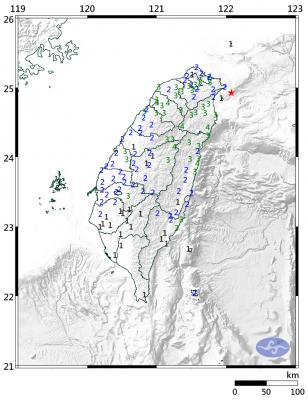
A magnitude 6.1 earthquake struck off the coast of Yilan County at 8:39pm tonight, the Central Weather Administration (CWA) said, with no immediate reports of damage or injuries. The epicenter was 38.7km east-northeast of Yilan County Hall at a focal depth of 98.3km, the CWA’s Seismological Center said. The quake’s maximum intensity, which gauges the actual physical effect of a seismic event, was a level 4 on Taiwan’s 7-tier intensity scale, the center said. That intensity level was recorded in Yilan County’s Nanao Township (南澳), Hsinchu County’s Guansi Township (關西), Nantou County’s Hehuanshan (合歡山) and Hualien County’s Yanliao (鹽寮). An intensity of 3 was

Instead of focusing solely on the threat of a full-scale military invasion, the US and its allies must prepare for a potential Chinese “quarantine” of Taiwan enforced through customs inspections, Stanford University Hoover fellow Eyck Freymann said in a Foreign Affairs article published on Wednesday. China could use various “gray zone” tactics in “reconfiguring the regional and ultimately the global economic order without a war,” said Freymann, who is also a nonresident research fellow at the US Naval War College. China might seize control of Taiwan’s links to the outside world by requiring all flights and ships entering or leaving Taiwan
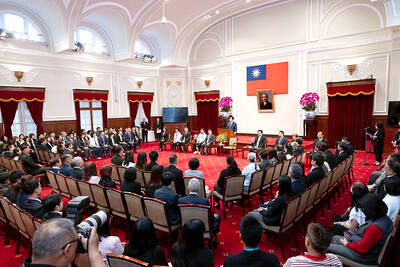
The next minimum wage hike is expected to exceed NT$30,000, President William Lai (賴清德) said yesterday during an award ceremony honoring “model workers,” including migrant workers, at the Presidential Office ahead of Workers’ Day today. Lai said he wished to thank the awardees on behalf of the nation and extend his most sincere respect for their hard work, on which Taiwan’s prosperity has been built. Lai specifically thanked 10 migrant workers selected for the award, saying that although they left their home countries to further their own goals, their efforts have benefited Taiwan as well. The nation’s industrial sector and small businesses lay


 RSS
RSS