


The Associated Press (AP) should apologize and correct a story whose headline suggested President Ma Ying-jeou (馬英九) said that China had approved Taiwan’s participation in the World Health Assembly (WHA) meeting, the deputy foreign minister said.
“The AP story’s headline reads: ‘Taiwan president: China approves island WHO role.’ This is totally untrue, therefore the Presidential Office should ask AP to run a correction and AP should apologize to the government,” Deputy Minister of Foreign Affairs Andrew Hsia (夏立言) told reporters on Friday.
On Wednesday, Department of Health Minister Yeh Ching-chuan (葉金川) said he received a fax from WHO Director-General Margaret Chan (陳馮富珍) on Tuesday night inviting Taiwan to attend the annual assembly this month under the name “Chinese Taipei.”
It will be the first time Taiwan has attended a meeting of a UN specialized agency since the Republic of China forfeited its UN membership in 1971.
Ma held a news conference on Wednesday to break the news, saying participation in this year’s WHA was a result of Taiwan’s perseverance, China’s goodwill and support from the international community.
Ma lauded improvements in cross-strait ties and the building of mutual trust.
Government Information Office Minister Su Jun-pin (蘇俊賓) yesterday said AP should improve the quality of its reporting.
He said the original AP report had been cited by local media and that resulting damage to the government “was not minor.”
“To be honest, we were very troubled by the report … We think that such a professional news outlet should demand its news coverage achieve a certain quality,” Su said.
AP has not responded to the government’s demand. On Friday, Peter Enav, the report’s author and head of AP’s Taiwan bureau, declined to comment when contacted by the Taipei Times.
The Ministry of Foreign Affairs yesterday reiterated that Taiwan’s accession to the WHA as an observer was the result of direct consultation with the WHO and not via Beijing.
But the Central News Agency (CNA) on Thursday quoted WHO spokesman Thomas Abraham as saying that the WHO had no involvement whatsoever in negotiations and that the director-general issued the invitation to Taiwan only after she was notified of the outcome of cross-strait negotiations.
“The ministry is still assessing the CNA report. But I can boldly say the arrangement was not made under Beijing’s dictate and that the diligent efforts of many supporters of Taiwan in the international community have been a crucial factor,” ministry spokesman Henry Chen (陳銘政) said.
Additional reporting by Jenny W. Hsu and Shih Hsiu-chuan
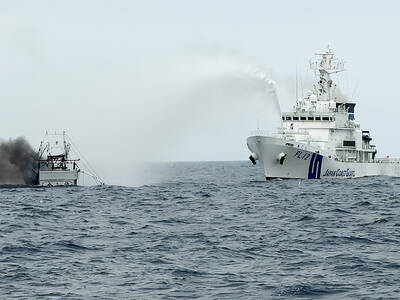
CREDIT-GRABBER: China said its coast guard rescued the crew of a fishing vessel that caught fire, who were actually rescued by a nearby Taiwanese boat and the CGA Maritime search and rescue operations do not have borders, and China should not use a shipwreck to infringe upon Taiwanese sovereignty, the Coast Guard Administration (CGA) said yesterday. The coast guard made the statement in response to the China Coast Guard (CCG) saying it saved a Taiwanese fishing boat. The Chuan Yu No. 6 (全漁6號), a fishing vessel registered in Keelung, on Thursday caught fire and sank in waters northeast of Diaoyutai Islands (釣魚台). The vessel left Keelung’s Badouzih Fishing Harbor (八斗子漁港) at 3:35pm on Sunday last week, with seven people on board — a 62-year-old Taiwanese captain surnamed Chang (張) and six
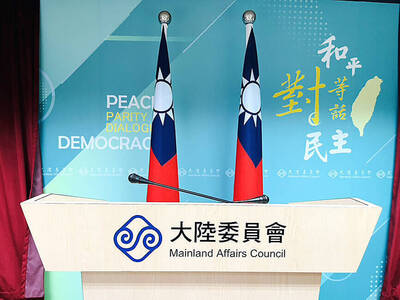
RISKY BUSINESS: The ‘incentives’ include initiatives that get suspended for no reason, creating uncertainty and resulting in considerable losses for Taiwanese, the MAC said China’s “incentives” failed to sway sentiment in Taiwan, as willingness to work in China hit a record low of 1.6 percent, a Ministry of Labor survey showed. The Directorate-General of Budget, Accounting and Statistics (DGBAS) also reported that the number of Taiwanese workers in China has nearly halved from a peak of 430,000 in 2012 to an estimated 231,000 in 2024. That marked a new low in the proportion of Taiwanese going abroad to work. The ministry’s annual survey on “Labor Life and Employment Status” includes questions respondents’ willingness to seek employment overseas. Willingness to work in China has steadily declined from

The Legislative Yuan’s Finance Committee yesterday approved proposed amendments to the Amusement Tax Act (娛樂稅法) that would abolish taxes on films, cultural activities and competitive sporting events, retaining the fee only for dance halls and golf courses. The proposed changes would set the maximum tax rate for dance halls and golf courses at 50 and 20 percent respectively, with local governments authorized to suspend the levies. Article 2 of the act says that “amusement tax shall be levied on tickets sold or fees charged by amusement places, facilities or activities” in six categories: “Cinema; professional singing, story-telling, dancing, circus, magic show, acrobatics

Tainan, Taipei and New Taipei City recorded the highest fines nationwide for illegal accommodations in the first quarter of this year, with fines issued in the three cities each exceeding NT$7 million (US$220,639), Tourism Administration data showed. Among them, Taipei had the highest number of illegal short-term rental units, with 410. There were 3,280 legally registered hotels nationwide in the first quarter, down by 14 properties, or 0.43 percent, from a year earlier, likely indicating operators exiting the market, the agency said. However, the number of unregistered properties rose to 1,174, including 314 illegal hotels and 860 illegal short-term rental


 RSS
RSS