


They’ve been described as “noble heroes” by sympathetic Somalis, denounced as criminals by critics. But the most often used word to describe the men holding an American captain off the Horn of Africa is “pirate” — conjuring images of sword-wielding swashbucklers romanticized by Hollywood.
The 21st century reality, though, is a far cry from that. There are no treasure-laden islands or Blackbeards in this part of the world, no wooden schooners flying skull and crossbones flags.
Instead: a vigilante movement that years ago tried to defend Somali shores morphed into a full-blown pirate scourge — after fishermen on defense stumbled upon an astoundingly lucrative bounty waiting to be had on their doorstep: Around 25,000 ships, most unarmed, transiting the Gulf of Aden each year.
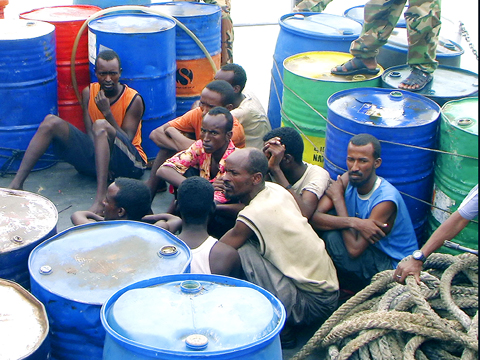
PHOTO: AP
Picture ragged Somali fishermen armed with rocket launchers, GPS systems and satellite phones. Picture tiny skiffs cruising the coast of a war-infested nation crawling with gunmen. Picture bandits with sunglasses in worn shirts firing machine-guns at cruise ships, scampering aboard captured trawlers with crude ladders.
And most of all, picture ransoms, huge ransoms.
“I think when most people think of pirates, they think of Johnny Depp and the Pirates of the Caribbean,” said security consultant Crispian Cuss of the London-based Olive Group. But these guys are “just fishermen paid to act as pirates by warlords and armed gangs who have taken over a lawless state.”
The plight of an American captain, seized from the US-flagged Maersk Alabama and held by Somali pirates since Wednesday on a drifting lifeboat out of fuel, is only one of the latest examples of a problem that has plagued the region for years.
Captain Richard Phillips, of Underhill, Vermont, is believed to be the first US citizen taken by pirates since 1804, when US Navy Commodore Stephen Decatur battled the infamous Barbary pirates off the northern coast of what is now Libya, dispatching US
Marines to the shores of Tripoli.
The modern piracy scourge in the Horn of Africa arose from the ashes of Somalia’s government, overthrown in 1991.
Since then, Somalia has suffered nearly 20 years of anarchy, chaotically ruled by rival clans backed by pickup trucks mounted with anti-aircraft guns. Its nominal government controls barely a few blocks.
With no coast guard to defend its shores, Somalis began complaining that vessels from Asia and Europe were dumping toxic waste in their waters and illegally scooping up red snapper, barracuda and tuna. The rampant illegal fishing began destroying the livelihoods of local fishermen.
A memo prepared last month by the staff of the US House Armed Services Committee said Somali clans began resorting “to armed gangs in an attempt to stop the foreign vessels. Over time, these gangs have evolved into hijacking commercial vessels for ransom as an alternative source of income.”
Attacks in the Gulf of Aden and along Somalia’s coast have risen dramatically, from 41 in 2007 to 111 in last year, the International Maritime Bureau said. Since January, pirates have staged at least 66 assaults and currently hold more than a dozen ships and more than 200 foreign crew members.
The House memo said pirates operating off Somalia earned US$30 million in ransom through the seizure of 42 vessels last year.
Other estimates put the figure at US$80 million.
The memo cited one captured pirate as saying pirates only take 30 percent of ransoms — on average US$1 million to US$2 million per boat.
Twenty percent goes to group bosses, 30 percent is spent on bribing local officials, and 20 percent goes for capital investment like guns, ammunition, fuel, food and cigarettes. Cuss said pirates were becoming more sophisticated and in the last two months have, for the first time, begun launching nighttime attacks, possibly indicating pirates have obtained night-vision goggles.
US officials have found no direct ties between East African pirates and terror groups, but the illegal trade is believed to be backed by an international network of Somali expatriates who offer funds, equipment and information in exchange for a cut of ransoms.
The House memo said Somali buccaneers operate in five well-organized groups, drawing members from large clans, which are extended family networks. Cuss said the industry is controlled by “warlords and criminal gangs who recruit local fishermen and take a lion’s share of the profits.”
Andrew Mwangura of the Mombasa-based East African Seafarers’ Assistance Program described the pirates as “desperate people taking desperate measures to earn a living.”
Today, they number around 1,500, up from around 100 five to seven years ago, Mwangura said.
“They’re earning a lot of money and everyone wants to join,” Mwangura said. “They’re getting new recruits every day.”
On the ground in Somalia, some pirates are seen as “flamboyant middle-aged men,” said Mahad Shiekh Madar, a car salesman living in the northeastern port town of Bossaso on the tip of Africa’s horn.
“They always travel in beautiful four-wheel-drive luxury cars and look like people who are working for a big business company,” he said.
Abdulahi Salad, a 43-year-old former pirate in the central coastal village of Gaan, said pirates were “different from the ordinary gunmen in Somalia. They are not thin and they have bright faces and are always happy.”
Indeed, they are often highly regarded for bringing wads of cash into impoverished communities.
A local elder in Gaan, Haji Muqtar Ahmed, said “being a pirate is not shame ... it is believed to be a noble profession.”
Ahmed said people there used to make a living fishing, “but now the only livelihood they have is the income from the piracy.”

SPEAKING OUT: After Siranudh Scott’s allegations surfaced, celebrities and public figures took to social media to share their own experiences of sexual misconduct and abuse A high-profile alleged sexual abuse case within a wealthy Thai beer brewing family has prompted a wave of painful accounts from survivors of unconnected abuse in the conservative nation. Siranudh Scott, a member of the billionaire Thai family that founded the ubiquitous Singha beer brand, posted an emotional video this month accusing his elder brother Sunit of repeatedly abusing him when he was a teenager. Sunit, who is in his 30s, later denied the allegations in a video posted online, but Singha parent Boonrawd dismissed him from his executive role with the company on Tuesday last week. “I felt I needed to speak

SEEKING ORDER: Rodrigo Paz said that ‘anyone who wants to destroy the nation will have to deal with this president and the full force of the constitution’ Bolivian President Rodrigo Paz on Wednesday said that the nation was at a “breaking point” after nearly a month of protests that have caused shortages of food, fuel and medicine. Paz, who took office six months ago amid the worst economic crisis there in four decades, is battling a groundswell of fury over his policies. The political capital, La Paz, has been besieged by low-income workers and members of the indigenous majority calling for his resignation. “The country needs order and is reaching breaking point,” the 58-year-old said at a public event in La Paz, renewing his appeal for dialogue. On Tuesday, the Bolivian

COMMUNITY CONFLICT: Concerns about disease spread from corpses has run up against friends and families’ desire to bury their dead as infection spreads in the area Angry residents of a town at the epicenter of the Ebola outbreak in the Democratic Republic of the Congo (DR Congo) attacked and burned a tent that was part of a health center where people are being treated for the virus, the staff there said Saturday. It was the second such attack in the region in a week. No one was hurt in the attack, according to reports but as patients ran out to escape the fire, 18 people with suspected Ebola infections fled the facility and are unaccounted for, a hospital director said. Angry residents arrived at the clinic in the

Forecasters in Europe yesterday warned of exceptional heat as record temperatures driven by a “heat dome” push temperatures well above seasonal norms across the continent. The surge follows a record-breaking Monday, with France logging its hottest day in the month of May on record, its weather agency said, and the UK also posting unprecedented highs. A so-called “heat dome” of warm air from northern Africa trapped under a high-pressure system over western Europe is behind the high temperatures not usually seen until high summer. Restrictions on outdoor work were imposed in parts of Italy, beaches in southwest France filled earlier than usual and


 RSS
RSS