


Indonesia voted yesterday in only its third general election since the fall of the Suharto regime in 1998, with Indonesian President Susilo Bambang Yudhoyono’s Democratic Party tipped to win most seats.
The elections will decide who can run for president in July, when Yudhoyono will seek a second five-year term on the back of his sound economic management and progress in the fight against corruption.
Five people were killed in attacks overnight by suspected pro-independence rebels in eastern Papua Province, but elsewhere in the vast archipelago the vote passed peacefully.
An unofficial tally by the independent Indonesian Survey Institute put the Democrats in front with 18.59 percent of the vote, based on a partial count from 2,100 ballot stations mainly in eastern Indonesia.
Analysts said the tally would change as more votes were counted but so far they were in line with pre-election opinion polls that put the centrist Democrats ahead of former president Megawati Sukarnoputri’s Democratic Party of Struggle and Suharto’s former ruling party, Golkar.
Official results may not be known for days.
Suharto’s resignation amid protests and financial ruin heralded the start of the “Reformasi” era of political change, and yesterday’s vote was seen as a key test for Indonesia’s young democracy.
It will decide who can run for president in the July election, as parties or coalitions must hold 20 percent of seats in the 560-seat lower house or 25 percent of the popular vote to nominate a candidate.
The country’s 171 million eligible voters were asked to choose between thousands of candidates on local, provincial and national levels, across 520,000 polling stations and around 6,000 islands.
Tensions were high in Papua after some 100 suspected separatist guerrillas armed with arrows and bombs attacked a police post.
One of the attackers was shot by police and 11 were arrested.
Elsewhere in Papua, three non-indigenous motorcycle taxi drivers were knifed to death, a girl was killed when a fuel depot was set alight, and police skirmished with suspected rebels along the border with Papua New Guinea.
Voting was peaceful in Aceh Province, where a 30-year separatist conflict ended only four years ago. Several members of the former rebels’ new political party were murdered in the lead-up to the election.
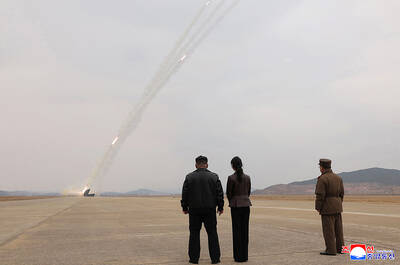
North Korea tested nuclear-capable rocket launchers, state media reported yesterday, a day after Seoul detected the launch of about 10 ballistic missiles. The test comes after South Korean and US forces launched their springtime military drills, due to run until Thursday. North Korean leader Kim Jong-un on Saturday oversaw the testing of the multiple rocket launcher system (MRLS), the Korean Central News Agency (KCNA) said. The test involved 12 600mm-caliber ultra-precision multiple rocket launchers and two artillery companies, it said. Kim said the drill gave Pyongyang’s enemies, within the 420km striking range, a sense of “uneasiness” and “a deep understanding

RECOGNITION: Former Fijian prime minister Mahendra Chaudhry said that Taiwan’s New Southbound Policy serves as a stabilizing force in the Indo-Pacific region Taiwan can lead the unification of the Chinese people, Nobel Peace Prize laureate and former Polish president Lech Walesa said in Taipei yesterday, adding that as the world order is changing, peaceful discussion would find good solutions, and that the use of force and coercion would always fail. Walesa made the remarks during his keynote address at a luncheon of the Yushan Forum in Taipei, titled “Indo-Pacific Partnership Prospects: Taiwan’s Values, Technology and Resilience,” organized by the Taiwan-Asia Exchange Foundation with the Ministry of Foreign Affairs. Walesa said that he had been at the forefront of a big peaceful revolution and “if
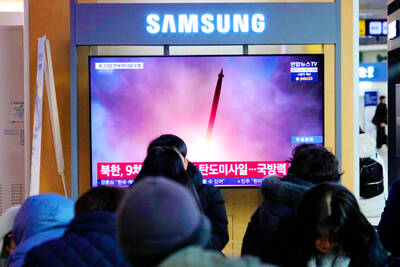
North Korea yesterday fired about 10 ballistic missiles to the sea toward Japan, the South Korean Joint Chiefs of Staff (JCS) said, days after Pyongyang warned of “terrible consequences” over ongoing South Korea-US military drills. Pyongyang recently dashed hopes of a diplomatic thaw with Seoul, Washington’s security ally, describing its latest peace efforts as a “clumsy, deceptive farce.” Seoul’s military detected “around 10 ballistic missiles launched from the Sunan area in North Korea toward the East Sea [Sea of Japan] at around 1:20pm,” JCS said in a statement, referring to South Korea’s name for the body of water. The missiles

‘UNWAVERING FRIENDSHIP’: A representative of a Japanese group that co-organized a memorial, said he hopes Japanese never forget Taiwan’s kindness President William Lai (賴清德) yesterday marked the 15th anniversary of the Tohoku earthquake and tsunami, urging continued cooperation between Taiwan and Japan on disaster prevention and humanitarian assistance. Lai wrote on social media that Taiwan and Japan have always helped each other in the aftermath of major disasters. The magnitude 9 earthquake struck northeastern Japan on March 11, 2011, triggering a massive tsunami that claimed more than 19,000 lives, according to data from Japanese authorities. Following the disaster, Taiwan donated more than US$240 million in aid, making it one of the largest contributors of financial assistance to Japan. In addition to cash donations and


 RSS
RSS