


Moldovan riot police regained control of the president’s office and parliament early yesterday after they were ransacked by protesters who say parliamentary elections were rigged.
A reporter saw about 100 riot police surround the buildings, which had been stormed a day earlier by protesters who set fire to furniture and hurled computers out of the windows.
More than 50 people were injured.

PHOTO: REUTERS
Police arrested 193 people, including eight minors, on charges of “hooliganism and robbery” following the protests against the ruling Communist Party’s victory in weekend elections, Interior Ministry Spokeswoman Ala Meleca said.
Authorities yesterday cleared streets littered with smashed computers and furniture from the parliament building. They swept up burnt documents and shards of glass. Every window on the first six floors of the 11-story parliament building had been smashed.
Moldovan President Vladimir Voronin yesterday accused Romania of being behind the protests and declared its ambassador to Moldova, Filip Teodorescu, persona non grata, Russian language news agency Newsmoldova said.
Romania’s Foreign Ministry declined to comment.
Moldova was part of Romania until 1940.
On Tuesday the president blamed pro-European opposition parties in his country for the violence, calling them “fascists [who] want to destroy democracy and independence in Moldova.”
Voronin’s Communist Party, which has been in power since 2001, won about 50 percent of the vote in Sunday elections.
The violence started on Tuesday after at least 10,000 mostly young protesters gathered outside parliament, demanding new elections.
The demonstrations continued yesterday.
International observers said Moldova’s election was fair, but Chisinau Mayor Dorin Chirtoaca, deputy leader of the opposition Liberal Party, said many people voted more than once.

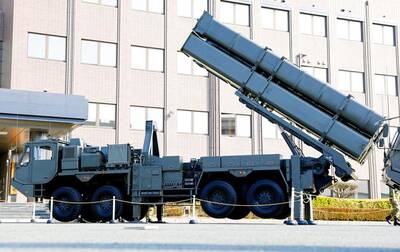
Japan has deployed long-range missiles in a southwestern region near China, the Japanese defense minister said yesterday, at a time when ties with Beijing are at their lowest in recent years. The missiles were installed in Kumamoto in the southern region of Kyushu, as Japan is attempting to shore up its military capacity as China steps up naval activity in the East China Sea. “Standoff defense capabilities enable us to counter the threat of enemy forces attempting to invade our country ... while ensuring the safety of our personnel,” Japanese Minister of Defense Shinjiro Koizumi said. “This is an extremely important initiative for

MORE POPULAR: Taiwan Pass sales increased by 59 percent during the first quarter compared with the same period last year, the Tourism Administration said The Tourism Administration yesterday said that it has streamlined the Taiwan Pass, with two versions available for purchase beginning today. The tourism agency has made the pass available to international tourists since 2024, allowing them to access the high-speed rail, Taiwan Railway Corp services, four MRT systems and four Taiwan Tourist Shuttles. Previously, five types of Taiwan Pass were available, but some tourists have said that the offerings were too complicated. The agency said only two types of Taiwan Pass would be available, starting from a three-day pass with the high-speed rail and a three-day pass with Taiwan Railway Corp. The former costs NT$2,800

NEW LOW: The council in 2024 based predictions on a pessimistic estimate for the nation’s total fertility rate of 0.84, but last year that rate was 0.69, 17 percent lower An expected National Development Council (NDC) report expects the nation’s population to drop below 12 million by 2065, with the old-age dependency ratio to top 100 percent sooner than 2070, sources said yesterday. The council is slated to release its latest population projections in August, using an ultra-low fertility model, the sources said. The previous report projected that Taiwan’s population would fall to 14.37 million by 2070, but based on a new estimate of the total fertility rate (TFR) — the average number of children born to a woman over her lifetime — the population is expected to reach 12 million by

COUNTERING HOSTILITY: The draft bill would require the US to increase diplomatic pressure on China and would impose sanctions on those who sabotage undersea cable networks US lawmakers on Thursday introduced a bipartisan bill to bolster the resilience of Taiwan’s submarine cables to counter China’s hostile activities. The proposal, titled the critical undersea infrastructure resilience initiative act, was cosponsored by Republican representatives Mike Lawler and Greg Stanton, and Democratic Representative Dave Min. US Senators John Curtis and Jacky Rosen also introduced a companion bill in the US Senate, which has passed markup at the chamber’s Committee on Foreign Relations. The House’s version of the bill would prioritize the deployment of sensors to detect disruptions or potential sabotage in real-time and enhance early warning capabilities through global intelligence sharing frameworks,


 RSS
RSS