

The Ministry of Economic Affairs (MOEA) will open a drought response center today in anticipation of a possible water shortage this summer because of lower-than-usual rainfall in the past two months.
After last month’s rainfall was only 19 percent of the usual average, director-general of the Water Resources Agency Chen Shen-hsien (陳伸賢) said the water level of Shihmen Reservoir in Taoyuan County, a major source of potable water in northern Taiwan, has fallen far below the minimum supply level.
Given its dwindling water levels, Shihmen Reservoir has now cut its daily raw water supply for industrial and household use to 1.2 million tonnes from the original 1.7 million tonnes, Chen said, adding that the supply gap has to be bridged by Feitsui Reservoir in Taipei County.
As for agricultural water supplies, Chen said his agency would discuss the issue with government departments and they hope to decide this week whether to restrict water supplies for farmland irrigation.
Asked whether local farmers would be asked to leave their land fallow, Chen said his agency would adopt a relatively conservative approach to agricultural irrigation to ensure adequate water supplies for manufacturers and households.
If weather conditions permit, Chen said his agency would not rule out the possibility of seeding clouds to induce rainfall.
Officials from the water company and farmland irrigation associations in the Taoyuan area agreed on Friday that Shihmen Reservoir would slash its water supply for agricultural irrigation by 25 percent starting yesterday and cut water supplies for household use by 10 percent starting on Thursday.
Shihmen Reservoir administration officials said the Taipei Water Department would supply 380,000 tonnes of raw water to make up for the reservoir’s shortfall.
In addition to supplying water for Taoyuan residents, Shihmen Reservoir provides raw water for the Bansin water purification plant, which supplies drinking water for one-third of the population of Taipei County, particularly residents in Banciao (板橋) and Sinjhuang (新莊).
During a visit to Shihmen Reservoir on Saturday, Premier Liu Chao-shiuan (劉兆玄) said this month’s rainfall would decide whether Taiwan will be gripped by a water shortage this summer.
Liu said he had directed the Water Resources Agency and other water management units to collaborate closely to ensure sufficient water supplies for local manufacturers and families as well as farmers in addition to fighting flooding during the typhoon season.
Separately yesterday, President Ma Ying-jeou (馬英九) said it was as important to prevent flooding as it was to economize water.
While inspecting a pumping station in Chiayi City, Ma said it was imperative to prevent flooding and also to promote the importance of economizing water as it was likely to be a dry year.
While Taiwan usually has abundant rainfall, there are not many reservoirs and the rivers are so short that they cannot efficiently conserve water in large quantities. As rainfall is estimated to be scarce this year, the public should brace themselves for a drier season, he said, adding that the government must also advertise the significance of water and encourage the public to develop the habit of saving it.
ADDITIONAL REPORTING BY KO SHU-LING

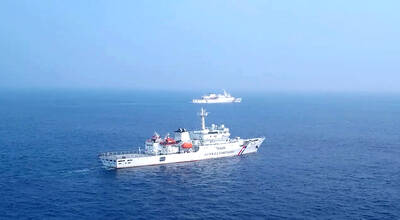
PATROL PARTNERS: The ‘Chiayi’ and the ‘Penghu’ departed for a two-day joint patrol of Palau’s exclusive economic zone, the CGA’s second diplomatic visit to the country The Coast Guard Administration (CGA) set a record for its southernmost deployment of a coast guard vessel as the vessels Chiayi and the Penghu reached Palau’s Pulo Anna Island on Saturday in a cooperative exercise between the two countries. The island, about 217 nautical miles (401km) southwest of Koror in the Palauan state of Sonsorol and 1,220 nautical miles from Taiwan’s southernmost point, Oluanpi (鵝鑾鼻), is the furthest south a CGA vessel has sailed. The two vessels are in Palau for the coast guard’s second diplomatic visit to the country. They docked at Malakal Harbor on Tuesday last week. The coast guard
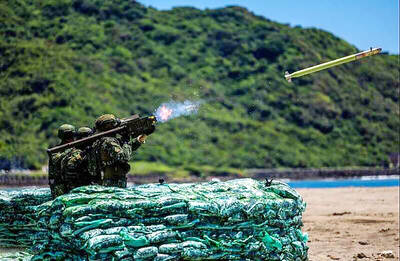
BATCH 1: The military has plans to assign the weapons to the army to defend Taiwan proper, as well as outlying islands and the navy for the Marine Corps, the official said Taiwan is to receive 500 Stinger missiles and 178 launchers from the US by the end of the year, the first batch under a planned two-stage acquisition totaling 2,621 missiles and 763 launchers, a defense official said yesterday on condition of anonymity. The portable missiles would play a vital role in the nation’s air defense capabilities, the source said. The army plans to deploy 2,235 missiles and 657 launchers to defend Taiwan proper and outlying islands, they said, citing military documents. The navy is allotted 295 missiles and 85 launchers to arm the Marine Corps and some surface vessels that lack air defense
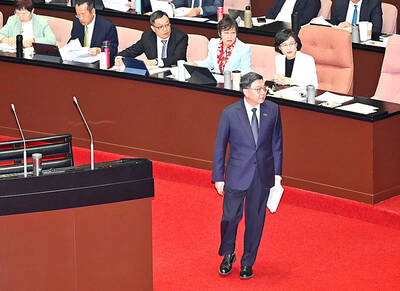
The government is monitoring online rumors that a pneumonic plague outbreak has spread from Russia into China, and it might enhance quarantine measures, Premier Cho Jung-tai (卓榮泰) said yesterday. During a legislative meeting, Democratic Progressive Party Legislator Wang Ting-yu (王定宇) said that rumors had circulated that the disease had spread across several Chinese provinces. He asked Cho whether the government was prepared to prevent the disease spreading to Taiwan, given the volume of traffic between the two sides, and how concerned the government was about the alleged outbreak. The Ministry of Health and Welfare had implemented border quarantine measures after briefing the Executive

The European Parliament on Wednesday adopted a recommendation on EU-China political relations that rejected China’s efforts to restrict Taiwan’s participation in international organizations and exchanges. The recommendation, addressed to the European Council, the European Commission and EU High Representative for Foreign Affairs and Security Policy Kaja Kallas, includes several references to EU-Taiwan relations and expresses support for closer ties, saying they would bring positive benefits and have strategic importance. Describing Taiwan as a valuable partner in trade and technology, the European Parliament said it “rejects China’s attempts to coerce international organizations, third countries and other actors into restricting Taiwan’s international participation and


 RSS
RSS