


A seasoned campaigner for high political office, US Secretary of State Hillary Clinton worked the crowds in Asia on her maiden tour in office, making good on a promise to reach out to the world.
And though she is a tough competitor who narrowly lost the race for the US presidency last year, Clinton proved a hit with many when she showed her softer side.
Appearing at a university campus in Tokyo, she charmed and inspired her audience with self-deprecating jokes about her roller-coaster public life and lofty talk about the planet’s future.

PHOTO: AFP
In Jakarta, she poked fun at her music tastes on a popular TV show and mixed with smiling and cheering crowds in a slum benefiting from US aid projects.
Clinton moved an audience of 2,000 at Ewha University in Seoul, the largest women’s college in the world, becoming deeply personal at one point when she spoke of her love for her husband.
In Beijing, she spoke humbly about past US environmental mistakes when she visited a clean-energy plant to highlight the need for international cooperation in fighting climate change.
Less hard-edged than she often appeared to be during the presidential campaign, the 61-year-old has basked in the glow of warm contact with private citizens and public officials alike.
Upon meeting Clinton, one of China’s top officials, Dai Bingguo (戴秉國), said: “And you look younger and more beautiful than you look on TV.”
She reddened, before replying: “Well, we will get along very well.”
Clinton has signaled she plans to meet as many people as she can, both inside and outside government, in her role as the top US diplomat.
She has said the new administration of US President Barack Obama is looking to balance military might with the “soft” power of diplomacy and development — a combination the Obama administration has called “smart power.”
Her approach so far has stood in contrast to that of her predecessor, Condoleezza Rice, an academic whose public persona on overseas trips was more reserved.
She says she wants to repair the damage to the image of the US abroad after eight years under former US president George W. Bush, although she does not mention the former president by name.
“I really believe that it’s that kind of outreach that we have to do everywhere ... there’s a real hunger for the United States to be present again,” Clinton told reporters traveling on her Asian tour.
“People still really want to like America and they want to know what we’re doing,” she said.
In Indonesia, she connected with a population fascinated by Obama, who spent four years of his childhood in Jakarta.
On popular television show Dahsyat, Clinton caused a stir among the young guests when she started off with: “I was just speaking to President Obama.”
Members of the audience, their eyes lighting up and voices rising with excitement at the comment, later wanted to know her tastes in music.
When she replied that she likes “old standbys” by the Beatles and the Rolling Stones, the audience applauded and cheered.
“I don’t feel so old,” she gushed.
She also complimented her audience by pointing out how Indonesia had changed over the years to become a place where “democracy, Islam and modernity” thrive.
It was a clear indication of how the new administration wants to promote Indonesia as a model for other Muslim countries with which Obama seeks a “new way forward” based on mutual interests and respect.
Clinton also spoke about the “struggle” against terrorism, discarding the “war on terror” language used by the Bush administration.
In Tokyo, she used a visit to a Shinto shrine to promote the Obama administration’s push for more “balance and harmony” in US foreign policy.
She also drew praise by promoting women’s rights on the tour.
During a meeting with Chinese women’s activists, one said: “I personally think you are a wonderful representative of the best women on this earth.”
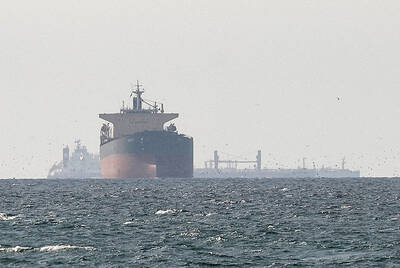
A ship that appears to be taking on the identity of a scrapped gas carrier exited the Strait of Hormuz on Friday, showing how strategies to get through the waterway are evolving as the Middle East war progresses. The vessel identifying as liquefied natural gas (LNG) carrier Jamal left the Strait on Friday morning, ship-tracking data show. However, the same tanker was also recorded as having beached at an Indian demolition yard in October last year, where it is being broken up, according to market participants and port agent’s reports. The ship claiming to be Jamal is likely a zombie vessel that

German Chancellor Friedrich Merz’s conservative Christian Democratic Union (CDU) yesterday faced a regional election battle in Rhineland-Palatinate, now held by the center-left Social Democratic Party (SPD). Merz’s CDU has enjoyed a narrow poll lead over the SPD — their coalition partners at the national level — who have ruled the mid-sized state for 35 years. Polling third is the far-right Alternative for Germany (AfD), which spells a greater threat to the two centrist parties in several state elections in September in the country’s ex-communist east. The picturesque state of Rhineland-Palatinate, bordering France, Belgium and Luxembourg and with a population of about 4 million,

Ugandan wildlife authorities have reintroduced rhinos into a remote protected area where they were once poached into extinction, an event seen by conservationists as a milestone in efforts to support the recovery of a species threatened by poaching. On Tuesday, two southern white rhinos from a private ranch in the East African country were reintroduced into Kidepo Valley National Park in the country’s northeast. Two more rhinos in metallic crates arrived on Thursday. There have been no rhinos in the park since 1983, the result of poaching. However, a private ranch in central Uganda — the Ziwa Rhino Sanctuary — has been
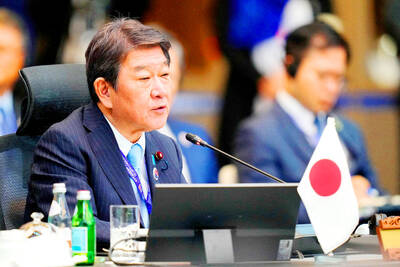
LAW CONSTRAINTS: The US has been pressing allies to send warships to open the Strait, but Tokyo’s military actions are limited under its postwar pacifist constitution Japan could consider deploying its military for minesweeping in the Strait of Hormuz if a ceasefire is reached in the war on Iran, Japanese Minister of Foreign Affairs Toshimitsu Motegi said yesterday. “If there were to be a complete ceasefire, hypothetically speaking, then things like minesweeping could come up,” Motegi said. “This is purely hypothetical, but if a ceasefire were established and naval mines were creating an obstacle, then I think that would be something to consider.” Japan’s military actions are limited under its postwar pacifist constitution, but 2015 security legislation allows Tokyo to use its Self-Defense Forces overseas if an attack,


 RSS
RSS